Saturday, April 30, 2011

22,000 Okinawan Plaintiffs bring the third Kadena Noise Suit, largest class action in Japanese court history

Via Closethebase.org on April 28, 2011: 22,000 Plaintiffs bring the third Kadena Noise Suit, the largest class action in Japanese court history:
Some 22,000 residents living near the U.S. Kadena Air Base in Okinawa Prefecture filed a lawsuit Thursday seeking a ban on nighttime flights and a combined 44.6 billion yen in compensation from the Japanese government, arguing their health has been affected by aircraft noise.

Friday, April 29, 2011

Still Present Pasts: Korean Americans and the “Forgotten War”

Still Present Pasts:
Korean Americans and the “Forgotten War”


A/P/A Institute at NYU
41-51 East 11th Street
7th Floor Gallery
New York, NY 10003


A multi-media exhibit that combines installation and performance art, documentary film, archival photographs, and oral histories to explore memories and legacies of the Korean War. Embodying life stories of ordinary Korean Americans who survived the war, the exhibit is a public space of remembering that breaks the silence about a tragic episode in U.S. and Korean history. Featured artists include Sukjong Hong, Deann Borshay Liem, Yul-san Liem, Yong Soon Min, Injoo Whang, Ji-Young Yooo.

NYU exhibition curated by Yul-san Liem. Project Director: Ramsay Liem.

Community cosponsor: Nodutdol for Korean Community Development.


The Korean War took the lives of 3 million Korean civilians and 1.2 million combatants, ushered in the Cold War era, and remains stalemated in an armistice agreement nearly 6 decades since its signing - yet most Americans remember it only as the “forgotten war.”

Listen to the Asia-Pacific Forum radio program on the exhibition, featuring curator and artist Yul-san Liem here.

Yul-san Liem is a social justice activist and artist whose work addresses issues of war, trauma and resistance. She is a long-time member and leader of Nodutdol for Korean Community Development (NDD), a Queens-based organization dedicated to achieving peace in Korea and empowering the Korean American community.

Wednesday, April 27, 2011

Okinawans urge Senator Carl Levin to use U.S. taxpayer dollars to create jobs at home, not to build a new base in Okinawa


Senators Carl Levin, Chairman of the Senate Armed Services Committee, and Jim Webb, chair of the Senate Committee on Foreign Relations East Asian and Pacific Affairs Subcommittee and member of the Senate Committee on Armed Services, are visiting Okinawa today and tomorrow. Okinawans greeted the senators with signs urging them to use U.S. taxpayer money not to build a new military base in Okinawa, but to create jobs at home. The official U.S. unemployment rate is over 8%.

Under the 2006 realignment "roadmap" that mandates the construction of a new base in environmentally sensitive northern Okinawa, American taxpayers would pay US $4 billion and Japanese taxpayers would pay US $6 billion. The U.S. government, which has radically increased military spending under the Bush and Obama administrations, does not have this money: gross national debt is $14 trillion. Washington would have to borrow the $4 billion, presumably from China.

Participants took photos of the demonstrators also rallying for tomorrow's start of the third class action suit against excessive noise at Kadena Air Base. 22,000 plaintiffs make up the class, the largest ever in Japanese court history.

You can see part of the demonstration in the last part of this local TV news’ video (in Japanese).

The Stars and Stripes reported on the senators' visit.

Today’s Ryukyu Shimpo published an open letter to Senator Carl Levin, written in English.

The Okinawa Times devoted one page to an article, “Okinawa Says No: Futenma reversion demanded, without relocation on the island,” published both in English and Japanese, with a chronological table of the proposed relocation of the Futenma base and realignment of U.S. bases in Japan. (We will post this article soon).

Speaker of the Okinawa Assembly Zenshin Takamine met with Senators Levin and Webb to hand them English translation of three resolutions calling for the closure of Futenma and the cancellation of the proposal for a "replacement" base at Henoko. Last June, Mr. Takamine handed John Roos, U.S. Ambassador to Japan, a letter addressed to President Obama, asking him for the same.

According to Okinawan newspaper reports, Okinawa City Mayor Mitsuko Tomon met the two senators at a meeting with Kin Town Mayor, Mr. Gibu Tsuyoshi. the Director of Okinawa Defense Bureau, Mr. Manabe Ro, Naha Chamber of Commerce and Industry, Mr. Kokuba Koichi, lawyer, Mr. Miyazaki Masahisa, and Consul General Raymond Greene.

It is reported that Ms. Tomon and Mr. Gibu argued that Okinawan people are against the relocation plan to Henoko and that it would be difficult to implement the plan.

Earlier this month, Okinawans called upon the U.S. government to forego its "sympathy budget" military subsidies from Japanese taxpayers hit by natural disasters and an ongoing catastrophic nuclear accident.

Shukan Post: Japanese Taxpayers paying for "Operation Tomodachi"

A new bilingual Japanese financial watchdog site, Finance Greenwatch, reposted Japan Today's synopsis of the Shukan Post's investigative piece on who's paying for "Operation Tomodachi."
The whole vast operation is purely for show, it says – and who will be paying the bill, it demands, when the hearts and minds have been won? You guessed it – Japan.

Exhibit A in Shukan Post’s case is the nuclear-powered aircraft carrier USS Ronald Reagan, Operation Tomodachi’s most visible symbol. No sooner did a hydrogen explosion rock the No. 3 reactor at the stricken Fukushima No. 1 nuclear power plant on March 14 than the Ronald Reagan fled 160 km away to the northeast, American military officials claiming the crew was exposed to low-level radiation...

Exhibit B is the U.S. Marine Corps’ Chemical Biological Incident Response Force (CBIRF), 150 of whose members landed in Japan in early April and on April 9 staged training routines at the Yokota air base. The exercises were open to the press. Japan’s media treated them as “saviors,” notes Shukan Post sardonically.

They were nothing of the kind, it argues. “CBIRF was deployed following a strong request from the American government, to which Japan yielded,” the magazine quotes an unnamed defense ministry official as saying. “The plan was not for them to enter the fray, just to train in public view. All they accomplished was to create the impression that Japan’s Self-Defense Forces in Fukushima in their protective gear dealing with the catastrophe were not to be depended on.” They were not called up to Fukushima at all.

Exhibit C: Between April 1 and April 3, 78 bodies were found along the Iwate Prefecture coast, supposedly by Japanese and American rescuers working cooperatively. On the 4th, Defense Minister Toshimi Kitazawa spoke of how moved he was at this evidence of “the deepening alliance” between the two countries.

In fact, an unnamed Maritime Self-Defense Force member tells Shukan Post, “All the U.S. side did was send planes and helicopters into the air. The searching was done by Maritime SDF, Japan Coast Guard and Japanese police divers.”
Read the entire article here. Finance Greenwatch is supported by Greenpeace Japan, A Seed Japan, Amnesty International, Rainforest Alliance Network (RAN), Friends of the Earth Japan, and other NGOs.

Hirose Takashi: More earthquakes ahead bodes ill for Rokkasho & Hamaoko nuclear plants - both sit on fault lines

April 25, 2011

On the Danger of a Killer Earthquake in the Japanese Archipelago: The Nuclear Disaster That Could Destroy Japan ... and the World

By HIROSE TAKASHI
Translated by Doug Lummis

The nuclear power plants in Japan are ageing rapidly; like cyborgs, they are barely kept in operation by a continuous replacement of parts.  And now that Japan has entered a period of earthquake activity and a major accident could happen at any time, the people live in constant state of anxiety...

Seismologists and geologists agree that, after some fifty years of seismic inactivity, with the 1995 Hanshin-Awaji Earthquake (Southern Hyogo Prefecture Earthquake), the country has entered a period of seismic activity.  In 2004, the Chuetsu Earthquake hit Niigata Prefecture, doing damage to the village of Yamakoshi.  Three years later, in 2007, the Chuetsu Offshore Earthquake severely damaged the nuclear reactors at Kashiwazaki-Kariwa.  In 2008, there was an earthquake in Iwate and Miyagi Prefectures, causing a whole mountain to disappear completely.  Then in 2009 the Hamaoka nuclear plant was put in a state of emergency by the Suruga Bay Earthquake.  And now, in 2011, we have the 3/11 earthquake offshore from the northeast coast.  But the period of seismic activity is expected to continue for decades. From the perspective of seismology, a space of 10 or 15 years is but a moment in time.

Because the Pacific Plate, the largest of the plates that envelop the earth, is in motion, I had predicted that there would be major earthquakes all over the world.

And as I had feared, after the Suruga Bay Earthquake of August 2009 came as a triple shock, it was followed in September and October by earthquakes off Samoa, Sumatra, and Vanuatu, of magnitudes between 7.6 and 8.2. That means three to eleven times the force of the Southern Hyogo Prefecture Earthquake. 

All of these quakes occurred around the Pacific Plate as the center, and each was located at the boundary of either that plate or a plate under its influence.  Then in the following year, 2010, in January there came the Haiti Earthquake, at the boundary of the Caribbean Plate, pushed by the Pacific and Coco Plates, then in February the huge 8.8 magnitude earthquake offshore from Chile.  I was praying that this world scale series of earthquakes would come to an end, but the movement of the Pacific Plate shows no sign of stopping, and led in 2011 to the 3/11 Earthquake in northeastern Japan and the subsequent meltdown at the Fukushima

There are large seismic faults, capable of producing earthquakes at the 7 or 8 magnitude level, near each of Japan’s nuclear plants, including the reprocessing plant at Rokkasho. It is hard to believe that there is any nuclear plant that would not be damaged by a magnitude 8 earthquake...

The Rokkasho Reprocessing Plant is where expended nuclear fuel from all of Japan’s nuclear power plants is collected, and then reprocessed so as to separate out the plutonium, the uranium, and the remaining highly radioactive liquid waste.  In short, it is the most dangerous factory in the world....

On April 7, just one month after the 3/11 earthquake in northeastern Japan, there was a large aftershock.  At the Rokkasho Reprocessing Plant the electricity was shut off.  The pool containing nuclear fuel and the radioactive liquid waste were (barely) cooled down by the emergency generators, meaning that Japan was brought to the brink of destruction.  But the Japanese media, as usual, paid this almost no notice.

The Hamaoka Nuclear Plant is located at Shizuoka City, on Suruga Bay.  Despite predictions of a magnitude 8 earthquake on Suruga Bay, it has continued in operation.  If you look at the illustration showing the configuration of the plates beneath the Pacific Ocean, you will see that there is a point at which the Philippine Sea Plate, the huge Pacific Plate, the North American Plate, and the Eurasian Plate all meet; directly over that point is the Japanese Archipelago.  And the very center of the area where these four plates press together is Shizuoka...

Large scale earthquakes in the eastern and southern seas have occurred regularly at intervals of between 100 and 250 years.  Today in 2011, 157 years have passed since the Great Ansei Earthquake of 1854, so we are in a period when the next big one could come at any time.  And the predicted center of this expected major earthquake is – though this is hard to believe – exactly under the location of the Hamaoka Nuclear Plant.  And sonar readings at the site indicate that from thirty years back the Eurasian plate has been bending, which means that it is in a condition where it can be expected eventually to spring back.

Hirose Takashi has written a whole shelf full of books, mostly on the nuclear power industry and the military-industrial complex.  Probably his best known book is Nuclear Power Plants for Tokyo in which he took the logic of the nuke promoters to its logical conclusion: if you are so sure that they're safe, why not build them in the center of the city, instead of hundreds of miles away where you lose half the electricity in the wires?

Douglas Lummis is a political scientist living in Okinawa and the author of Radical Democracy. Lummis can be reached at ideaspeddler@gmail.com
Read Dr. Hirose's entire article here at Counterpunch.

Tuesday, April 26, 2011

87 Japanese NGOs call for nuclear-free society on 25th anniversary of Chernobyl accident


From Japan Today:
TOKYO — A group of 87 nongovernmental organizations in Japan reiterated calls to achieve "a nuclear-free society" on Tuesday, the 25th anniversary of the Chernobyl nuclear disaster, at a time when a nuclear crisis is continuing in Japan at the Fukushima Daiichi power plant.

"We will launch a large national action" seeking the permanent closure of the Fukushima Daiichi and neighboring Daini plants, cancellations of the nuclear fuel recycle program and new reactor construction plans as well as shutdowns of aging reactors, the NGOs said in their joint statement.

"As a first step we are issuing this joint statement today, 25 years after the Chernobyl accident," it noted. "And we will propose a process for achieving a steady phase out of nuclear energy" so the earth will not be further subjected to radioactive contamination and radiation exposure.

On the state of the Fukushima plant, the statement said the reactors there "have not achieved cold shut down. The situation continues to be unpredictable."

The No. 4 reactor of the Chernobyl nuclear power plant exploded on April 26, 1986, becoming the world’s worst nuclear accident.
A list of the signatory NGOs is included following the Japanese version of this statement at the website of the Citizens' Nuclear Information Center.

For a gripping photojournalist account of post-disaster Chernobyl, see the Kid of Speed website, which documents the 2004 motorcycle journey of a Ukranian woman who simply calls herself Elena as she travels through the abandoned town and records what she sees and feels.

Sunday, April 24, 2011

"We are not powerless": Shizuoka Residents Voice Fears, Hopes at “Nanohana Parade Hamaoka”

People of all ages gathered in Shizuoka City this past Sunday, April 24th in a lively gathering to call for an immediate halt to the Hamaoka nuclear plant, as well as to begin forging alliances for creating new alternative energies. Sitting atop the juncture of two tectonic plates within the prefecture on a fault line that is now overdue for a major earthquake, residents fear that if the plant is not stopped now, another Fukushima-like tragedy could occur.

Around 800 people attended the event, making it the largest ever such gathering for Shizuoka prefecture. In addition to a parade calling for the plant to be shut down, attendees also assembled in Aoba Park to the backdrop of lively music to share information and listen to speakers calling for an end to Japan’s reliance on nuclear power. Many also displayed creative signs and artwork voicing their fears for another accident—as well as their hopes for a future of clean energy.

The name of the parade comes from the nanohana (field mustard) plant, which many say can help mitigate the negative effects of radiation.

Bouquet of field greens including nanohana

The powerfully-written press release for the event explains the name and the ethos for the event as follows:
Following the earthquake in Northern Japan, a group of young people called Fukinotou (butterbur sprout) in Shizuoka organized ‘Nanohana Parade Hamaoka (Field mustard flower Parade Hamaoka).

The situation at the damaged Fukushima nuclear power plants remains critical, and there has been enormous suffering and anxiety caused as a result of the accident on many levels. This has made us realize that the Hamaoka nuclear power plants are still operating in our Shizuoka prefecture where we live.

Concerned about this, some of us rang Chubu Electric Power Company and checked their website. We found out that the electricity generated from the Hamaoka plant is only 14% of the total supply for the area, which means it could be possible to stop the Hamaoka plant. (Hamaoka plant was built on fault line and in the Tokai area where M8 earthquake has been expected to happen with a probability of 87% within next 30 years.)

We are raising our voices to ask: ‘Why is the Hamaoka plant still operating?’ We need to say our message loudly; otherwise it will not be heard and no change will come. We have organized this parade to show our deep concern at the continued operation of the Hamaoka plant. As we raise our voices, we are also questioning ourselves as to why are we not cutting down on our use of electricity. ‘Why are we not installing solar panels on our roofs', for example? We have realized that it is important to reflect on our daily lives to start making changes and do what we can to help.

We are hoping to set up a space for all residents to discuss new energy sources and about lifestyles which are green and sustainable as individuals, and also to look at organizing a citizen’s bank in order to design new natural energy plans from a grass-roots level.

After the earthquake in Northern Japan on 11 March, many of us were motivated to act. We believe that it is important to raise our voices outside, look into our own actions inside and discuss both approaches together. We feel we need to express this externally, and put this out to society as well as personally reflecting on our own lives.

Why “Nanohana”(field mustard flower)?

The field mustard flower is believed to have the highest capacity to absorb Cecium 137 and Strontium 90 in soil. Field mustard needs calium and calcium to grow, and they are similar in nature to cecium and strontium. Thus, they can absorb radioactivity in soil. We have not experimented with this ourselves to prove it scientifically. However, we decided to use “Nanohana” as a symbol of hope and solutions in thinking about the accidents at the Fukushima plant, and our Hamaoka plant in Shizuoka prefecture.

We have chosen to hold a parade so that we can encourage both children and adults to take part. We hope that every small step which all of us will make on this parade can change our world. We are not powerless; we all have some personal power. We dream and believe we can create a new society by gathering some small power from everybody. Thank you very much for your attention and support.

Nanohana Parade Hamaoka HP: http://parade-hamaoka.com/
Yukiko Hosomi, a native of Shizuoka City who has spent the last decade living in the United Kingdom, happened to be home visiting this past weekend, and attended the event in order to voice her concerns. “International news sources have called the Hamaoka plant the most dangerous nuclear power facility in the world, and so it is unbelievable to me that so many Japanese citizens—even ones in Shizuoka—seem to be quiet about it," commented Hosomi, who is pictured in the photo at the top of this post carrying her own handmade sign. "What frustrates me particularly is that many people do not realise that their complacency is actually supporting the continuation of the status quo. A new wave of demonstrations seems to be emerging, however, and so I truly hope that this event represents a new beginning whereby Japan will say a strong 'no' to nuclear power.”

Toby Siguenza, a teacher from the United States living in Shizuoka prefecture, agreed with Hosomi's optimism. "I saw everyone from octogenarians using walkers with protest signs strapped onto their backs to a baby wearing a home-made anti-radiation T-shirt—hardly people whom I would have imagined as 'protesters'", she commented. "More and more people are speaking out, and it is so inspiring to know that this issue has gone from faction to movement in a mere month."

One of the final speakers at the event emphasized to the crowd:“We have learned through the recent crisis that we cannot believe what the mainstream media tells us—so it is critical that we continue to share information amongst ourselves. Our struggle is not finished today when we disperse, however. Since the Hamaoka plant is still operating, it is just the start."
Top: Musicians adding energy to the day's events

Right: "Against Nuclear Power!"


Japan’s Mainichi Shimbun newspaper included this recent article calling for Hamaoka to be shut down, and the video below from Al Jazeera probes the dangers existing at the facility.

The next gathering in Shizuoka is scheduled for June 11th, exactly three months after the earthquake, tsunami and nuclear disaster occurred, with solidarity demonstrations occurring in other cities worldwide. Watch this site for further information.

If you have not yet signed the international petition spearheaded by local residents to stop the plant’s operation, please do so and spread the word! If you are on Facebook, please also click “like” on the Stop Hamaoka Nuclear Power Plant in earthquake zone in Japan page in order to bring more attention to this critical issue. Many thanks!


--Kimberly Hughes

Saturday, April 23, 2011

Kenzaburo Oe prevails in "Okinawa Notes" lawsuit

Kyodo via The Japan Times:
Saturday, April 23, 2011

'Okinawa Notes' suit favors Oe
Kyodo

The Supreme Court said Friday it has finalized the judgment in favor of Nobel Prize-winning novelist Kenzaburo Oe in a libel suit filed against him and his publisher for writing in a 1970 book of essays that the Japanese military forced civilians to kill themselves and others en masse during the Battle of Okinawa.

In its Thursday ruling, the court turned down an appeal from two plaintiffs who claimed in the 2005 suit that Oe's depiction disgraces two garrison commanders they represent and sought an injunction to block further printing of the book.

But the top court's five-justice First Petty Bench did not touch on whether the military issued an order for civilians to commit mass suicide, unlike lower courts that found the military was involved and thus adjudged Oe's descriptions as not defamatory.
Read the rest here.

Friday, April 22, 2011

Earth Day festival this weekend at Yoyogi Park, Tokyo


Fom Philip Brasor's "Earth Day Japan Needed More Than Ever" posted at The Japan Times:
Plans for this year's Earth Day festivities in Tokyo, which organizers predict will attract some 140,000 people, remain fluid in light of the disaster, but in addition to fund-raising activities for the victims of the earthquake/tsunami, one of the themes of this year's festival is saving electricity, an issue that has become much more immediate with the loss of the Fukushima nuclear reactors and the probability of another hot and muggy summer in the city. Electricity for the entire festival this year, including the power to drive public address systems for concerts and lectures, will be generated using recycled cooking oil, or so-called biodiesel fuel. There will even be a car on display that was designed to run on hemp oil.

More than 400 nonprofit organizations and nongovernment organizations will be on hand manning booths, distributing literature and selling wares. The 27 restaurants participating in the Earth Day Kitchen will serve dishes containing ingredients that are locally grown, organic and free of genetically modified elements. The president of Earth Day Tokyo since its beginnings, author, naturalist and Japan Times contributor C.W. Nicol, will honor 2011 as the International Year of Forests by presiding over the Earth Day Forest...Patrons are encouraged to bring their own dishware to cut down on waste, and those who do will receive a discount on all prepared food. The nonprofit recycling group A Seed Japan will provide utensils to those who come empty-handed, but you pay for it...

There will also be workshops in Japanese paper-making and various exhibitions, including one by Japan's only photojournalism magazine, Days Japan, featuring photographs related to issues having to do with the environment and poverty.

At least four nonprofit food resellers will be in the park selling fresh organic produce grown on farms in the Kanto region, some even within the Tokyo city limits. In many cases the farmers who actually grew the fruits and vegetables on offer will be counting the change. Other outlets for consumables include a Himalaya Bazaar featuring handmade clothing and accessories, and a Fair Trade Village occupied by various foundations dedicated to helping small producers in foreign countries get real value for their goods.
Read Brasor's entire article at the above link and find out more about Earth Day Tokyo 2011, Apr. 23-24, Yoyogi Park and other locations in the Shibuya-Harajuku area at www.earthday-tokyo.org

Thursday, April 21, 2011

Plea for helping domesticated animals in Fukushima: Please email the Japanese government

(Activists sneak into evacuation zone to save dying animals. Photo: CNN)

The photos of tethered and starving dogs in Fukushima are reminiscent of images from Hurricane Katrina aftermath when the U.S. and Lousiana governments ignored the welfare of animals that hurricane evacuees were forced to abandon.

Now that the Kan administration has made the Fukushima exclusion zone official, what about the animals nuclear evacuees had to leave behind? They couldn't bring their 600,000 domesticated animals to shelters. Most have starved to death.

Pet rescuers including Isabella Gallaon-Aoki of Japan Earthquake Animal Rescue and Support had been independently going into the exclusion zone to save dogs and cats. Animal owners want the government to euthanize those than remain rather than let them starve to death; none want to leave them behind to suffer:
A man, 73, who looked after 20 cattle in Tomiokamachi, said he often left his evacuation center to go and feed his cows. "I know each of these cows right down to their facial details and individual characteristics. I don't want to see them suffer," he said.
Ken White at the San Francisco Chronicle shares a letter from a reader:
My name is Mikiko Kuroda who live in San Mateo,California. I really want to act about rescueing animal in Fukushima, in Japan. I am a Japanese and I really want to inform many people in U.S how terrible to animals in Fukushima.(around nuclear plant ) Individual volunteers groups have tried to rescue dogs, cats, horses, cows and more. However, unfortunately they try to survive by eating each other or they die of starvation.

I saw a lot of horrible pictures. And also I have contacted volunteers. Many people in Japan have appealed to Japanese government, but Japan is backward country for animals so the government is no reaction.

Please inform to people in U.S and write e-mail from U.S about rescuing Fukushima animals to Japanese government. This is e-mail address: https://www.kantei.go.jp/foreign/forms/comment_ssl.html

Thank you very much. Mikiko Kuroda
Let me add only one P.S. to this message, and it's one that won't give any easy answers or comfort. We've all seen many requests for funds from national and international organizations claiming to be helping the animals in Japan and asking for your financial support. My advice: be cautious; try as best you can to really determine if the support is effective. Although charlatans do certainly exist in the world of charities, the larger concern here is out-of-country efforts to help which fall short because of no in-country connections. We see this every time there is an international disaster, and even organizations with international sounding names may not be an effective path for getting your dollars where you want them to go. Kuroda's request above is, hopefully, a way to help motivate Japan's government to remain mindful of the non-human victims, and I think that may be especially valuable right now.

Thich Nhat Hanh's and Joanna Macy's thoughts for Japan, humanity, & all beings

(Photo of Jizo shrine: Jean Downey)

Via Jizo Chronicles, Thich Nhat Hanh's and Joanna Macy's thoughts for Japan after the great earthquake and tsunami:
Dear Friends in Japan,

As we contemplate the great number of people who have died in this tragedy, we may feel very strongly that we ourselves, in some part or manner, also have died.

The pain of one part of humankind is the pain of the whole of humankind. And the human species and the planet Earth are one body. What happens to one part of the body happens to the whole body.

An event such as this reminds us of the impermanent nature of our lives. It helps us remember that what’s most important is to love each other, to be there for each other, and to treasure each moment we have that we are alive. This is the best that we can do for those who have died: we can live in such a way that they continue, beautifully, in us.

Here in France and at our practice centers all over the world, our bothers and sisters will continue to chant for you, sending you the energy of peace, healing and protection. Our prayers are with you.

Thich Nhat Hanh
Nuclear abolitionist Joanna Macy who spent time with the people  of Novozybkyov, a village about 100 miles from Chernobyl, in 1992, addresses the nuclear disaster in Fukushima:
Dear Ones,

In this hour of anguish we reach out to our Japanese colleagues and all beings of that noble and stricken land.  As our hearts unite in prayer for them, we experience our own non-separation from the immeasurable suffering inflicted by the successive earthquakes and tsunamis, and by the nuclear catastrophe these have triggered.

Having just begun the last week of my three-month retreat, I break silence to give voice to my solidarity with you all.  By speaking to you, I remind myself of what we can remember in this time of grief and fear.

It helps me to remember what I learned in Novozybkov with survivors of Chernobyl: that is that there are two basic responses to massive collective trauma.  One response is to let it destroy our trust in life and in each other, plummeting us into division, blame and despair.  The other is to let the shared cataclysm strengthen us into greater solidarity, and deepen our knowledge of our mutual belonging in the web of life. Your communications are evidence already of that second response.  Indeed the Work That Reconnects has been preparing us for it.

We remember to breathe.  As we have practiced, we breathe through the reports as we hear and the images of disaster. This helps us simply take in what is happening, and not be blocked by horror or the desire to fix or flee.

We also breathe with those who are caught up in this tragedy, in the intensity of panic, shock, and loss. Feel how this breathing-with helps your heart-mind fearlessly and tenderly embrace them.

You see, if we understand and accept the Great Unraveling, we can let it break us open to greater realizations of our innate solidarity.  That this realization in itself is a kind of “enlightenment” has been brought home to me in my retreat by two great teachers of Japan.

One is the 13th century Zen master Dogen.  He illumines our connections with the ancestors and the future ones, so that we can experience these connections in the immediate present moment.  So does the other figure, the archetypal bodhisattva Ksitigarbha, who is beloved in Japan, where he/she is known as Bodhisattva Jizo, with images everywhere.  Both of them help us realize that we are not alone in this moment of time, but surrounded by past and future generations ready to help.  We who inhabit the present can do what they cannot: that is to make choices and take action/  But the past and future ones are right at our side with support and guidance.

Also, to hold steady and open in this anguished time, try the Spiral of the Work That Reconnects. As I take in the catastrophe in Japan, the Spiral serves to ground my heart-mind, and widen its dimensions.  It brings gratitude for all those at work to bring support and clear reporting.  It helps me honor the heartbreak, to simply open to it and let it reveals our true nature and mutual belonging. It shows me how solidarity can move us forward, and offer us practical, immediate steps to alleviate suffering and enact safe, sustainable, and sane energy policies. An obvious urgency is to stop US government subsidies and loan guarantees to nuclear industries, including bills that are before Congress now.

As radiation from Fukushima spreads, I know that protection of self and family is on our minds.  I’m asking Anne to append here two kinds of information: about health measures, and some links to breaking news from Japan. See our page dedicated to this issue: http://joannamacy.net/nuclearguardianship/fukushima-dai-ichi-2011.html

Love,

Joanna

Wednesday, April 20, 2011

Okinawans ask U.S. to shift Japanese taxpayer military subsidies for use in disaster relief. Support Okinawa by commenting at their GDAMS website!


Okinawans rallied for the Global Day on Military Spending (GDAMS) by holding talks on peace and releasing the Okinawa Network for Global Day of Action on Military Spending (GDAMS) Statement at Henoko's Tent Village. They are asking the U.S. government to stop taking Japanese taxpayer money for subsidization ("sympathy budget") of U.S. destructive military purposes so that these resources (billions of dollars) can go to much-needed constructive disaster relief instead.

* Please show Okinawans your support of their life-affirmative vision by commenting at their GDAMS website! *
Okinawa Network for Global Day of Action on Military Spending (GDAMS) Statement

Amid an unprecedented crisis caused by earthquake, tsunami, and nuclear disaster, the National Diet of Japan, on March 31, the last day of the Japanese fiscal year 2010, approved a bill to pay for continued hosting of US military in Japan. Referred to as the “Sympathy Budget” or Omoiyari yosan, the bill now enables the Japanese government to spend 188 billion yen ($2.3 billion) a year of taxpayers’ money for next 5 years on labor costs, utility bills, “facility improvement projects”, and the costs of “training relocation” to Guam.

The passing of the bill in a time of national crisis of this magnitude not only raises questions about the seriousness of the Japanese government in terms of its commitment to disaster relief and rebuilding of devastated communities. It also illustrates that the US-Japan security relation has become a “sacred area” and militarization has become prevalent in Japan.

We of Okinawa Network for Global Day of Action on Military Spending believe that the passing of the bill was unjustified, and we voice our strong objection to the bill.

The Japanese government estimates the costs of relief and rebuilding efforts to be more than $300 billion, excluding the costs of decontamination of radioactive wastes. Albeit receiving large and generous donations from all over the world, Japan as a whole is struggling to find ways to cover the costs and to aid the people in desperate need of help. Ironically, however, the Japanese government is still able to support the US military.

It should be emphasized that the sympathy budget constitutes only one third of the total amount of money Japan pays for the US military in Japan. In fiscal year 2010, the Japanese government spent staggering 672 billion yen ($7.92 billion) on hosting US military bases. As Mr. Kevin K. Maher, former Director of the Office of Japan Affairs, said, the US has “a very good deal in Japan”. While ranked as the 6th military spender in the world, Japan has been one of the biggest contributors to keep the US as the world’s military superpower.

We believe that both Japanese and US governments impede our global efforts to realize a truly peaceful and secure world by diverting our limited resources to military spending. We thus voice our objection to their military spending and policies.

We urge the Japanese government to suspend the sympathy budget and shift it from supporting the US military to aiding disaster relief and rebuilding efforts.

We urge the US government, as our “Tomodachi" or "friend”, to decline our sympathy budget, if it truly wishes to help Japan’s recovery and rebuilding.

We also urge both Japanese and US governments to stop further militarizing Okinawa: the base construction in Henoko/Oura Bay and the helipad construction in Takae.

We call on the international community to urge the Japanese and US governments to shift their military budgets to aid those who are in need of help.

April 12, 2011

Okinawa Network for Global Day of Action on Military Spending at “Henoko Tent Village”, sit-in site to stop the construction of a new US military base

Contact:Dr. Masami mel Kawamura mamikw@nifty.com
Okinawa Network for the Global Day of Action on Military Spending
Website : http://okinawagdams.ti-da.net/


Japanese translation ( この記事へのトラックバックURL: http://okinawagdams.ti-da.net/t3347538)

沖縄からの軍事費についてのグローバル行動日のための声明

地震、津波、原発災害によって生じた未曾有の危機の中、2010年会計年度の最終日の3月31日、日本の国会で、引き続き、在日米軍駐留経費負担予算が承認されました。「思いやり予算」と呼ばれるこの予算により、日本政府は、年間1881億円(2,3億米国ドル)の税金を、在日米軍の労務費、光熱水料費、提供施設整備費、およびグアムへの訓練移転に関わる経費に、今後5年間支出することになったのです。

これほどの国家的な危機の中で、思いやり予算を通過させたことは、日本政府が震災の救援や、破壊された共同体の復興に真剣に取り組むつもりがあるのかと、疑問を生じさせています。それだけでなく、日米同盟が「聖域」となり、軍事化が日本に蔓延していることを示しています。

私たち、軍事費のためのグローバル行動日のための沖縄ネットワークは、思いやり予算の通過を不当と考え、ここにその強い反対の声を挙げます。

日本政府は、救援・復興費用を3億米国ドルと見積もっています。これには放射線物質除去費用は入っていません。日本は、世界中から、寛容にも多大なる寄付を受けていますが、助けを強く必要としている人々の援助にかかる費用の捻出に苦闘しています。しかし皮肉にも、日本政府は在日米軍の支援は行えるのです。

強調されるべくは、思いやり予算は米軍への経費全額の1/3を占めているにすぎないことです。2010年度、日本政府は米軍基地関係経費に6,729億円(7.92億米国ドル)という膨大な額を負担しています。前国務省日本部長ケビン・メイヤーがいったように、米国は「日本と、とてもよい取引」をしているのです。世界で第6位の軍事費を支出している日本は、米国が超軍事大国の位置を保持していることに、大きく加担している国の1つなのです。

私たちは、真に平和で安全な世界の実現が、日米両政府の軍事支出によって阻まれていると考えます。それゆえ、私たちは、両政府の軍事費と軍事政策に反対の声を挙げます。

私たちは、日本政府に対し、思いやり予算を凍結し、その予算を米軍の支援から、震災の援助や復興の取り組みにまわすことを要求します。

私たちは、米国政府に対し、もし日本の復興を真に望むなら「トモダチとして」、「思いやり予算」の受け取りを拒否することを要求します。

私たちは日米両政府に対して、これ以上沖縄を軍事化しないことを要求します。それは、辺野古・大浦湾への基地建設と高江のヘリパッド建設を中止することです。

最後に、私たちは国際社会に対して、日米両政府が軍事費を真に助けを必要としている人々の援助へとまわすことを呼びかけたいと思います。

2011年4月12日
軍事費についてのグローバル行動日のための沖縄ネットワーク
新基地建設反対のための座り込みの場である辺野古テント村より

CNN's Eve Bower on continued Okinawan resistance: Disaster relief is not a good excuse for destroying eco-systems in Okinawa for another U.S. base

It's strange some people think U.S. assistance in bringing water and food to victims of Japan's natural and nuclear disasters is an argument to build yet another U.S. military base in Okinawa.

Destroying Oura Bay, habitat of the endangered Okinawa dugong, to build a mega-base, and cutting down old-growth trees in biodiverse Yanbaru Forest to build V-22 Osprey helipads for U.S. jungle training is the last thing Japan needs right now. The archipelago already has 100 U.S. military bases and facilities, including 30 on 20% of Okinawa.

After the earthquake and tsunami destruction of the beautiful Tohoku coastline and the ongoing irradiation of idyllic rural areas, Japan does not need (nor did it ever need) further environmental devastation by the U.S. military in Okinawa. It's long past time for the Tokyo and Washington to honor Okinawan democratically expressed choice to protect the exquisite eco-systems and peaceful villages in northern Okinawa.

CNN's Eve Bower wrote this on the day after 3/11. She describes continued Okinawan efforts to save Henoko Village, Oura Bay, Takae Village, and Yanbaru Forest from unwanted and unneeded destruction by the U.S. military. "Earthquake response doesn't shake Okinawans' opposition to U.S. bases:"
Every morning at 7:30, Hiroshi Ashitomi trudges up sand-dusted steps, pries open a metal folding chair, and joins a handful of his fellow retirees under a plastic tent, facing seaward. They are staging a protest.

Their "sit-ins" are in opposition to a perceived threat that many of his neighbors also fear: the planned expansion of a U.S. military base on Okinawa's east-facing Henoko Bay.

On Saturday, however, both the routines of Ashitomi and of the U.S. military were upset. And even though the reason for that disruption -- a devastating earthquake and subsequent tsunami -- demonstrated the advantage of having U.S. bases, Ashitomi and others say they will not alter their efforts to get the U.S. military off the island...

In an interview with CNN Saturday, Susumu Inamine, mayor of the city of Nago on Okinawa, pointed out that he was elected on a platform of "no new construction of U.S. facilities" on the island. He also recited a litany of statistics that many in Okinawa have committed to memory: 75% of all U.S. bases in Japan are on Okinawa, an island that makes up less than 1% of Japan's territory; and 20% of the land on the island is already taken by U.S. bases.

Inamine said his constituents feel that the Japanese central government requires a disproportionate "burden" of Okinawans, relative to residents of other parts of Japan. He wants some of the U.S. presence currently on his island to be relocated to another Japanese island.
Read Bower's entire article here.

Monday, April 18, 2011

Is another Pacific War inevitable? John Feffer says "No" & brings clarity & hope to the issue of changing excessive military spending in the A-P

(Okinawa Network for the Global Day on Action on Military Spending (GDAMS) banner flying at Tent Village, Henoko, Okinawa: Photo: Okinawa Network for the Global Day on Action on Military Spending (GDAMS))

Some pundits tell us the U.S. is going to war with a "rising China" in the near future. That's why they want to spend more on missile defense surrounding China, military expansion in South Korea and Guam, and another U.S. military mega-base on Okinawa (although 30 U.S. bases and facilities already exist on 20% of the island).

But is another Pacific War inevitable?

John Feffer says "No" and brings clarity and hope to a discussion on excessive global military spending and how we can stop the march toward more wars in this great National Public Radio (NPR) interview, with good audience Q&A. (Head's up: a fund-raising drive interrupts the interview; just use the button to scroll through those parts).

Feffer, an editor at Foreign Policy in Focus and a fellow at the Institute for Policy Studies (IPS), a D.C.-based think tank that focuses on social justice, peace, and environmental issues, explains how the Global Day of Action on Military Spending came into being. Last summer, he and others at IPS got together with people from around the world concerned about excessive global military spending that has doubled over the last decade. Without attention, they didn't see any prospect of change, even with the severe economic recession. People facing crises all over the world like global warming don't have the money to deal with these challenges because of the money wasted on military spending. So they decided to have a global day focused on military spending.

IPS' major partner is the International Peace Bureau (IPB), located in Geneva, first winner of the Nobel Peace Prize, and about one hundred other organizations are working with GDAMS; Physicians for Social Responsibility, Pax Christi, Fellowship of Reconciliation, and many nationally based organizations in the 35 countries involved.

They chose April 11 because this is the date the Stockholm International Peace Institute releases its figures for 2010. Their goal: to make sure the photographs in the media accompanying these figures were of people rallying for a reduction in global military spending rather than photographs of fighter jets.

Some notes from the interview...

• Excessive & Wasteful Military Spending; U.S. versus China

Sadly, U.S. military spending has doubled over the last ten years.

Number two is China; its economy has grown and some of that money is going to military spending. China roughly spends between 1/7th and 1/10th of what the U.S. spends on military. Its total military spending equals what the U.S. wastes on military spending according to the General Accounting Office (GAO), which identified $70 billion annual waste on military spending in the U.S. budget. That's how much China spends annually.

Russia's economy has turned around from its collapse at the end of the Cold War, largely because of sales from oil and natural gas; it has returned to high levels of military spending that brought it to economic collapse in the 1990's. India and Saudi Arabia are also in the Top Ten.

There have been a number of scandals involved in Pentagon contracts. There was a student from Florida buying cheap ammunition from China and reselling it to the Pentagon; he was indicted. The Pentagon can't track all the number it spends. Most goes to the major contractors: Boeing, Lockheed, Martin. They get U.S. assistance in selling military equipment overseas. There are private contractors who do much of the same work our soldiers used to do. Money goes to healthcare, benefits. This totals around $650 billion in the base budget alone.

• Limiting a Militarized Economy & Expanding Our Civilian Economy: Jobs & Arms Trade

There's only been one time when there's been a reduction in military spending — after the Cold War. That money went to deficit reduction.

Reducing military spending involves an interwoven set of issues. A jobs conundrum accompanies the military spending issue. Factories for components of weapons systems have been distributed carefully across the United States to make it difficult to cut spending. Politicians don't want to close weapons factories and thereby cut jobs in their states.

The question is how to repurpose those manufacturing facilities. If you look at a comparison, a dollar spent on military industries versus a dollar spent on education, healthcare, infrastructure repair, then you find that the latter produces more jobs than the military industry. There was a lively debate on repurposing military factories during the stimulus spending. Unfortunately that was a one-time amount of money; a lot of it hasn't passed through the pipeline, and it hasn't resulted in any structural changes yet.

Have we gotten past they days of $100 bullets yet? There's still enormous waste that we see in cost-overruns. Manufacturers typically low-ball to get contracts and then bill in cost-overruns.

This is a global problem because the military arms market and trade is global. We have to do this globally, restraining the arms trade as we reduce arms spending. So GDAMS is global: a women's demonstration in Seoul, village protests in Kerala, demonstration in front of the White House. Part of this is to build a movement. Part of this is to discuss what works at the local, regional, national, and global levels. We are in the process of identifying effective political tools and developing alliances.

GDAMS is not about eliminating, but, instead, limiting military spending: a problem since Dwight Eisenhower's famous speech on the military-industrial-congressional complex. There are ways to reduce military spending that can make us safer. One way is to cut back on military exports to countries that end up using those weapons against us.

• More About Wasteful Military Spending

The accident-prone V-22 Osprey is an example of a weapons that has had a lot of cost overruns and is an unnecessary addition. We have a plan to expand the U.S. Navy at a time when this is simply fiscally irresponsible. We have plenty of ships. We don't know what to do with all of our ships. Missile defense is problematic for a number of issues. One is technical: does it work? Another is that it encourages a lot of other countries to build more weapons simply to address U.S. & allied missile defense.

• Is Change Possible?

First of all, we have to remind ourselves that military spending hasn't always been this way. The U.S. economy has only been militarized for the past 40 to 45 years. That's not a long time looking at history.

We can reverse what we created. We can roll it back to what the U.S. had before the Cold War. In the U.S., political campaign finance reform is a necessary step to restrain the influence lobbying has on military spending. We can prevent the collapse of our economy overburdened by military spending and build up viable manufacturing.

Citizens were able to stop the war in Vietnam. We were able to influence the U.S. polices in Iraq and Afghanistan by drawing down those wars. We have been able to change things in this country much more powerful than the military-industrial complex.

Other movements have faced much more challenge. Racism in the U.S. was much more powerful, yet the Civil Rights Movement had tremendous impact. We have this capability.

We can take inspiration from other countries that were able to affect U.S. military bases, whether in Puerto Rico, Latin American, in the Philippines, and other places in which our 1,000-based base empire.

Sunday, April 17, 2011

Former Minnesota Governor Jesse Ventura's Call for Global Peace & Justice Activism: "We ain't got time to bleed."

Excuse me! I have something to say.
聞いてください!言うことがあるんです!

In an epic American journey, Jesse Ventura has transformed from Navy SEAL to pro-wrestler to Minnesota governor to actor to an anti-torture advocate, conspiracy investigator, and populist. His latest (gone viral) cuts to the chase:
Letter to the Ruling Class

You control our world. You’ve poisoned the air we breathe, contaminated the water we drink, and copyrighted the food we eat. We fight in your wars, die for your causes, and sacrifice our freedoms to protect you. You’ve liquidated our savings, destroyed our middle class, and used our tax dollars to bailout your unending greed. We are slaves to your corporations, zombies to your airwaves, servants to your decadence. You’ve stolen our elections, assassinated our leaders, and abolished our basic rights as human beings. You own our property, shipped away our jobs, and shredded our unions. You’ve profited off of disaster, destabilized our currencies, and raised our cost of living. You’ve monopolized our freedom, stripped away our education, and have almost extinguished our flame. We are hit… we are bleeding… but we ain’t got time to bleed. We will bring the giants to their knees and you will witness our revolution!

Sincerely,

The Serfs.
Japanese translation:
http://weaintgottimetobleed.com/ 「ジェシー・ヴェンチュラ」
http://weaintgottimetobleed.com/dossier/ 「人物調査書」

あなたたちは我々の世界を支配する。あなたたちは我々が呼吸する空気を有毒なものにし、我々が飲む水を汚染し、我々が食べる食品に著作権をかけた。我々はあたたたちの戦争を闘い、あなたたちの大義のために死に、あなたたちを守るため我々の自由を犠牲にする。あなたたちは我々の貯蓄を精算し、我々の中産階級を潰し、あなたたちの尽きぬ欲を救済するために我々の税金を使った。我々はあなたたちの企業にとっての奴隷であり、あなたたちの放送局にとってのゾンビであり、あなたたちの堕落の召使いだ。あなたたちは我々の選挙結果を不正に欺き、我々の指導者を暗殺し、人間としての我々の基本的権利を廃止した。あなたたちは我々の土地を所有し、我々の職を海外に移転し、我々の組合を細分化した。あなたたちは我々の災難につけこんで儲け、我々の通貨を不安定なものにし、我々の生活費をつりあげた。あなたたちは我々の自由を独占し、我々から教育を奪い、我々の情熱をほぼ消滅させた。我々は打たれ...血を流している....しかし我々は血を流す暇はない。我々はその巨人をひざまずかせるだろう、そしてあなたたちは我々の革命を目撃するのだ!
Many thanks to Makiko Sato for the translation.

Joseph E. Stiglitz on the same theme: "Of the 1%, by the 1%, for the 1%" published at Vanity Fair:
Americans have been watching protests against oppressive regimes that concentrate massive wealth in the hands of an elite few. Yet in our own democracy, 1 percent of the people take nearly a quarter of the nation’s income—an inequality even the wealthy will come to regret.

Saturday, April 16, 2011

Over three thousand march in Osaka on April 16th- No more Nuclear!

video
"We don't need nuclear power, nuclear weapons either"
No more nuclear power,
Protect our children,
Protect the women,
Protect the men,
Protect Japan,
Protect the world,
Give us back Fukushima,
Give us back our land,
We want to drink milk,
We want to eat rice,
We want to eat vegetables,
We want to see tomorrow,
We want to be alive tomorrow,
We want to be alive the day after tomorrow,
No more nuclear
Let's put an end to nuclear power together!
(Chant sung at Osaka April 16th Demonstration)
Anti-nuclear chants rang through the streets of Osaka, as over 3000 demonstrators filled the streets in solidarity against the continued use of nuclear power by Japan in the face of the unfolding nuclear disaster in Fukushima. Inspired by the 17,500 people-strong demonstration in Tokyo on April 10th, people young and old, walking on two feet or in wheel chairs, school teachers, business people, politicians, and celebrities gathered their creative energy together to raise their voices on behalf of those that can not. Some demonstrators, fearful of losing their jobs for participating in the demonstration, covered themselves with masks and hats so as not to be identified by their respective companies as they marched in the three-hour demonstration.

This young man led protesters in the group I walked with.


The demonstration was commenced with speeches from anti-nuclear movement leaders from the following 8 organizations:
Aileen Mioko Smith of Green Action spoke of her visit to Fukushima prior to the disaster. She could see the fear in people's eyes as they discussed the potential for disaster at Fukushima.

A Taiwanese man described how the nuclear crisis in Japan is providing momentum for the anti-nuclear movement in Taiwan, where there stands a nuclear plant constructed by Toshiba. An Anti-nuclear Power Network of Nara member shared her frustration with the city of Nara. Her attempts to convince politicians to create a plan to move away from nuclear power fell on deaf ears.

Some estimate 50% of energy in Kansai originates from nuclear reactors. We have yet to see if Japan, the third largest producer of nuclear energy in the world, will reverse it's goal to derive 50% of its domestic energy production from nuclear plants.

While politicians, including Tokyo governor Shintaro Ishihara, continue to make statements in favor of the use of nuclear power in Japan, others, such as newly elected Kanagawa governor Yuji Kuroiwa, are promoting a shift to renewable energy. Drawing upon the experience of Kamakura, where the Great Buddha 800 meters from the shore was swept away by a tsunami 1100 years ago, Kuroiwa is criticizing leaders who propose that building higher walls along the shores will protect Japan from tsunamis, and instead is proposing an end to nuclear power and investment in the solar banks.

For some people, including popular comedians who wish to remain unidentified, it was their first time to participate in any public demonstration. A 32-year old school teacher, hidden behind a mask, explained his reasons for joining the demonstration. "I wanted to show my solidarity with the people who want to see a future with no nuclear power. Nuclear power has the potential to destroy the world, it can kill the earth. We should invest money in alternative energy creation. I will not stop raising my voice." It is time to listen to the voices of the people and end Japan's dependence on nuclear power.

Over 3000 people march in Osaka

Show your support by adding your name to the petition to close down the Hamaoka Nuclear Power plant.

- Jennifer Teeter

Peace Talk Between Japanese & Iraqi Students, April 17th, Keio University


It has been eight years since the war in Iraq began. These days, we do not even hear the word “Iraq” very much in the news.

The fact is, however, that people in Iraq continue to live with confusion and uncertainty about their futures. Depleted uranium used throughout the war has resulted in continuing cases of leukemia and other cancers, many people whose lives were threatened have become refugees, and life for Iraqis is becoming more and more difficult in general.

Insofar as Japan participated and contributed vast amounts of money to the war, our country in fact has a connection to this situation. At this event, our purpose will be to look at the present lives of Iraqi students—whose world was literally turned upside down by the war—as well as to hear their views toward Japan.

The event will provide an opportunity to hear views not available within the mainstream media, as well as to participate directly in discussions with Iraqi students. Don’t miss this opportunity to learn about creating true peace, not through weapons—but through dialogue!

Peace Talk: Iraqi and Japanese Students
Sunday, April 17th
16:00~18:00
Keio University, Mita Campus, South Building Rm. 2B42

Click here to see a map (Japanese only).

☆ Entry: Free!
☆ Interpretation will be provided
☆ No reservations required
☆ Please tell your friends!

Peace Talk Organizing Committee:
peacetalk.0417@gmail.com

For more information, see the blog of humanitarian aid worker Nahoko Takato (Japanese only).

Friday, April 15, 2011

Okinawa Network for Global Action on Military Spending (GDAMS) Statement

Okinawa Network for Global Day of Action on Military Spending (GDAMS) Statement


Amid an unprecedented crisis caused by earthquake, tsunami, and nuclear disaster, the National Diet of Japan, on March 31, the last day of the Japanese fiscal year 2010, approved a bill to pay for continued hosting of US military in Japan. Referred to as the “Sympathy Budget” or Omoiyari yosan, the bill now enables the Japanese government to spend 188 billion yen ($2.3 billion) a year of taxpayers’ money for next 5 years on labor costs, utility bills, “facility improvement projects”, and the costs of “training relocation” to Guam.

The passing of the bill in a time of national crisis of this magnitude not only raises questions about the seriousness of the Japanese government in terms of its commitment to disaster relief and rebuilding of devastated communities. It also illustrates that the US-Japan security relation has become a “sacred area” and militarization has become prevalent in Japan.

We of Okinawa Network for Global Day of Action on Military Spending believe that the passing of the bill was unjustified, and we voice our strong objection to the bill.

The Japanese government estimates the costs of relief and rebuilding efforts to be more than $300 billion, excluding the costs of decontamination of radioactive wastes. Albeit receiving large and generous donations from all over the world, Japan as a whole is struggling to find ways to cover the costs and to aid the people in desperate need of help. Ironically, however, the Japanese government is still able to support the US military.

It should be emphasized that the sympathy budget constitutes only one third of the total amount of money Japan pays for the US military in Japan. In fiscal year 2010, the Japanese government spent staggering 672 billion yen ($7.92 billion) on hosting US military bases. As Mr. Kevin K. Maher, former Director of the Office of Japan Affairs, said, the US has “a very good deal in Japan”. While ranked as the 6th military spender in the world, Japan has been one of the biggest contributors to keep the US as the world’s military superpower.

We believe that both Japanese and US governments impede our global efforts to realize a truly peaceful and secure world by diverting our limited resources to military spending. We thus voice our objection to their military spending and policies.

We urge the Japanese government to suspend the sympathy budget and shift it from supporting the US military to aiding disaster relief and rebuilding efforts.

We urge the US government, as our “Tomodachi or friend”, to decline our sympathy budget, if it truly wishes to help Japan’s recovery and rebuilding.

We also urge both Japanese and US governments to stop further militarizing Okinawa: the base construction in Henoko/Oura Bay and the helipad construction in Takae.

We call on the international community to urge the Japanese and US governments to shift their military budgets to aid those who are in need of help.


April 12, 2011
Okinawa Network for Global Day of Action on Military Spending
at “Henoko Tent Village”, sit-in site to stop the construction of a new US military base

Okinawa Network for the Global Day of Action on Military Spending
Website : http://okinawagdams.ti-da.net/

Thursday, April 14, 2011

Fellowship of Reconciliation: Do those who profit from war, hatred, and bigotry fear peace?

Mark Johnson of Fellowship of Reconciliation, "Thousands Call for Peace in Protest of Continuing Wars": "As many as 5000 gathered in Union Square (NYC) on Saturday, April 9th for a rally followed by a march to Foley Square."

Global Day of Action on Military Spending (GDAMS) event: Living Along the Fenceline screening today in San Francisco

Thanks for the head's up to Mitzi Uehara Carter's blog, Grits and Sushi: my musings on okinawa, race, family, militarization, blackness, & the south, about this documentary that spotlights the consequences (environmental and community degradation, noise, violence against women, cancer) of having a military base in one's backyard and shows how 7 women respond in constructive and affirmative ways to these challenges: creating alternative paradigms of security that prioritize life, sustainability, democratic process, and peace:

Living Along the Fenceline


Film Screening with Music, Food, Speakers

Delancy Street Foundation Screening Room
600 Embarcadero St. San Francisco, CA
Thursday April 14, 2011


Doors Open 6:30 PM
Sliding Scale $5 - $15

No one turned away.
For more information, visit
www.genuinesecurity.org


Living Along the Fenceline, a groundbreaking 80-minute documentary by award-winning filmmaker Lina Hoshino, tells the stories of seven women whose lives have been affected by the US military presence in their backyards.

Their individual journeys of strength and courage represent the unheard stories of myriad communities across the globe that live alongside US bases and bear tragic hidden costs to their land, culture, and spirit. They are teachers, organizers, and healers, moved by love and respect for the land, and hope for the next generation.

From San Antonio (Texas) to Vieques (Puerto Rico), Hawai', Guam, Okinawa, South Korea, and the Philippines, this film inspires hope and action.

Storytellers:

Diana Lopez, a Mexican American teen in San Antonio (TX). She has seen military planes flying over her city all her life and dreams of becoming an Air Force pilot. She learns that a creek flowing from a nearby base is highly polluted and that many of her neighbors have cancer. She begins to question whether the military is the best job option for her…

Zaida Torres, a seamstress in Vieques (Puerto Rico). She has lost several family members to cancer. The US Navy used part of the island as a bombing range for 60 years, and left it reduced to rubble and strewn with bomb fragments and unexploded weapons. Popular protest finally closed the bombing range. Now the challenge is to clean up the debris and contamination and to support the local community, including those with cancer.

Alma Bulawan, a Filipina in her early 50s, leads an organization that creates alternatives for women working in prostitution near the former US Subic Bay Naval Station. In part, her strong leadership comes from the fact that this was her life too…

Yumi Tomita (Pseudonym,) an Okinawan woman in her late 30s. She was raped by US soldiers when she was in high school. It has taken her many years to cope with the shame and trauma of this assault. She finally began to speak of her ordeal in 1995, when a 12-year-old girl was raped also…

Sumi Park, a young Korean social worker. She studied theology in college, then joined the staff of a small organization that provides services to women who work in bars around US bases. As her commitment grows, she sees what it means to put her beliefs at the center of her life…

Lisa Natividad, a professor at the University of Guam, joins other Chamorro community leaders in responding to the news that the military will base 8,000 more Marines (plus support staff and families) on her small Pacific island home...

Terri Keko’olani Raymond, a Hawai’ian activist. Her grandfather was a fire fighter on duty when Japanese planes attacked the US fleet in Pearl Harbor in 1941. This wide harbor, now severely contaminated by the Navy, was once the site of bountiful fishponds that sustained Hawai’ian communities for generations. She works to expose the many impacts of the military in Hawai’i—a side of the islands that visitors rarely see...
To read more about the storytellers and to see the trailer, visit the website of Living Along along the Fenceline.

Wednesday, April 13, 2011

Radioactive materials from Fukushima Daiichi reached the US by March 18, Iceland by March 20, and Europe by March 22


Radioactive materials from Fukushima Daiichi reached the US by March 18, Iceland by March 20, and Europe by March 22 (Kyushu University and Tokyo University research. Image: Jiji Press)

Tuesday, April 12, 2011

Global Day of Action on Military Spending in Okinawa

“Friends” don’t destroy eco-systems and take hard-earned taxpayer money during natural disaster and nuclear crises...

The Global Day of Action on Military Spending (GDAMS) in Okinawa focuses on Okinawan humanitarian and ecological values that prioritize life. Peace talks by Ms. Suzuyo Takazato of Okinawa Women Act Against Military Violence, Mr. Hiroshi Ashitomi of the Committee against Heliport Construction, and the Elders of Save Life Society.


Global Day of Action on Military Spending in Okinawa


"Friends" don't take away Japan's budget.


Shift our "Sympathy Budget" from supporting the US military to aiding disaster relief

------
Date: April 12, Tue, 14:00-

Place: ”Henoko Tent Village”, Henoko, Okinawa, Japan
(sit-in site to stop the construction of a new,U.S.military base)

Peace talk with:

Ms. Suzuyo Takazato, Okinawa Women Act Against Military Violence
Mr. Hiroshi Ashitomi, Committee against Heliport Construction
Oji-Oba (elders) of Save Life Society


Okinawa Network for the Global Day of Action on Military Spending
http://okinawagdams.ti-da.net/
http://demilitarize.org/


Christine Ahn & Sukjong Hong: "Bring War Dollars Home by Closing Down Bases"

(Film critic Yang Yoon-Mo has been on a hunger strike in a confinement cell of the Dongbu Police Station, Jeju City on April for a week. He was arrested for protesting the South Korean government's forced removal of Gangjeong villagers and the confiscation of their ancestral property on the southern coast of Jeju Island to build a South Korean naval base to be used jointly with the U.S. military. Photo: No Base Stories of Korea)

In this article for Foreign Policy in Focus, Christine Ahn and Sukjong Hong discuss Washington’s exorbitant, wasteful spending on politically, economically, and environmentally unsustainable overseas U.S. military bases. They focus on the ongoing struggle of Jeju islanders for the land where their forebears have lived for centuries. However, the pattern of environmental destruction, disrespect of democratic process, and widespread citizen protest against U.S. bases also applies to Okinawa, the entire Asia-Pacific, and the rest of the world::
Bring War Dollars Home by Closing Down Bases
By Christine Ahn and Sukjong Hong

On the eighth anniversary of the U.S. invasion of Iraq, U.S. fighter planes took off to start yet another military action -- this time, in Libya. A recent Gallup poll found that only 47 percent of Americans approved of military action in Libya, the lowest level of support for military intervention in 40 years. At the same time, U.S. President Barack Obama has sent Congress a budget that includes $1.2 trillion dollars for military and security expenditures. Clearly, Americans are weary of war, especially during an economic crisis that has threatened jobs, health plans, and pensions most families need to survive.

The hopeful news is that a grassroots movement of ordinary people across U.S. towns and cities has launched the New Priorities campaign, uniting under the demand to “bring the troops and war dollars home” by cutting defense spending instead of benefits, jobs, and basic government services. Worldwide actions are also being planned for the Global Day of Action on Military Spending on April 12th to shine a light on egregious amounts of military spending by the world’s governments. Central to these efforts must include demands to shut the 1,000-plus U.S. military bases in over 46 countries.

Bases are the most visible structures of the U.S. drive to maintain global military hegemony. Yet for most Americans, bases remain out of sight and outside the national discourse on war. Many don’t know about the enormous footprint of U.S. military installations around the world and how they undermine the lives and aspirations of the people who live directly in their shadow. Ending U.S. wars is essential, but closing down foreign bases is even more critical to dismantling U.S. militarism and global hegemony.

On the island of Cheju off the coast of South Korea, villagers are struggling to prevent the construction of a South Korean naval base intended for U.S. military use. In 2009, one of us traveled there and can still remember the tattered yellow flags lining the fence posts of homes, symbolizing the movement’s determination to stop the project. Walking along the endangered rocky coastline at the edge of this quiet village of farmers and fisherfolk, it was clear that Cheju Island and other sites of U.S. military bases in Korea have borne enormous costs to the people and to the future of peace in the region.
Read the entire article (with links to more background) here.


Tokyo extends evacuation zone; raises nuclear emergency to Chernobyl-level

Greenpeace:
Just hours after our field radiation team held a press conference calling for further evacuation around Fukushima, the Japanese government announced that it will extend the mandatory evacuation zone around the stricken nuclear plant to 30km and evacuate the contaminated towns of Namie, Iitate and parts of Minamisoma within one month.
Reuters:
Japan raised the severity of its nuclear crisis to the highest level on Tuesday, putting it on a par with the world's worst nuclear disaster at Chernobyl in 1986 because of the amount of radiation released into the air and sea.

As another major aftershock rattled the earthquake-ravaged east of the country, a fire broke out at the Fukushima Daiichi power plant, although engineers later appeared to have extinguished the blaze. Developments in recent days suggest the operator of the stricken facility is no closer to restoring cooling systems at the reactors, which is critical to bringing down the temperature of overheated nuclear fuel rods.

An official at Japan's Nuclear and Industrial Safety Agency (NISA) said that based on cumulative levels of radiation released, the severity of the incident had been raised to 7, the worst on an internationally recognized scale...The month-long nuclear crisis that has gripped Japan following an earthquake and tsunami has claimed up to 28,000 lives and the estimated cost stands at $300 billion, making it the world's most expensive disaster.

Japan's Nuclear and Industrial Safety Agency (NISA) said the amount of radiation released into the atmosphere from the plant, 240 km (150 miles) north of Tokyo, was around 10 percent that of Chernobyl. However, plant operator Tokyo Electric Power (TEPCO) warned the release could eventually exceed Chernobyl if leaks were not halted. "Radiation released into the atmosphere peaked from March 15 to 16. Radiation is still being released, but the amount now has fallen considerably," said Hidehiko Nishiyama, NISA's deputy director-general.

Monday, April 11, 2011

17,500 gather in Tokyo on Sunday in lively events to demand clean energy, urge halt to Hamaoka nuclear power plant!

Demonstrators flanked by police in Tokyo's Koenji neighborhood

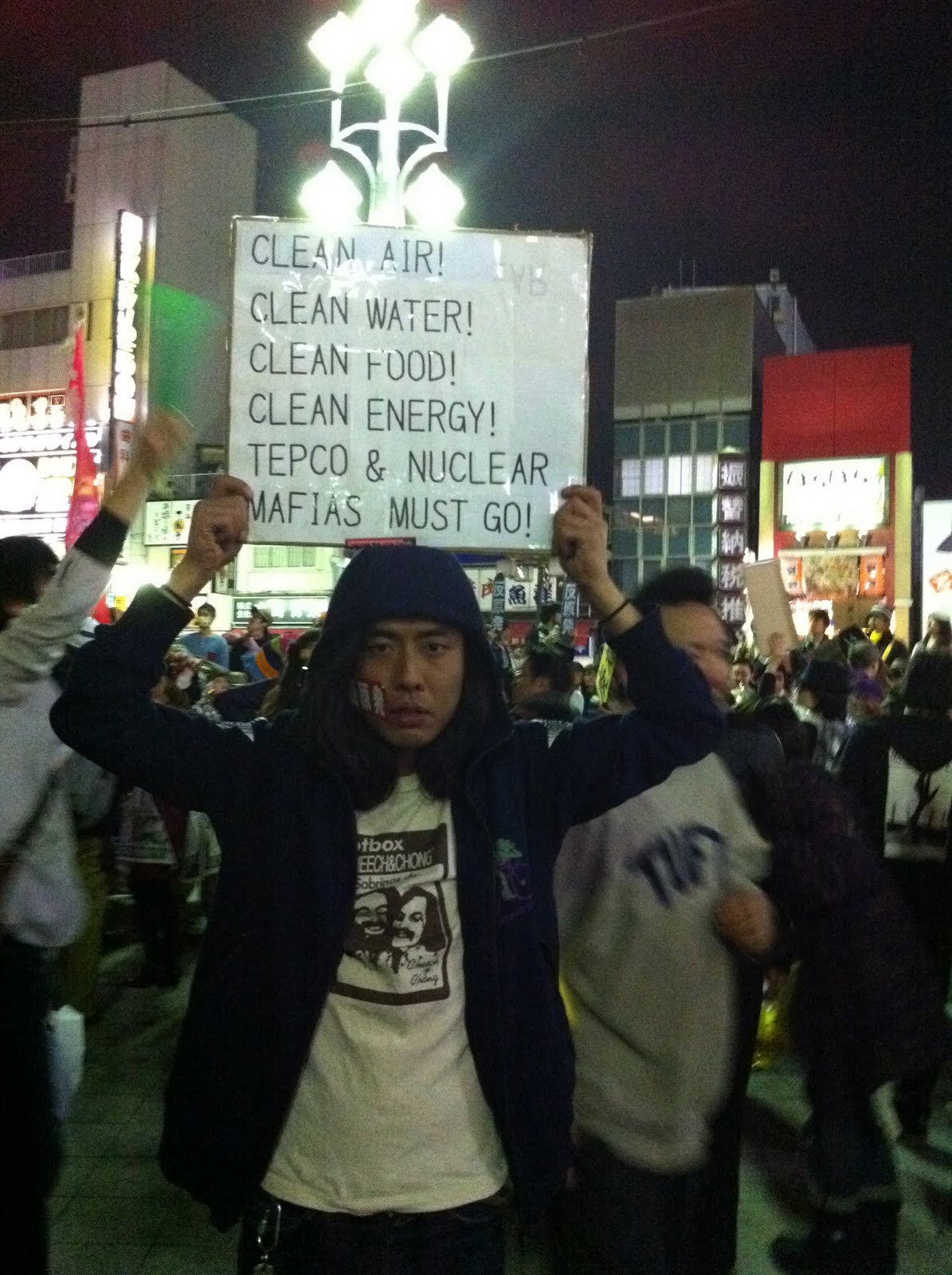
Residents from Tokyo and nearby prefectures poured into the streets on Sunday for the April 10th 'Stop Nuclear Power Plants! Global Action Day', issuing impassioned calls for the Japanese government to stop its reliance on nuclear power.

Two separate events were held in Tokyo on Sunday, with organizers estimating a total of 17,500 people in attendance—more than twice the numbers who attended a No Nukes Festa in 2009. While NHK reported that only 2000 attended, some organizers estimated the total figure at something closer to 20,000.

The first event was held in Tokyo’s Shiba Park, where 2,500 people showed up to call on government and electric power company officials to immediately stop the Hamaoka nuclear power reactors. The plant sits atop the junction of two tectonic plates in the prefecture of Shizuoka, where—in addition to presently ongoing aftershocks from last month's quake—a large earthquake is said to be overdue. A petition to stop the plant is now circulating widely throughout Japan, and supporters from overseas are urged to add their voices. More information about the plant, as well as the petition itself—which will be submitted to the Japanese government, electric power companies, local authorities in Japan and related companies—may be found here at the Stop! Hamaoka Nuclear power plant website.

Meanwhile, some 15,000 attendees—mostly young people in their 20's and 30's who learned about the event online—added fresh energy to Japan’s often traditionally somber demonstrations at a colorful parade and live music gathering in the artsy neighborhood of Koenji in western Tokyo. Parade-goers carried signs with all manner of creative self-expression regarding the tragedy, and many dressed in costumes or decorated their face masks with designs and slogans as the event pulsated with energy and emotion from the early afternoon on into the night.
Banner reading “We Prioritize Life Over Electricity”, lovingly handcrafted by Crystal Uchino, author of “Rise Like Tsunamis After the Earthquakes”

The group I marched with chanted slogans that included the following:
Give us back our land
Give us back our work
Give us back our lives
Give us back Fukushima

Radiation is dangerous
How can this possibly be “ecological”?
We don’t need nuclear power
Nuclear power is dangerous

Stop Hamaoka
Stop the Monju reactor
Don’t build the Kaminoseki plant
Stop nuclear power
30 year-old Japanese-Brazilian Sheila Yamamoto de Souza, a Tokyo resident who took part in the parade, said, “When I heard others starting to chant ‘Give us back our lives,' it really hit me hard. Even in Tokyo, our daily lives have been completely changed as we deal with fears of radiation, and I fear things will never go back to the way they were before. And we have it easy compared to others. I can’t even begin to imagine how the people who have been affected by the earthquake and tsunami in Tohoku, as well as those living near the nuclear plant in Fukushima, must be feeling right now.”


Video of Koenji demonstration

The demonstration was organized by Hajime Matsumoto, owner of a small recycled goods shop in Koenji called Shiroto no ran (Amateur Revolt), that also serves as an artist and activist collective. He wrote on his blog the day after the event: “The great thing about the event was it proved that anyone can organize something similar. I am a shop owner, and although some politicians did end up coming, I didn’t put together the event through any type of organization or structure. Truly, anyone can do this.”

Many participants had never attended any kind of demonstration before, but were inspired by fears brought on by the ongoing nuclear crisis in Fukushima. A young couple from Chiba prefecture marching near me in Koenji among first-time attendees told me they were unsure of what to expect at the event—but felt they had to show up to voice their concerns about the dangers of nuclear power.

Top: Demonstrators carrying sunflowers with nanohana (field mustard) designs sewn on their masks—both plants are said to mitigate the effects of radiation


Right: “The cows, dogs and cats are all crying too”


Also spearheading the event were members of the Human Recovery Project, whose website describes their network as follows:

The Human Recovery Project /DIY music network "nobody for everybody" outreach is a loose group of DIY punk band people, rising up in support for victims of the earthquake/tsunami/nuclear power plant catastrophe in north-east Japan. We are based in Tokyo and work in solidarity with our nation-wide/worldwide network of DIY musicians and have already started our "gigs" to the disaster areas with band-vans full of supplies for the victims. Donations welcome!
A local musician involved with the event tweeted afterward, “The mass media in Japan is clearly afraid that the anti-nuclear wave created in Koenji today would turn into a tsunami that would reach every corner of the country, and so they just ignored us. This is no different than the fear we have seen recently on the part of dictator-led governments regarding the small struggles for freedom in Middle Eastern countries spreading elsewhere like wildfire.”

"TEPCO and nuclear mafias must go"


Watch the website of the April 10th 'Stop Nuclear Power Plants! Global Action Day' for updates on solidarity actions that took place in countries around the world including Canada, France, Germany, Korea, Mexico, the United Kingdom and the United States, as well as cities throughout Japan.

Your assistance in spreading the word regarding the "Stop Hamaoka!" petition will also be greatly appreciated.

—Kimberly Hughes