Links

Showing posts with label India. Show all posts

Saturday, September 15, 2012

DiaNuke.org: Residents of Koodankulam, India protest in the sea against nuclear plant


Photo: Via DiaNuke.org via OutlookIndia.com via AP

For over two decades, Indian citizens across Tamil Nadu, the southernmost part of the Indian Peninsula, have been protesting against the Kudankulam Nuclear Power Plant (KNPP). Thousands have joined in the past month because they are concerned that hot, radioactively contaminated water discharged from the nuclear plant into the sea will poison fish and other marine life. They are also concerned forced displacement after a nuclear accident, as has happened to residents of Fukushima.

Patibandla Srikant details this history in "Twenty years of resistance at Koodankulam" published at InfochangeIndia.org in November, 2011:
According to the Atomic Energy Regulatory Board’s (AERB) stipulations, a 1.6-km radius around a nuclear power plant should have no habitation, while the next 5-km radius should have a small density of population; in a 16-km radius population must not exceed 10,000. Two reactors, Unit-I and Unit-2, are ready for testing in December this year, but no rehabilitation has been carried out to date. Government after government has changed in Tamil Nadu and in New Delhi, but the plight of the people struggling against the Koodankulam nuclear power plant continues. The central government finally seems to have taken cognisance of the protests thanks to a letter from the Tamil Nadu chief minister. But people in and around Koodankulam village continue to live with the fear of nuclear risk and threat to livelihoods.

The KNPP has its roots in the 1974 Pokhran [nuclear explosion] test conducted by India. Following the test, India came under the influence of the Soviet nuclear establishment because of its isolation from the West (the US had stopped fuel shipments to the Tarapur nuclear power plant after the 1974 test). Against this backdrop the nuclear deal with the Soviet Union was discussed as early as 1979 during Morarji Desai’s prime ministership. Finally, in 1988 the Soviet President Mikhail Gorbachev and Indian Prime Minister Rajiv Gandhi signed the Koodankulam Nuclear Power Project deal.

This triggered opposition in and around Koodankulam. The proposal to draw water for the nuclear reactors from the nearby Pechiparai reservoir and to discharge waste water into the sea threatened the livelihoods of the people. In May 1989, around 10,000 people assembled to protest against the plant under the banner of the National Fish Workers’ Union (NFWU). During this protest, police opened fire and disconnected the mike, preventing anyone from speaking. However, the disintegration of the Soviet Union, Gorbachev losing power and the assassination of Rajiv Gandhi stalled the Koodankulam nuclear power plant.
Unfortunately, the nuclear project picked up steam again. Over the past decade,Tamil Nadu residents attempted legal and environmental challenges, but were blocked by manipulative tactics.

Indians have engaged in popular resistance against nuclear plants throughout the country, but, as in Japan, they are up against "economic growth-oriented development" that require national sacrifice zones that will destroy natural environment and victimize locals. Srikant explains:
In the context of globalisation, government after government in India has pledged 8-9% growth rates. Such growth rates would naturally require more energy for consumption. Given increasing awareness of environmental issues, nuclear energy is often perceived as a viable alternative to high-polluting thermal power plants and big dams.

It is in this context that increased investments in nuclear power plants need to be seen. In spite of the high costs and risks involved, successive governments showed keen interest in pursuing nuclear energy.
Such a pursuit of growth rates is putting an enormous burden on many people, particularly the marginalised sections of society – rural populations, tribals, dalits, women, the poor and others. Big projects like nuclear power plants are posing a threat to the livelihoods of these people, while putting them in a hazardous situation in the long run.
Therefore the people of Koodankulam are fighting for their survival. During a brutal repression over the last two days by police, Anthony Samy, a fisherman, was killed.

Japan's ongoing nuclear melt-throughs have not only shocked almost everyone in Japan into nuclear-free action, but have spurred others everywhere, including those were previously silent about the nuclear radiation in their backyards, and those who have long been actively resisting nuclear power, as the people of Koodankulam, to see the interconnections of nuclear issues across borders and to work for a nuclear-free world.


On Aug. 7, 2012, people of Koodankulam, India praying for the
victims of the atomic bombing of Hiroshima
"We have chance to save Koodankulam...."
Photo: Amirtharaj Stephen, Dianuke.org

Kumar Sundaram, editor of DiaNuke.org, a India-based nuclear-free world advocacy organization that is a long-time supporter of the Hydrangea Revolution, understands the planetary history and structures of the nuclear industry. DiaNuke engages at multiple levels: critical, scientific, public-dialogical, prophetic (truth-telling) & organic (making connections, showing the common ground between diverse people).

DiaNuke articles, including those by Tokyo-residents Ruthie Iida and Jacinta Hin on the weekly Friday night protests, support a public dialogical working through of the collective shock and trauma that those of us exposed to nuclear radiation and those threatened with nuclear radiation must deal with as we also work to make our world nuclear-free.

DiaNuke's meta-message of the primacy of humanity always brings home the common ground that unite us all. This post is a shout out of gratitude to DiaNuke for their support of the Hydrangea Movement; facilitation of deep dialogue; and a heartfelt prayer for the people of Koodakulam and throughout India, that they may live free of fear of radioactive fallout; and for the political leaders in India for the wisdom to see and hear the profound message of these nonviolent resisters spoken with the power of truth (satyagraha).

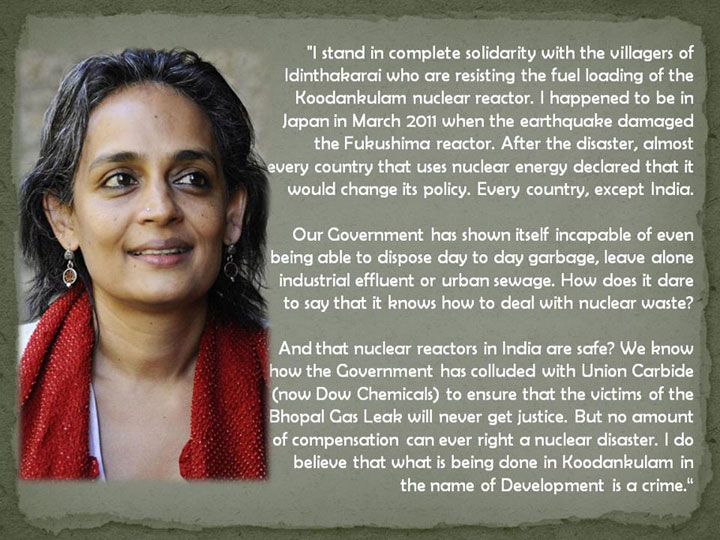
(Arundhati Roy, via Countercurrents.org)

Monday, July 11, 2011

Grassroots Asians part of interconnected worldwide coal-free movement: Coal is not the answer for post-3.11 Japan

China's example demonstrates that coal is not an answer to energy production. (Image: Sierra Club)


Congratulations to locals in Sabah, Malaysia and their global supporters in prevailing against a coal company 
that wanted to destroy this beautiful coast! (Image: Sierra Club)


Last month scientists reported that Pacific marine life passed into the Atlantic Ocean for the first time in thousands of years because global warming has melted ice cover in the Arctic. This month we've seen a flurry of news stories stating China's coal burning has "halted" global warming. Responsible media outlets like Reuters and Discover qualified the finding with pronouncements from climate change scientists who stressed that, over the long term, sulfur dioxide emissions from coal would increase global warming. Anyone who has been to China (or the Appalachian region of the United States) already knows coal is not an answer to energy production. The coal industry is as destructive as the oil and nuclear energy industries: causing permanent ruin of entire eco-systems and communities worldwide.

Even before 3.11, Japanese electricity producers were, together, the world's #1 coal importer and had planned or had under construction several new major coal-fired power stations in Japan:
Tepco previously said it expected two new coal-fired units to start operations in late 2013—a 1 GW plant at Hitachinaka and the 600 MW Hiromo No. 6 unit northeast of Tokyo, and J-Power has several plans for new coal-fired generating stations.
In past years, Japanese energy companies clashed with the Environment Ministry over emissions. Coal energy concerns now are using the Fukushima catastrophe to push through previously rejected projects and pursue growth. Owners of a mine project (20% owned by Japanese; 20% owned by South Koreans) in Vancouver, British Columbia want to produce coal for export to Asia over the objections of local residents. Itochu, a Japanese trading group, paid US$1.52 billion to acquire a 20% stake in Drummond International’s Colombian coal mining operation. The agreement gives Itochu “rights” to sell Colombian coal in Japan. The conglomerate, a major uranium supplier, used to buy most of its coal from Australian companies and has investments in Canada, Indonesia, and China. Two days ago, Mitsui bought a 49% share of Australia's Cockatoo coal project.

In Asia (and elsewhere), coal companies have seized farm land and destroyed villages, rendering entire populations homeless. The Sierra Club details this pattern of destruction, attempted destruction, and local resistance by rural people who want to save their ancestral homes and natural environments in "Down With Coal! The Grassroots Anti-Coal Movement Goes Global":
While China struggles with the enormity of the pollution burden from its world-leading annual coal consumption, it is not the only hotbed of future coal-plant construction. Activists in India, for example, report that regulators gave the green light to at least 173 coal projects during 2010 -- nearly one plant every other day. In Southeast Asia, large Chinese utilities such as China Huadian are setting up shop to finance and build a slew of new coal plants. Meanwhile, new coal mines are being proposed in Australia and Indonesia, overwhelmingly for export sales. Countries from Mozambique to Mongolia, which have had little domestic need for coal, are now being hyped as the next big players in the global coal rush. (Photo: A 2,000-MW coal plant in Madhya Pradesh, India.)

In the fertile farming areas that support large rural populations in much of Asia, the new coal boom spells civil conflict, as fields are seized, villages are ordered to pack up and leave, and communities resist. For the U.S. coal movement, the 2,500 people who turned out to protest the Capitol Power Plant was a large number. In India or Bangladesh, marches and demonstrations of more than 10,000 people are not uncommon.

The dominant international narrative focuses on the need to build large numbers of new coal plants across the developing world to spur economic progress. However, the assertion that development can only be achieved through a massive expansion of coal use is being met with increasingly fierce resistance by those asked to bear the most toxic and destructive burdens of this expansion: the people living next to coal projects.

Local populations are resisting private and public-sector pressure to dramatically expand coal-fired power because these projects are not intended for their benefit. While local people face displacement and the destruction of their livelihoods, electricity is often exported to urban centers. Communities are calling for a more sustainable model of energy development that prioritizes access to energy services for all, environmental sustainability, and human health. Their efforts to halt coal-plant construction have placed them front and center in the struggle over energy and development in the 21st century.

In the past, most communities struggling to take on ill-conceived projects have done so largely on their own, but that's starting to change. International coalitions are beginning to develop to bring publicity and support to front-line efforts. Here are a dozen places around the world where people are uniting to halt coal projects, increasingly with international support.

•  Sabah, Malaysia

In April, 1,500 people convened on a beach in Malaysia to savor a victory that had been judged impossible just two years earlier: the defeat of a 300-MW coal plant in the Malaysian state of Sabah, located on the northeast side of the island of Borneo. Celebrations were also underway 7,500 miles away, in California, among a group of activists who had helped draw international publicity to the issue -- including a Time magazine article entitled "A Coal Plant in Paradise."

• Phulbari, Bangladesh

Bangladesh's high population density (more than 164 million people in a country the size of Iowa) and rich agricultural land make coal mining a destructive proposition. In the township of Phulbari, as many as 220,000 people would be displaced by a proposed 15-million-ton-per-year coal mine and a 500-MW coal plant. Community opposition reached a crescendo in 2006, when paramilitary forces fired on a protest rally of as many as 70,000 people, killing three people and injuring 200. In the wake of these deaths, nationwide protests and strikes closed down the country for four days... During recent demonstrations, the Bangladeshi government has deployed its Rapid Action Battalion, notorious for torture and for the deaths of persons in its custody. The repression has failed.

• Andhra Pradesh, India

This coastal state of eastern India is experiencing a coal-plant construction boom, including the 4,000-MW Krishnapatnam Ultra Mega Power Project, one of nine such massive projects in planning or under construction across the country...The 2,640-MW Sompeta plant proposed by Nagarjuna Construction Company and the 2,640-MW Bhavanapadu plant proposed by East Coast Energy have both provoked large nonviolent protests that have ended in police attacks, including four deaths of local residents. Following coverage of the police action on Indian television, investigations revealed a pattern of "crony capitalism" among the permitting agencies and corporate sponsors. As of May 2011, the Sompeta plant had been cancelled and the Bhavanapadu plant had been placed on hold by officials, with corruption investigations continuing...

• Dawei, Burma

In Dawei, on the beautiful southern peninsula coast of Burma, Italian-Thai Development Plc signed a deal in Nov. 2010 to build a 4,000-to-6,000-MW coal plant, the largest in Southeast Asia and possibly the world. Within weeks of the signing, 19 villages had received orders to move. Dawei is 10 miles from Maungmagan, a scenic beach and rich fishing district...

• Nakhon Si Thammarat Province, Thailand - On Feb. 24, 2011, 10,000 people formed a human chain in this province in Thailand to protest a coal-fired power plant planned by Electricity Generating Authority of Thailand...

• Konkan Coast of Maharashtra, India

Home to 112 million people, this state in western India is building a concentration of large coal plants on a tiny sliver of land south of Mumbai known as the Konkan Coast (dubbed "the California of Maharashtra")...Concerned by the pollution and displacement entailed by the massive proposals, farmers have targeted some of the largest projects. One of these is the 4,000-MW Girye Ultra Mega Power Project, which prompted mango farmers and others to stage marches, hunger strikes, and other nonviolent actions. They successfully forced the project to seek a new location [PDF] as protests barred the government from acquiring the needed land.

• Orissa, India

In this state on the eastern coast of India, the scale of coal-plant development is staggering... In March, activists from across India converged on Orissa for a national conclave to plan a response to the coal boom, as well as the related issues of energy use and climate change. The mobilization includes the National Alliance for People's Movements, Focus Odisha, and numerous other groups.

• Madhya Pradesh, India

Since 1977, when the World Bank financed the first coal-fired plant in the region, the Singrauli district of this state in central India has been notorious for roughshod development and population displacement. Now more massive coal plants are being built or planned... The concentration of power generation in an agricultural area has left local communities reeling. The Sasan Ultra Mega Power Project, for example, has displaced 6,000 people. One man is benefiting: Mukesh Ambani, the controlling owner of India-based Reliance Power, whose reported net worth of $27 billion makes him one of the world's five richest individuals.

• Queensland and New South Wales, Australia

On a tonnage basis, Australia already leads the world in coal exports, and that lead may widen significantly if several massive mines are allowed to move forward in the eastern coal-mining states of Queensland and New South Wales... Farmers and ranchers are fighting back with a concerted effort to protect rich agricultural lands and precious water resources from mining operations...

•  Victoria, Australia

While the low-quality coal in this state in southeastern Australia is not suitable for export, it provides 91 percent of the fuel used for power generation in Victoria itself...

• Colombia

One of the oldest examples of citizens working across national boundaries on coal issues is the coalition of human rights and labor organizations that has brought attention to the massive mines in Colombia, such as the 35-by-5-mile Cerrejón coal mine, operated by Cerrejón Coal Company, and the mines operated by Drummond. The expansion of these mines has been marked by paramilitary violence, high numbers of deaths in mining accidents, and displacement of entire communities, including Tabaco, a 700-person Afro-Colombian village that was razed in 2001. Witness for Peace has brought members of Kentuckians for the Commonwealth to visit the mines, as well as people who live near the Salem Power Station in Massachusetts, which uses coal from Colombia.

• Sarangani Province, the Philippines

In the Philippines, grassroots protests against new coal plants and open-pit coal mining have taken place across the country...At a separate demonstration, students at Mindanao State University dressed as Na'vi from the film Avatar marched on the fenced property of the proposed plant site...
The co-authors (collaborative activists worldwide) conclude:
As grassroots resistance grows in countries around the globe, a nascent, interconnected, worldwide anti-coal movement is emerging. In an increasingly globalized world, local campaigns can quickly reach a global audience and tap into previously unimagined support networks. While the participants in this new movement are diverse, some of the patterns are becoming clear: sustained and passionate grassroots activism is challenging the idea that fossil fuels are the only option. Many governments have backtracked or shelved plans in response to political pressure or legal actions. Some banks, investors, and even energy companies are growing increasingly wary of further supporting coal.

But it's still too early to write the obituary for King Coal. The industry is now attempting to wrap itself in the cloak of "development," justifying dirty energy projects in the name of providing energy access for some of the world's most economically poor countries. While many coal projects have encountered strong opposition, too many others are proceeding without challenge.

...Like tobacco, coal insinuated its way into our lives delivering a cheap, short-term energy high, but leaving a bitter long-term aftertaste -- in the case of coal, ruined rivers and lands, lives wrecked and cut short, abandoned communities, and an increasingly polluted and potentially unlivable atmosphere.

We need clean energy alternatives, not the continuation of dirty energy that destroys people's health, livelihoods, and resources. Will you join the growing global movement to move away from coal?
(24 February 2011 - Thailand. Children join Greenpeace & thousands of other people from Nakhon Si Thammarat to protest plans for a new coal-fired power station to be built in their province by the Electricity Generating Authority of Thailand (EGAT). The protesters call for EGAT to immediately withdraw its coal project due to projected serious economic, social and environmental impacts. Photo: Greenpeace Int.)

Thursday, December 9, 2010

Human rights awardees inspire Tokyo audience in emotional ceremony

Kanda Kaori, Kitamura Toshiko, Tairah Firdous, interpreter (Motoyama Hisako, Director of the Asia-Japan Women's Resource Center)

“The one and only way to bring about positive change in the world is through love.”

Journalist and social activist Kitamura Toshiko, one of the honorees at the Woman Human Rights Activities Award (or Yayori Award) ceremony held in Tokyo this past Saturday afternoon, revealed that she was able to arrive at this seemingly simple understanding only after a period of profound soul-searching.

"At one point in my life, I was driven almost exclusively by anger. After reaching a point where my work was no longer sustainable, however, I turned to spiritual pursuits including meditation and yoga. Only then was I able to realize what was missing in my approach."

In her work with numerous social issues, including child abuse, homelessness, youth bullying and suicide, Kitamura has deeply probed corners of society where love is often painfully lacking.

Her selection as this year's Yayori Journalist awardee was in recognition of her tireless commitment to these issues—as well as her recognition of the interconnections therein. In fact, her understanding of the common thread between all forms of discrimination and suffering—and her ability to look past surface-level social categorizations in order to connect with the common humanity that we all share—has often led to uncomfortable moments with others who do not share her vision.


Kitamura Toshiko

"When some members of the women's movement heard that I was working with homeless people in Osaka's Kamagasaki district, they reacted by saying they couldn't understand why I would want to spend that much time with 'a bunch of lewd men'," she said. "Similarly, when I began a correspondence with a youth who was jailed after killing a homeless person—telling him that I believed in him and his capacity to change—I was harshly criticized by some of the other Kamagasaki volunteers as having betrayed the life-affirming work that we were trying to do there.

"In fact, violence is something that we are all capable of. Instead of immediately condemning someone for committing a violent act, then, we must seek to understand what particular constellation of factors caused that person to act in the way that they did," she emphasized to Saturday's attendees—most of whom (including myself) were in tears as her gentle and yet powerful words traveled straight into our heart-centers. "It is only when we calm our rage with love that we are able to have compassion for others and encourage them to change in positive ways."

Also speaking at Saturday's event was documentary filmmaker and human rights activist Tairah Firdous, who grew up in Kashmir amidst constant turmoil as India and Pakistan have continued a decades-long power struggle over the region. She received the Yayori Award in support of her forthcoming documentary, which will focus on Kashmiri survivors of rape and torture.

"The Indian government has declared Kashmir a 'disturbed area', and implemented an Armed Forces Special Powers Act that essentially gives state officials free license to do whatever they feel like," Firdous explained to Saturday's audience. "What this means in terms of actual experience are continuous human rights violations including forced migration, searches without warrants, arbitrary arrests and detention, torture, and rape.


Tairah Firdous

"My own work with these issues began when my family was forced to leave our home after my father was arrested and tortured on six different occasions, even though he had absolutely nothing to do with the conflict," Firdous told attendees. "Completely innocent peoples' lives are being shattered within this political climate, and so I intend to expose the killings and other unreported human rights violations so that the rest of the world will know what is really happening."

New to the 2010 awards lineup was a special prize given to Kanda Kaori, a kodan (traditional storytelling) performer whose work focuses on issues connected to war and other forms of institutionalized violence.

"After I finished the obligatory three-year period of apprenticeship and was able to start my own career as a professional performer, I went on vacation in Saipan to celebrate," she told Saturday's crowd. "I was completely unprepared, however, for what I saw: a sunken U.S. military ship and other lingering remnants of World War II, which seemed so completely out of place amidst an otherwise idyllic scene of beauty. After I got over my shock, it became clear to me that I must use my craft to communicate the personal suffering unleashed by wars."


Kanda Kaori

Kanda followed her acceptance speech with a brief kodan performance detailing the painful final hours of a Yokohama family after a U.S military jet crashed into their home in September 1977, badly burning their two toddlers, who died several hours later. Again, there were few dry eyes in the room at her emotional interpretation of the tragic event, memorialized in a bronze statue in a Yokohama seaside park titled Ai no boshizou ("An Image of a Mother's Love"). The statue represents the two small boys with their mother, who also died four years later from complications sustained in the crash.


Ai no boshizou ("An Image of a Mother's Love")

"I sometimes feel overwhelmed by pain while preparing my performances, which have focused on horrific issues such as the Hiroshima atomic bombing and the Chernobyl nuclear power accident," Kanda said. "However, I will continue to speak out against war and other injustices, and encourage my protegees to do the same—particularly as Japan continues to follow the United States in its misguided war escapades."

Saturday's event was held at a small chapel located on the same grounds as the Women's Active Museum on War and Peace (WAM), an institution founded by the Violence Against Women in War Network (VAWW-Net) that was spearheaded by the late Matsui Yayori (from whom the Yayori Awards have been bequeathed). The museum is presently housing an exhibition commemorating the tenth anniversary of the Women's International War Crimes Tribunal on Japan's Military Sexual Slavery that took place in 2000. Following the ceremony, a separate memorial was held in remembrance of the of the so-called "comfort women" who have died before having attained full justice for their suffering.

More information about the Yayori Award program may be read at this previous post. For full profiles of the 2010 (and past year) awardees, see the official website.

Text by Kimberly Hughes
Photos by Ando Makiko

Friday, November 12, 2010

Vandana Shiva on industrial agriculture's use of war chemicals and food sovereignty versus the new colonialism


This is an excerpt of Vandana Shiva's talk about the role of war chemicals (pesticides, fertilizers) in industrial agriculture's new colonization in her talk on food and seed sovereignty at the International Meeting on Resisting Hegemony held 2-5 August 2010 in Penang, Malaysia.
I'm going to talk about the work I've been doing for the last 30 years on issues of biodiversity, food, and agriculture, largely because of the recognition this is the cutting edge of the new colonization and the new imperialism...

For me, 1984 was significant because of two major events, both very tragic. One was June 4, when the Sikh shrine, the Golden Temple, was invaded by the Indian Army, largely because of the unrest and the extremism that had built up in Punjab, and the extremists were hiding in the Golden Temple. And, later that year, we had the Bhopal tragedy where the pesticide plant leaked and killed 3,000 people in one night. 25,000 since then...

Bhopal is historically a watershed in terms of the structures. Part of it involves "shedding," First shedding hazards and then shedding liabilities related to hazards. Bhopal is a watershed where sacrificing the rights of people in the time of industrial genocide starts...

Someone mentioned Lawrence Summers who is currently Obama's chief economic advisor. But I first came across Lawrence Summers in 1992 when he was the chief economist of the World Bank because he wrote a memo saying it makes good economic sense to move pollution and hazards to developing countries. First because it's cheaper to find labor and therefore costs come down. And when people fall ill, it's cheaper. And when people die, it's cheaper, because their lives are worth less. So that's 3/5 of a human being on a scale issue. This continues in the contemporary calculus of what is a life worth.

Because of this series of violent episodes, I decided to start looking at what is really happening to agriculture....

Because of this series of these very violent episodes, I decided to start looking at what is really happening to agriculture. And in those days, I was associated with the peace and global transformation program that the CSDS that used to have...I decided to study what happened to Punjab...I was young, an innocent physicist with no idea of what was going on in agriculture...

A series of things I learned during that study. First, that agriculture had become the place to extend the war economy. Every input in agriculture is a war chemical. Every agrichemical is a war chemical. Herbicides were used in Vietnam. Pesticides were used to kill people which is why Bhopal killed people. Fertilizers came out of explosives factories...

The other day I was at some gathering and there was someone who is very close to the U.S. security establishment and they said Iraq was easy because the weapons were very evident. The weapons had been bought on global markets. Afghanistan is tough because the weapons are fertilizer bombs made from the fertilizer the U.S. distributed. So this is, in fact, the fertilizer coming back to its original purpose. And of course, it's not just that these are just war chemicals extending into agriculture.

But bringing them into agriculture is very much part of the new imperialism. The common narrative of the Green Revolution is India chose it. The reality of it is that the defense labs of the U.S. started to work in the '40's on how do you retool these chemicals for agriculture...So you had to change the plants to adapt to the chemicals...

Rather than calling them varieties bred for chemicals, they were now called "high-yielding" varieties. In fact, they were even called "miracle seeds." And the first 12 people they trained were called...the "wheat apostles" introducing these new seeds...

In the colonization through agriculture, land was emptied of its biodiversity...

This whole structure only worked because when these varieties were ready, the U.S. government was waiting for an opportunity to push them. And it was a drought that took place in 1965 that provided that opportunity because the need for additional imports became the time for imposing conditionalities: "We won't send you wheat unless you change our agriculture." Our prime minister at that time said "no." He died soon after, in Tashkent, under very mysterious conditions. And the conditions continued. The two foundations, the Rockefeller Foundation and Ford and the World Bank joined hands to create this package of conditionalities...

You couldn't borrow unless you proved you had taken money and subsidies for chemicals. You couldn't get any benefits from any government program unless you showed you were planting the new seeds. The Green Revolution didn't spread because of the choice farmers were making, but because of conditionalities...

A lot of my work in the Punjab study showed that actually food production went down. Rice and wheat production went up, but only because you displaced all the other crops. In an Indian diet, you need your pulses, your oil seeds, lots of vegetables. All of that disappeared. Now you had a monoculture...

We had a huge decline in pulses, the basic protein for a vegetarian diet. Quite clearly, the West never understood because they never had pulses in their diet...

Wednesday, November 3, 2010

URBAN TYPHOON WORKSHOP NEW DELHI @Khirkee Village, Nov. 9-16

Matias Echanove, Geeta Mehta and Rahul Srivastavavarious conceived the idea of URBZ (user-generated cities) with fellow urban planners, architects, artists, and other people engaged in the organic formation and direction of the cities in which they live.

Their goal: to challenge bland generic redevelopment plans presented as urban rationalization and modernization and offer alternative visions of urban community generated by those who actually live in these communities.
While these redevelopment plans usually benefit real estate actors and financing institutions operating on a global scale, they are often threatening local social networks and economic activities.
They began their collaborations in the 2000's in Tokyo (focusing on saving Tokyo's most creative neighborhood, Shimokitazawa) and Mumbai:
The initial concept of URBZ was born in the mind of a restless group of urban planning students in New York in the early 2000’s. The idea was to exchange knowledge about cities, network and travel globally for events and conferences. URBZ was developed as an early and basic prototype of social networking sites such as Flickr and Facebook.

After various phases of trial and development the project nearly died. It was resuscitated in Tokyo and in Mumbai by Geeta Mehta, Matias Echanove and Rahul Srivastava as participatory urban planning, architecture and research tool. The recent spread of open source web content management systems such as Drupal and Worpress made it easier to develop media rich participatory websites.

www.urbz.net functions as a virtual office for projects in cities including New York, Tokyo, Mumbai, Goa and Geneva. In addition to maintaining its website and providing support to partner organizations and initiatives, URBZ members organize workshops where ideas and visions about localities are expressed and shared. URBZ believes that the encounter of local actors and global contributors unleashes new potentials at all levels.
Their latest gathering is upcoming in India:

The Urban Typhoon Workshop New Delhi will be held in Khirkee Village from November 9-16, 2010.

The Urban Typhoon Workshop invites artists, architects, academics, activists and other practitioners to work in Khirkee Village and conceptualize alternative scenarios for its future along with its inhabitants.

The workshop will start on November 9th with the self-formation of the participants into small groups and end on November 16th with collaborative output in the form of plans, projections, installations, multimedia events being presented to the inhabitants and the city at large.

Khirkee, where KHOJ International Artist's Association has its studios, is one of the several urban villages that make New Delhi's fabric unique. KHOJ is one of the leading contemporary art incubators in India. Its presence in Khirkee has made it possible for artists and inhabitants to interact and start a conversation about alternative ways of experiencing and developing the village.

URBZ brings its expertise of organizing cross-disciplinary dialogues in the area of urban planning. The partnership between URBZ and KHOJ hopes to forge new relations between art and urban practices along with encouraging constructive dialogues and collaborations between residents, civic officials and urban practitioners of all kinds.
For more info, see the Urban Typhoon New Delhi's website.

For more background on user-generated cities, see Urbanology (fascinating page on Tokyo), and Save the Shimokitazawa.

Saturday, August 7, 2010

Ikuo Hirayama, artist from Hiroshima: War is the "supreme folly of humankind"


Ikuo Hirayama passed away in December 2009, five months before the Miroku Project's Nara 2010: Conferences on the Future of East Asia, which he chaired, was to begin.

The renowned artist and Silk Roads preservation activist said that the wish for peace was the core of his work. His fervent quest was born when he was a fifteen-year-old living in Hiroshima on August 6, 1945. That morning, he witnessed the atomic bombing "like a flashbulb had gone off right in front of me." Suffering from radiation-induced leukopenia, Hirayama knew he wanted to work for world peace but did not know how to do this until his mind suddenly filled with spontaneous image of the Chinese pilgrim Xuanzang who defied his government to go in search of Buddhist texts:
As a child I suffered from the effects of the nuclear bombing of Hiroshima. This devastating experience has made me harbor a strong wish for world peace, just as I believe monk Xuanzang did. Identifying with him thus, I have wished to relive his journey of sacrifice and discovery along the Silk Road.
In following Xuanzang's footsteps across the Silk Roads, Hirayama realized the deep historical and cultural interconnections between Eurasia, Africa, and the Middle East, all the way to Japan:
What we call Japanese fine arts have their origin in China...If Chinese art objects of the early Tang age were excavated (in Japan) now, they would be taken for Japanese objects. With the passage of time, Japanese fine arts became recognizably different from Chinese fine arts, but in the Asuka, Hakuho and Tenpyo periods, that is, in the seventh century, the two were identical.
This realization of human unity helped to heal Hirayama's psyche and spirit. His journeys west also reinforced his knowledge of the devastation of war:
It’s no exaggeration to say that a culture can be wiped out in a second by war. Many ruins and remains found along the Silk Road are the result of war, the supreme folly of humankind.
It took the artist decades to recover enough personal strength to look backwards into his life, at what happened in Hiroshima. When he did, he was ready to portray the atomic bombing in his medium, Nihon-ga, the richly colored traditional Japanese paint medium using dry mineral pigments, which originated in India and was brought to Japan via the artist's beloved Silk Roads.

"Ikuo Hirayama says the wish for peace is at the core of his art work" by NPR's Robert Rand, published in 2008, explores Hirayama's peace activism through visual art and historic preservation:
Today, the Japanese city of Hiroshima is a thriving metropolis of 1.2 million that speaks with the rumble and squeal of streetcars and traffic. But on Aug. 6, 1945, an atomic bomb shattered the city, killing more than 90,000. Of those who survived, one man, Ikuo Hirayama, would go on to turn the devastation into art...

"There was a powerful flash right in front of me. I covered my ears. And there was a strong wind, and I squatted down and the wind went right over my head. And I then tried to escape through waterfalls of fire..."

Many of his friends died. Hirayama grew ill from radiation sickness and his white-blood-cell count plummeted, but eventually he recovered. He left Hiroshima, adopted Buddhism as a way of honoring the dead, and took up painting, practicing an ancient technique called Nihonga, in which colors are blended from ground-up mineral pigments, then attached to the canvas with glue.

Hirayama became famous as a painter of Buddhist images and of the Silk Road, the highway that brought Buddhism to Japan. His Silk Road paintings convey Hirayama's belief that the road, with its exchange of commerce and ideas, showed that cultures can interact constructively. The paintings epitomize a sense of hopefulness and cooperation, peace and tranquility, the antithesis to Hiroshima, 1945...

Two decades after the bombing, Hirayama finally returned to Hiroshima. He visited the city's Atomic Bomb Memorial Park, and found himself drawn by the hiss and flicker of a flame honoring the dead.

"I saw the color of the fire, which was orange. It reminded me of the day of the bombing, and I could not get rid of that color behind my eyelids," he says.

Hirayama immediately began sketching out what would become one of his most powerful works, a huge, six-paneled canvas called "The Holocaust of Hiroshima..."

(Takato Kageyama, who lost his parents and two sisters in the bombing, stands before "The Holocaust of Hiroshima." Photo: NPR)

Hirayama says that despite the sorrow and destruction portrayed in "The Holocaust of Hiroshima," the painting offers a message of hope.

"The Buddhist god is telling everybody to rise like a Phoenix, to stand up and live for all eternity," he explains. "I believe that art can overcome hardships. I believe that flowers can blossom from anguish and inhumanity. You can overcome these things and make something beautiful..."

"I started to create my artwork as a requiem for those who lost their lives in the war. The wish for peace is at the core of my work," says Hirayama.
Read Rand's entire article here.

— JD

Wednesday, April 7, 2010

Arundhati Roy on the new global conquistadors: violent grabs for remaining indigenous lands & "resources"

We hear reports about Indian farmers committing suicide from debt; militarized police forcing indigenous peoples from their forest homes that have been leased out to mining companies; cruel caste discrimination and the usual images of hundreds of thousands of starving children and elders in India--worsened with India's so-called modernization.

Worldwide we hear parallel stories of devastated lives and suicides because of debt resulting from predatory banking; militarized police enabling land grabs in indigenous lands; and record rates of hunger worldwide.

Arundhati Roy no longer sees people as "Indian," "American," or "Chinese," because of the globalized nature of the latest forms of predation upon indigenous and marginalized people (now including the middle classes of "developed" nations). Instead she sees a world in which domestic colonization vies with imperial forms of colonization. In India and many other nations, corporate elites backed by their nation's military and police power, are preying upon the last lands of the world's remaining indigenous peoples.

From Christopher Lydon at HuffPost:"Arundhati Roy's Version of Disaster in 'This Year of India.'"
Arundhati Roy is giving us "the other side of the story" in this "Year of India" at Brown University and elsewhere. Media consumers in the US don't get it all in the TED talks, or in Nandan Nilekani's success epic, much less in Tom Friedman's relentless celebrations of the Bangalore boom in The New York Times.

I sat with Ms. Roy for an hour and a half near MIT last Friday -- first time since her book tour in another life, with the Booker Prize novel, The God of Small Thingsin 1998. This time she was just off a remarkable journalistic coup for Outlook India -- an "embedded" report from the so-called "Maoist" uprising in the Northeastern states of India, the rebellion that Prime Minister Manmohan Singh has called India's greatest security threat and Arundhati Roy calls a battle for India's soul:

AR: What does the boom do? It created a huge middle class -- because India is a huge country, even a small percentage is a huge number of people -- and it is completely invested in this process. So it did lift a large number of people into a different economic bracket altogether -- now more billionaires in India than in China, and so on. But it created a far larger underclass being pushed into oblivion.

India is home to the largest number of malnourished children in the world. You have 180,000 small farmers who've drunk pesticide and committed suicide because they've been caught in the death trap. You have a kind of ecocide where huge infrastructural projects are causing a drop in the water table. No single river now flows to the sea. There is a disaster in the making.

The way I see it, we had a feudal society decaying under the weight of its caste system, and so on. It was put into a machine and churned and some of the old discriminations were recalibrated. But what happened was that the whole separated into a thin layer of thick cream, and the rest of it is water. The cream is India's market, which consists of many millions of people who buy cellphones and televisions and cars and Valentine's Day cards; and the water is superfluous people who are non-consumers and just pawns who need to be drained away.

Those people are now rising up and fighting the system in a whole variety of ways. There's what I call a bio-diversity of resistance. There are Gandhians on the road, and there are Maoists in the forests. But all of them have the same idea: that this development model is only working for some and not for others.

CL: How do we Americans listen for a true Indian identity in this period of fantastic growth and, as you say, fantastic suffering?

AR: You know, I have stopped being able to think of things like Americans and Indians and Chinese and Africans. I don't know what those words mean anymore. Because in America, as in India and in China, what has happened is that the elites of these countries and the corporations that support their wealth and generate it form tham have seceded into outer space. They live somewhere in the sky, and they are their own country. And they look down on the bauxite in Orissa and the iron ore in Chhattisgarh and they say: 'what is our bauxite doing in their mountains?' They then justify to themselves the reasons for these wars.

If you look at what is going on now in that part of the world, from Afghanistan to the northeast frontiers of Pakistan, to Waziristan, to this so-called "red corridor" in India, what you're seeing is a tribal uprising. And it's taking the form of radical Islam in Afghanistan. It's taking the form of radical Communism in India. It's taking the form of struggles for self-determination in the northeastern states. But it's a tribal uprising, and the assault on them is coming from the same place.

It's coming from free-market capitalism's desire to capture and control what it thinks of as resources. I think 'resources' is a problematic word because these things cannot be replenished once they are looted. But that is really the thing. And the people who are able to fight are those who are outside of the bar-coded, cellphone-networked, electronic age -- who cannot be tracked and who can barely be understood.

It's a clash of civilizations, but not in the way that (Samuel P.) Huntington meant, you know. It's an inability to understand that the world has to change, or there will be -- I mean, as we know, capitalism contains within itself the idea of a protracted war. But in that war... either you learn to keep the bauxite in the mountains, or you're not going to benefit from preaching morality to the victims of this war. A victory for this sort of establishment and its army and its nuclear weapons will never be a victory. Because your victory is your defeat, you know?
More on these issues with an Indian focus in Amy Goodman's interview with Roy at Democracy Now.

Wednesday, March 31, 2010

Head's Up: Obama appoints Pesticide Lobbyist as USTR Chief Ag Negotiator--disappointing fair trade, organic & sustainability advocates worldwide

Disappointing millions of fair trade, organic, anti-GMO and sustainability advocates in the U.S. and worldwide, President Obama appointed Islam Siddiqui as the Chief Agricultural Negotiator in the Office of the U.S. Trade Representative. Siddiqui was one of 15 people Obama recess-appointed to government posts last weekend to bypass Senate approval hearings.

More than 80 environmental, small-farm and consumer groups opposed the GMO advocate's Senate confirmation. Siddiqui was vice president for agricultural biotechnology and trade for CropLife America, a trade group of biotech and pesticide companies, including Monsanto. CropLife fought popular initiatives seeking to ban GMO food in California--claiming that pesticides positively impact endangered species. CropLife also lobbied the Bush administration for human and child testing of pesticides, and wrote a letter to Michelle Obama urging her to use pesticides in the organic garden at the White House.

Siddiqui also worked for the Clinton Administration at U.S. Department of Agriculture as Under Secretary for Marketing and Regulatory Programs, Senior Trade Advisor to Secretary Dan Glickman and Deputy Under Secretary for Marketing and Regulatory Programs.

Paula Crossfield at Civil Eats covers the story in "Pesticide Lobbyist Gets Posted as Chief Agricultural Negotiator." More at a great organic blog, Living Maxwell.

What does this mean for Japan and the rest of Asia?

It means that the USTR will be pushing GMO, non-organic, unsustainable practices (on behalf of industries)--as it did under the Bush administration. Asia is a region where governments have more respect for citizen concerns about the health risks of GMO (with notable exceptions like China's recent acceptance of GMO rice and India's acceptance of GMO cotton). The Japanese government has particularly listened to citizens' voices on this matter.

More than ever, grassroots organizations and consumers are going to have to encourage and support government efforts to maintain health and consumer standards that the USTR may falsely label "trade barriers."

Tuesday, March 16, 2010

Vandana Shiva: GMO crops "suicidal" compared to native crops adapted to flood & drought--"Resilience is built through diversity"

GMO companies have pushed their way into India, persuading small farmers to purchase expensive GMO seeds on borrowed money. Many of these farmers have committed suicide after the promises of better cotton yields turned out to be false hype--poor or bad GMO crop yields resulted in insufficient income to pay back their debts.

In February, India's government imposed a moratorium on the use of a GMO eggplant because of safety concerns.

In a recent interview with Reuters, Indian environmentalist and GMO-free advocate Vandana Shiva, warned that the use of genetically modified crops is "suicidal" because they, unlike native and normal crops, cannot adapt to flooding and drought:
"The (GM) system is more about companies making money from farmers than food security..."

Plenty of drought- and flood-resistant traditional crop varieties already exist and simply need to be brought back to market, supporters of traditional farming say.

Shiva said India has hundreds of varieties of rice, and many that show resistance to flooding, drought and saltwater are now being carefully bred at Indian research institutes to increase yields and are then re-released to farmers.

In India's northeast Assam province, where fields have been flooded for weeks after intense rains, demand has surged for two rice varieties that can survive weeks under water and also produce well even in dry conditions.

Planting a broader variety of crop strains - rather than a couple of GM varieties - should help protect the world food supply and insure it against emerging climate threats, including an expanding range of crop pests.

While a pest might decimate some varieties of crops, it is unlikely it could destroy a wide range of varieties, she said.

"Resilience is built through diversity," Shiva said.

Keeping small farmers on their land is also key, she said, because small farmers are more productive per acre than big-scale growers, according to the U.N. Food and Agriculture Organisation's figures.

"The majority of people in the world are still farming on small farms," she said. "If we're addressing food security we'd better enhance the security of small farms."

Tuesday, March 2, 2010

Steven Leeper: "We must graduate from a culture of war & violence into a culture of cooperation."


From Hiroshima, the global epi-center of hope, optimism of the global nuclear abolition movement--powerful insights from Steven Leeper, chairman of the Hiroshima Peace Foundation--from "“Mr. Truman Meets Hiroshima on the Future of Nuclear Weapons, 1944-2020"--a cross-Pacific dialogue with scholars at the Truman Library in Independence, Missouri last night:
We need to get this awareness into our consciousness. That is the key...that we want to be liberated from the threat of nuclear annihilation...

Recently India and North Korea were the only two nations that expressed a desire to keep nuclear weapons in a United Nations conference last year.

How can the voices of ordinary people help to change?

Energizing at the global grassroots level...this is the key right now.

There's something called the "nuclear trance." Our culture has trained us to feel nuclear weapons are a fact of life...

But nuclear abolitionists are not a fringe group. We're the vast majority of people on this planet...

Only a very small group of people are trying to maintain nuclear weapons, but they're very powerful because of their money...

We must graduate from a culture of war and violence into a culture of cooperation.

And we must say we will have a peaceful, sustainable world..

Mayors for Peace are developing this culture at the city level...

How can we apply pressure on our governments to make nuclear abolition happen.

The key is to work on this together. We are being tested on the extent that human beings can start cooperating for survival.

Nuclear weapons are the first test. If we don't pass this one, we won't go on to the next ones.

We must work for the banning, stigmatizing of nuclear weapons.

This involves advancing human consciousness and moving from a war culture to the peace culture that Jesus, Gandhi, and Martin Luther King talked about.

Maybe humans can't become nonviolent completely. But we have to become nuclear-nonviolent.
A video replay is available soon at this link.

-- Jean Downey (this loose transcription is from handwritten notes taken during the dialogue)