Links

Showing posts with label Post-3/11 Japan. Show all posts

Tuesday, February 25, 2014

Don't Forget Fukushima: "...if people don't make an effort to raise my voice, then no one outside of Japan will know what's happening. And that is...soul-destroying."


Via Greenpeace:  Over one hundred thousand Japanese people have been forced to leave their familial homes and livelihoods because of the second largest nuclear plant fallout in history. They have been ignored by their government and TEPCO, owner of the disaster site. They fear life will get even worse if they are forgotten by the world.  So Greenpeace brought six activists to Fukushima to see and listen.

Here is the page with links to the stories of Minako Sugano (mother of young children), Kenichi Hasagawa (former Iitate Village dairy farmer, now a nuclear refugee), Hiroshi Kanno (another former Iitate farmer, now a nuclear refugee), Tatsuko Ogawara (organic farmer) , Katsutaka Idogawa (former mayor of Futaba, an evacuated village), and Kenji Fukuda (a lawyer who advocates for 3/11 victims): "Fukushima: Don't Forget"

Many thanks to Fresh Currents on FB for a head's up re the video of the Foreign Correspondents Club of Japan (FCCJ) press conference of the six activists, "Bearing Witness to the Fukushima Nuclear Disaster."

The press conference began with testimony from the Fukushima victims who all shared that it is their moral duty to tell the world about the nuclear catastrophe, especially given the inadequate response by the government and Japanese media to the catastrophe, and to a clean energy future for Japan and the world.

One of the striking themes from the global witnesses for Fukushima is how the catastrophe has raised global awareness about  the dangers from the nuclear industry. (In the years since 3/11, locals worldwide have began to speak out about nuclear issues in their own backyards, attributing their newfound outspokenness to Fukushima.  People are speaking out about uranium mining pits, nuclear waste, nuclear fuel plants, nuclear weapons, depleted uranium plants and depleted uranium weapons in their backyards).

Another theme is that people now realize governments and nuclear energy companies are incapable of controlling nuclear accidents. Chernobyl was written off as the an accident by a bumbling managers. Initially 3/11 was excused as the result of an unpreventable natural disaster, but we know now that the nuclear disaster at Fukushima was preventable. TEPCO was incompetent and negligent.

A final theme is that Fukushima is an ongoing, planetary issue. It's not over.

Hisayo Takada. Greenpeace Japan Climate and Energy campaigner, pointed out that it's possible forJapan to end dependence on nuclear and fossil energy, and shift directly to renewable energy, combined with increased conservation efforts. In so doing, Japan could be a global model for clean energy policy.

(7:28) Minako Sugano, mother and former kindergarten teacher:
This is time I should be spending with my children -- and losing that makes me hate nuclear power plants even more.

So when I come to speak to you about my experience, I'm also thinking, 'Why do I have to do this?' I'm just a mother. Why should I spend time doing this when I should be spending it with my children?

But if people don't make an effort to raise my voice, then no one outside of Japan will know what's happening.  And that is even more soul-destroying. (crying...)
(8:10) Katsutaka Idogawa, former mayor of Futaba:
While the primary cause of the disaster was the tsunami, in fact, the real underlying cause of the disaster was that the managers had fallen asleep at the wheel and evaded their responsibilities.

Right at the moment in Japan, the regulatory authority only debates in terms of natural disasters being the only threat causing nuclear power plant accidents

And unbelievably and terrifyingly, among the regulatory authority and the managers, none of them have experienced on the front line themselves. And the real cause of the accident was that the people in charge don't have any experience, on the front line, where it counts. And without reflecting upon this at all, or thinking about why this is wrong, they are now, trying to restart nuclear reactors in Japan.
(10:15) Kenichi Hasegawa, former dairy farmer:
The biggest problem in Japan now is the deliberate cover-up of the levels of radiation that people have been exposed to and the health problems they have. There is a continual, purposeful concealment of facts that the media in Japan will not properly report.

So, what we need is for foreign countries to put pressure on Japan and hopefully bring the truth to light.
(13:08) Jean-François Juliard, Greenpeace France Executive Director:
...This is not just a natural disaster. You can't just build new houses...new infrastructure...and say, 'Okay we can forget about the accident.'

We cannot convey how important it is for the people of Fukushima to keep their stories alive....This is why I'm here, to take these stories back to my country...

Japan should not export nuclear materials to other countries. Japan should not relaunch new reactors. It has to be a nuclear-free country forever. This is not just a responsibility for the Japanese people, but for the whole world...
(16:45) Sundarrajan Gomathinayagam, director, Hard n soft technologies pvt:
The people of  a small village in the southernmost part of India have been putting up a spirited fight against the Koodankulam nuclear plant for more than two years. We owe this spirit to Fukushima. People have learned about the dangers of nuclear power after the catatrophic accident that happened in Fukushima. We woke up and are standing against the dangers because of Fukushima.

We know all is not well in Fukushima...Minako Sugano has charged us to take her voice to all the mothers across the globe; she believes it is the voice of the mother has the power to change things in the future...
Yoon Ho Seob, Green Designer and Professor Emeritus in Kookmin University:
The Fukushima disaster is clearly an ongoing global catastrophe, an unmistakable mistake in our era. The rights of Fukushima people to live healthy and happy lives have been violated...

Right after the March 2011 disaster, I felt the disaster was different from other disasters; something is very wrong, to the point I can't ignore. Then immediately I had a discussion with my family to decrease our energy consumption as much as possible...

The current situation of the victims and what they have gone through gives a clear impression that no government and no company can control a nuclear accident and protect people...Still the South Korean government is planning to increase nuclear reactors from the current number of 23 to 39, although the nuclear density is the highest in the world.  Also, we have millions of people living near nuclear power plants in Korea. If a nuclear accident happens in South Korea, the scale will be the highest in world history...

If we put our knowledge together, we already have cleaner and better options...
(38.08) Hisako Tanaka:
Currently about 12-13 percent of Japan's energy comes from renewable sources. That includes hydropower from water dams.
In-depth Background: "Toward a Peaceful Society Without Nuclear Energy: Understanding the Power Structures Behind the 3.11 Fukushima Nuclear Disaster" by Nishioka Nobuyuki, Translated by John Junkerman (APJ: Dec. 26, 2011):
Japan has experienced more exposure to nuclear bombs and radiation than any country on earth. August 6, 1945—Hiroshima. August 9—Nagasaki. March 1, 1954—Lucky Dragon No. 5. And March 11, 2011—Fukushima. Japanese people have repeatedly been the victims of radioactive contamination. And each time, they have pledged their opposition to nukes. With 3.11 as a starting point, the world is attempting to pursue a new way of living.

We aim to create a society without war that has no use for armies, bases, soldiers, and weapons. That society is also a no nukes society, free of nuclear power.

Sunday, October 27, 2013

Japan as Number One in Radiation Education: Lessons for the World

"Children taught radiation studies: Nuke education now compulsory subject in schools in Fukushima" 
(Story and Photo: Mizuho Aoki, JT, March 24, 2012)

Today Martin Frid at Kurashi reminds us that Japan is now number one in the world in radiation education.

The Japanese educational system should have been number one in radiation education starting in 1946, when Japan's grassroots nuclear-free movement began, amidst US Occupation censorship of news about the consequences of radiation fallout from the nuclear bombings of Hiroshima and Nagasaki.

When the US Occupation ended in 1952, the Japanese nuclear-free movement gathered more steam, especially after the March 1954 irradiation of the fishing boat, "The Lucky Dragon #5," by fallout from the US hydrogen test bombing of the island of Bikini in the Marshall Islands.  Outrage increased after people learned irradiated tuna was sold and eaten in Japan.  The explosion provided the initial scenes of the film quasi-sci-fi film Godzilla which premiered eight months after the bombing.

With the raw hindsight of 3/11, it's astonishing to realize that Washington was able to explode 105 nuclear test bombs in the Pacific from 1946 to 1962, vaporizing entire islands, irradiating the Asia-Pacific region, and, simultaneously, in partnership with the Japanese postwar political establishment, was able to overcome the nascent Japanese nuclear-free protest movement, and successfully promote the idea of nuclear energy production as "safe." How did nuclear industry promoters subdue awareness and concern in Japan about the dangers of nuclear radiation?

Yuki Tanaka and Peter Kuznick detail how Washington's "Atoms for Peace" program worked to counter the widespread perception of the dangers of nuclear radiation in Japan.  This program was especially calculated to obscure the memory of the nuclear bombings of Hiroshima and Nagasaki. Atomic Energy Commissioner Thomas Murray and a US congressman even proposed that Japan's first nuclear energy plant be built in Hiroshima to push the images of radioactive carnage out of the Japanese public mind.  The Washington Post seconded their idea:
Many Americans are now aware … that the dropping of the atomic bombs on Japan was not necessary. … How better to make a contribution to amends than by offering Japan the means for the peaceful utilization of atomic energy. How better, indeed, to dispel the impression in Asia that the United States regards Orientals merely as nuclear cannon fodder!"
Japan's first nuclear power plant was not built in Hiroshima, of course, but The Daily Yomiuri's traveling exhibition "The Peaceful Use of Nuclear Energy” did make a stop in the atom-bombed city in 1958, incredibly with the support of the Hiroshima establishment:
Although in other cities the exhibition was sponsored exclusively by the Yomiuri with the assistance of the U.S. Information Service, in Hiroshima co-sponsors also included the Hiroshima City Council, Hiroshima Prefectural Government, Hiroshima University, and the Chugoku Newspaper... All praised the promotion and application of this new powerful energy.  By contrast, many A-bomb survivors were skeptical and cautious about this non-military application of nuclear power, claiming that there was still no solution to the problem of managing radioactive materials produced by operating nuclear power reactors.
The newly completed A-bomb Museum building in Hiroshima was even used as the pavilion for the  exhibition:
Thus, in the same building, exhibits related to the devastation caused by the atomic bombing were displayed together with various dream-like applications of nuclear energy.  Such things as nuclear powered planes, ships and trains, as well as medical, agricultural and industrial uses of radioactive materials were displayed.
Hundreds of thousands of people throughout Japan, including 155,000 in Kyoto, visited the exhibition when it stopped in their cities. However, nuclear-free activists, including many Hibakusha, and some media, notably The Mainichi, countered:
First, baptism with radioactive rain, then a surge of shrewd commercialism in the guise of 'atoms for peace' from abroad. 
Nuclear power propaganda efforts continued, and the nuclear industry made inroads by the 1960's. In 1966, Tokai, Japan's first nuclear power plant began operating, and in the 1970's, nuclear plants were constructed throughout the archipelago.  The nuclear reactors at Fukushima Daiichi are from this era.

Even throughout the heyday of nuclear boosterism, the Japanese nuclear-free movement stayed strong, with notable local successes. The movement strengthened after the Chernobyl meltdown and during the 1990's, a period of numerous nuclear accidents in Japan.

Local communities, Japanese civil society and nuclear-free activists stopped the construction of nuclear power plants, notably in Iwaishima, where the Chugoku Electric Power Company has attempted to build a nuclear power plant in the Inland Sea National Park. In 2006, musician Ryuichi Sakamoto and  Greenpeace launched an international awareness project protesting the Rokkasho [plutonium] Reprocessing Plant under a campaign called "Wings of Peace – No more Hiroshima Nagasaki."  Japanese nuclear-free activists warned of the risks at Fukushima Daiichi long before 3/11.


Gavan McCormack says it's no longer possible to kick Japan's radioactive cans down the road in "Japan as a Plutonium Superpower."  He suggests a way forward for Japan (and the world) in "Hubris Punished: Japan as Nuclear State."  It's the same choice that Japanese nuclear-free,  carbon-free, renewable energy, energy conservation, organic, and Slow Life advocates have been calling for and working towards: turning the ongoing disaster into a time of change towards a sustainable future.
Successive generations of Japan’s bureaucratic, political, corporate, and media elite have insisted that Japan pursue the nuclear power path at all costs. In retrospect, they drove the country forward, as the elite of the Kwantung Army drove it in the pre-war era, towards disaster, ignoring, coopting, or crushing all opposition. Only now, facing the costs—human, environmental and economic—the long-postponed debate opens...

What is called for, in short, is the reversal of a half century of core national policies and the switch to a renewable energy system beyond carbon and uranium.  Such a strategic decision, turning the present disaster into the opportunity to confront the key challenge of contemporary civilization, amounts to a revolutionary agenda, one only possible under the pressure of a mobilized and determined national citizenry.

At this crucial juncture, how Japan goes, the world is likely follow. The challenge is fundamentally political: can Japan’s civil society accomplish the sovereignty guaranteed it under the constitution and wrest control over the levers of state from the irresponsible bureaucratic and political forces that have driven it into the present crisis?
---

Background:

"Children taught radiation studies: Nuke education now compulsory subject in schools in Fukushima" (Mizuho Aoki, JT, March 24, 2012)

Anti-Nuke Who's Who (Citizens' Nuclear Information Center, Tokyo)

"The Kaminoseki Nuclear Power Plant: Community Conflicts and the Future of Japan’s Rural Periphery" (Tomomi Yamaguchi, The Asia-Pacific Journal, Oct. 10, 2011)

"Japan, the Atomic Bomb, and the “Peaceful Uses of Nuclear Power” (Yuki Tanaka and Peter Kuznick, The Asia-Pacific Journal, May 2, 2011)

"Hubris Punished: Japan as Nuclear State 驕れる者は久しからず−−核国家としての日本" (Gavan McCormack, The Asia-Pacific Journal, April 18, 2011)

Japan's Once-Powerful Nuclear Industry is Under Siege" (Caroline Fraser, Environment 360, March 17, 2011)

Japan as a Plutonium Superpower" (Gavan McCormack, The Asia-Pacific Journal, Dec. 9, 2007)

"The Power of Protest: The campaign against nuclear weapons was not simply an ideological movement; it was a potent political force"  (Lawrence Wittner,  Bulletin of Atomic Scientists, July-August 2004)

Thursday, October 24, 2013

Singer & Organic Farmer Yae: "That's what I want to prove by living this way, to show how important it is to live in a system that is sustainable and not simply going on exploiting and harming the land..."


Via webdocumentary AU-DELA DU NUAGE °Yonaoshi 3.11, singer and organic farmer Yae—daughter of two renowned Article 9, nuclear-free, environmentalist activists—singer Tokiko Kato and the late author Toshio Fujimoto, who created Daichi-wo-Mamoru-Kai (The Association to Preserve the Earth), an organic farming and food distribution organization and the Kamogawa Natural Kingdom, an organic farm/community in Chiba:
There's certainly something in this soil that protects us. That's what I want to prove by living this way, to show how impt is is to live in a system that is sustainable and not simply going on exploiting and harming the land...

We need to share ideas and build a future together...

All this didn't begin with 11 March 2011.

For many years, we've been subjected to many forms of contamination without even realizing it.

An yet, we're still alive. It's still a mystery, the life force, the power of life. It has so much undiscovered potential.

In the next five or ten years, we still don't really have any idea what diseases or physical changes we might see in children. Perhaps some incurable disease.

But at this stage, we don't know anything yet. We will think about what needs to be done when such things do happen. Together with the parents of the  little children, we'll be looking for solutions.

People are quick to forget. With the passage of time, we forget the past and look towards the future without learning from our mistakes.

In Japan in particular we have allowed things to happen during and after the war as if we didn't learn from our mistakes. We haven't learned from our mistakes. It's as if we were made to forget.

Today, we should teach the true history of Japan, the things we have done for the sake of the children, as well as for people like me so that we can reflect together on how we should behave in the future.

Iitate mura is a wonderful village, so very beautiful...The people tried to be self-sufficient in energy production....But from one day to the next, it has become a radiation hotspot, with high levels or radioactivity. Despite this, people in the village yearn to return to their homes.

I read in a magazine about a 102-year-old gentleman who committed suicide in one of the temporary shelters....If ever he'd remain behind in the contaminated area, he would probably have been irradiated, but he certainly wouldn't have died immediately. He had lived for 102 years but ended up taking his own life.

My father used to say: "If you don't take pleasure in life, then you're not really living...

---

http://www.yonaoshi311.com

Singer and farmer, Yae is the daughter of the famous singer and anti-nuclear activist Tokiko Kato. Yae has written a song for UNESCO, dedicated to the children who were affected by the triple disaster of 11 March. She herself chose a different lifestyle when leaving Tokyo to live in the area referred to by her father as « the kingdom of nature of Kamogawa ».

We are in Chiba, two hours from Tokyo by train, where the land has also been affected by radiation. They can still plant the rice, and people come from Tokyo at each season to help and learn rice planting.
(Many more video interviews by Keiko Courdy at the AU-DELA DU NUAGE °Yonaoshi 3.11 website).

Some background on Yae, Tokiko Kato, and the late Toshio Fujimoto: 

"Soil and Peace Festival 2011 – it would never be the same again" (Keibo Shinichi Oiwa Tsuji, Slow Japan blog, Nov. 24, 2011)

"Hands-on farm training new path for city slickers" (Hayato Ishii, JT, Jan. 11, 2006)

"POWER TO THE PEOPLE: Tokiko Kato gives voice to anti-nuclear power movement" (Louis Templado, Asahi, Jan. 15, 2012)

Tuesday, October 22, 2013

Filmmaker Hitomi Kamanaka: "We need to face the problem otherwise it will never be solved..."


Via webdocumentary AU-DELA DU NUAGE °Yonaoshi 3.11, filmmaker Hitomi Kamanaka:
The people of Fukushima think it's too late.

They think they have been contaminated and the country has abandoned them. They can't do anything about it so they better live without worrying.

A lot of people think like this. Today I read in the newspaper that the children of Fukushima say they will die anyway, so there's no need to study...

It is not only the cancer risk that grows. For example, heart attacks also. Cesium goes into the muscles...The risk of strokes also grows...Diabetes also...

In spite of that, they say everything is fine.

This is because these are diseases anyone can have...

Concerning the accident, we all have to face this: Face the fact that we've been contaminated and that it's not over, that there is still no serious compensation even though we lost our way of life, and that for a long time, our health will be exposed to danger.

Can we just go along saying, " Everything is fine."

We need to face the problem otherwise it will never be solved.

For many years, Japanese electricity companies have hidden information.  In 2007, it was revealed that nuclear power plants had hidden many accidents.  On this occasion, a complete report was ordered, with many details. It revealed 456 accidents. Among them, there had been very serious accidents. And they had hidden everything...

We lost trust...

They knew there was a meltdown but they didn't say it.

To avoid the explosion and release internal pressure, they vent radioactive vapor into the air, releasing a lot of radiation. But when they did this, they didn't inform the population to escape in a certain direction. They didn't reveal the quantity released into the air. They didn't say anything.

And it was only after the accident, one, two, three months later, that the inhabitants of the cities nearby, Futaba, Okuma, or Minami-Soma, finally learnt about the facts, one after the other.

This was an unbelievable situation.

They were not prepared for crisis management, although these facts were openly revealed, one year has passed, and there is still no one to take responsibility.

Before and after the disaster, the very same people are still in charge.  It is an incredible situation.

If they had changed to new people, people we can trust, it would have been different...

---

Hitomi Kamanaka is a Japanese documentary filmmaker known particularly for her films on the danger of atomic power and the nuclear industry in Japan. In 2012, she directed a movie on internal contamination where she interviews 4 doctors from Japan and Russia who studied the consequences of Hiroshima, Tchernobyl, and now Fukushima.

ドキュメンタリー映画監督, 鎌仲ひとみは2012年に発表した映画で、広島、チェルノビルそして福島での被曝(ひ

ばく)の影響を研究している日本とロシアの4人の医師にインタビューしている。
---

Interview conducted by Keiko Courdy for 霧の向こう*AU-DELA DU NUAGE°Yonaoshi 3.11_ Japan Webdoc project in Tokyo on June 18, 2012
Background: Hitomi Kamanaka's website: http://kamanaka.com/


Background: 

Hitomi Kamanaka's website: http://kamanaka.com/

"Complicity and Victimhood: Director Kamanaka Hitomi's Nuclear Warnings" (Norma Field, The Asia-Pacific Journal, May 2, 2011)

Wednesday, October 16, 2013

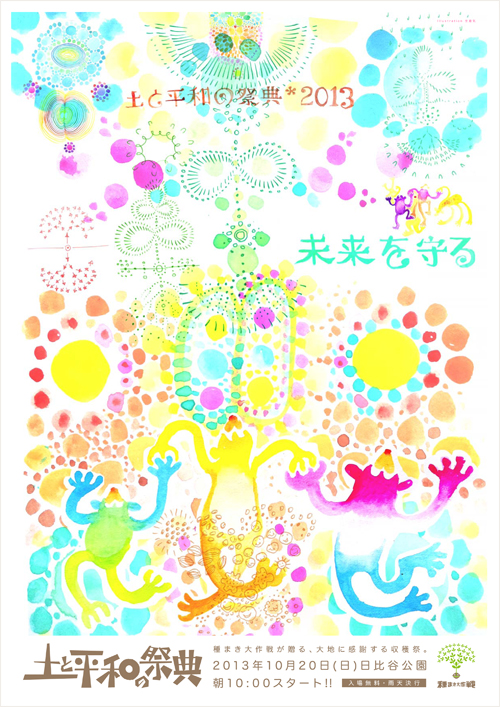
World Food Sovereignty Day • Soil and Peace Festival @Hibiya Park, Tokyo - Oct. 20, 2013


soil and peace festival 2013

Today is the international family farmer movement Via Campesina's World Food Sovereignty Day; and this weekend, Japanese organic family farmers and their supporters will join in a celebration of the best of visionary Japanese (organic, recycling, nuclear-free, GMO-free, fair-trade, Slow Life, satoyama, Tohoku-supporting) culture.

Via the Consumers Union of Japan:
There will be a Soil and Peace Festival in Hibiya Park, Tokyo, on Sunday October 20, 2013. Starting at 10:00 hundreds of farmers and activists and artists will hold a great event until the evening.

A great opportunity to meet your favourite NGOs and learn more about organic food, anti-nuclear campaigns and the future of Japan. Look forward to lots of inspiration! Music by Kato Tokiko and many others throughout the day, starting with a taiko performance by Gocco.

Website with more info (J) here.

Monday, October 14, 2013

40,000 rally in Tokyo for a nuclear-free and war-free Japan (and World); Global Article 9 gathering in Osaka

(Via Jacinta Hin and Beautiful Energy)

Good Morning world! Today is NO NUKES DAY in Tokyo, the day of the big demonstration. Many people from all over Japan coming together in protest to ask for a nuclear-free Japan.

If you're in Tokyo, JOIN, be seen, be heard, make a difference!

If you cannot join in person, be with all of us in spirit and heart.

To get you in the mood, we have the perfect song for you. Talented musician Natsu of our Beautiful Energy core group, has created a NO NUKES version of a famous pop song. Listen to her beautiful voice and soulful NO NUKES, BABY and be connected with us today!
At the end of September, nuclear-free supporters held two rallies after TEPCO asked for permission to restart TEPCO on Friday asked Japan's nuclear watchdog for permission to restart its Kashiwazaki-Kariwa nuclear power plant in Niigata Prefecture.

Since September 15, all of Japan's nuclear plants have been in shut-down for maintenance.
---

Also over the weekend, the Global Article Nine Campaign held 
its second international conference  supporting a (nuclear-free) world without war:  

Saturday, October 12, 2013

Is it safe for any of Fukushima's 160,000 nuclear refugees to return to home?


A Tamura resident used to harvest organic fruit from her orchard. 
Her house was decontaminated; her orchard was not. 
Authorities say it is ‘out of category’ – it does not fit  the categories  in the decontamination plan.
(Greenpeace: Fukushima's Returning Residents 2013)

Is it possible to decontaminate irradiated areas around the (still unstable) Fukushima Daiichi nuclear plant and make them safely inhabitable again? 

In March 2011, a series of hydrogen explosions amid nuclear meltdowns (not acknowledged by the Japanese government until June 2011) at the Fukushima Daiichi Nuclear Plant resulted in sudden evacuations of residents who lived  in communities around the plant.  

The first evacuation zones were simply concentrically drawn around the plant complex.  

March 11, March 12, and March 15, 2011 revised evacuation zones. (Image: Nature.com)

However when it was realized that radiation was not dispersing concentrically around the plant, but deviated because of winds, and gathering in hot spots (as far south as metropolitan Tokyo), the evacuation map was redrawn.  Iitate, a farming village 40 km northwest of the nuclear plant, showed  higher much higher radiation readings than some places adjacent to the plant.  The hot spots were created where snow, rain, and dust delivered radiation to the ground. 

Revised evacuation zone on April 11th, 2011. (Image: Wikipedia)

The evacuation zone, altered several times since 3/11, now includes eleven towns and extends up to 45 km (northwest) from the nuclear meltdowns. It is divided into three categories: a "no-return zone" (above 50 mSv of radiation dose per year); "no-residence zone" (above 20 mSv of radiation dose per year); and "zones being prepared for lift of evacuation order."

In the "no-residence zone," residents will be allowed to  enter the areas and return to their homes on a temporary basis, but they cannot stay overnight.  In "zones being prepared for lift of evacuation order," residents will be allowed to visit and to reopen stores or engage in farming.

In April 2012, the towns of Tamura, Kawauchi, and Minamisoma were reclassified. Tamura (10 miles west of the nuclear plant) was redesignated as being prepared for lift of evacuation order.  Kawauchi (15 miles west) was redesignated as two areas: a "No-residence zone" and a zone being prepared for lift of evacuation order.   And Minamisoma (16 miles north) was reclassified into three zones.

In July 2012, Iitate was also reclassified into three zones. Decontamination work was scheduled for houses, but not farmland.  Not surprisingly, since most of the former inhabitants were farmers,  Iitate remained a "ghost town" by December  2012.  Only a nursing home housed permanent residents (who had opted out of the April 2011 mass evacuation).

Despite the lifting of the evacuation order, running water, electricity, sewage systems and other infrastructure were not restored and hospitals and schools remain closed.  Proprietors of small businesses dependent on ruined local economies had lost their livelihoods. Except for decontamination projects, there is little employment available.  

In December 2012, Minamisoma  remained partly deserted.  Of the 70,000 residents (outside the exclusion zone) who voluntarily evacuated; one third have not returned.  Many in Minamisoma who did not voluntarily evacuate told filmmaker Ian Thomas Ash (In the Grey Zone, A2-B-C) that they could not afford to leave without economic assistance.

 In July 2013, authorities announced the preparation of resumption of utilities in Tamura, to ready for the return of residents. 

Greenpeace has questioned the feasibility of safe return, citing radiation monitoring that reveals inconsistent decontamination in Tamura: 
A recent Greenpeace survey found that decontamination programs have been effective for houses and many parts of major routes in the city.

But some lesser-used public roads, large areas of farmland and mountain areas still have high contamination levels, said Jan Vande Putte, Greenpeace radiation protection adviser.

He said the cleaned houses and roads were like “islands” and “corridors” in an otherwise polluted region.

It would be “unrealistic” to ask residents to stay off contaminated roads and farmland, he said.

“They can be exposed to high levels of radiation” if they returned home, he said...

“It requires enormous dedication to reduce radiation levels on roads, on houses and farmland,” he said.

But Vande Putte added that radiation levels around houses have been “significantly lowered” after decontamination work.

Residents should be given adequate information before deciding whether to return to their homes, he said, and government financial assistance should continue regardless of their decision on going back.

Contaminated soil in temporary storage (plastic bags) in Tamura; long-term storage hasn’t been worked out. 
17,800 tons of contaminated soil and leaves remain in plastic bags piled along streets and in fields.

Authorities also plan to reopen Katsurao, Namie, Kawamata, Tomioka, and the no-go parts of Iiate,  although the evacuation order will continue through 2016 and 2017.  Most of the 83,000 nuclear refugees from these highly irradiated towns within the 20-km exclusion zone now doubt they will ever be able or want to return.

David McNeill and Miguel Quintana explore issues related to the ambitious decontamination and repopulation plan  in "Mission Impossible. What Future Fukushima?"  (ミッション・インポッシブル 福島に未来は ) published at The Asia-Pacific Journal.

At the top of concerns: uncertainty; contradictory monitoring reports; conflicts regarding what constitutes "safe" radiation limits; and how to deal with massive collections of irradiated soil and debris:
Nobody knows for certain how dangerous the radiation is.

Radiation levels in most areas of Fukushima have dropped by around 40 percent since the disaster began, according to central government estimates, but those figures are widely disbelieved. Official monitoring posts almost invariably give lower readings than hand-held Geiger counters, the result of a deliberate strategy of misinformation, say critics.

The disagreement over real radiation levels is far from academic. Local municipalities are desperate for evacuees to return and must decide on what basis, in terms of exposure to radiation, evacuation orders will be lifted. If they unilaterally declare their areas safe, evacuees could be forced to choose between returning home and losing vital monthly compensation from Tokyo Electric Power Co. (Tepco), operator of the ruined Daiichi complex.

For the refugees, a worrying precedent has already been set in the municipality of Date, which lies outside the most contaminated areas. In December 2012, the local government lifted a “special evacuation” order imposed on 129 households because of a hotspot, arguing that radiation doses had fallen below 20 millisieverts per year (20 mSv/yr). Three months later the residents lost the $1000 a month they were receiving from Tepco for “psychological stress.”

...The Fukushima cleanup, however, faces another, perhaps insurmountable challenge: securing sites to store contaminated soil, leaves and sludge. Many landowners balk at hosting “interim” dumps – in principle for three years – until the central government builds a mid-term storage facility. Local governments throughout Japan have refused to accept the toxic waste, meaning it will probably stay in Fukushima for good. The waste is stored under blue tarpaulins across much of the prefecture, sometimes close to schools and homes.

This irradiated soil and leaf storage site is in Naraha. 

Thursday, October 10, 2013

Alone in the Zone: Naoto Matsumura, caretaker of hundreds of animals in evacuated Tomioka, Fukushima


Alone in the Zone (原発20キロ圏内に生きる男)
via filmmakers Jeffrey Jousan and Ivan Kovac for VICE Japan 


Naoto Matsumura and his elder parents lived on a rice farm in Tomioka, a coastal town in Fukushima prefecture, known for having one of the longest cherry blossom tunnels in Japan.

After hearing the hydrogen explosions at the Fukushima Daiichi nuclear plant, eight miles away from their home, the Matsumuras  attempted to evacuate. However, they were turned away from a relative in Iwaki, a coastal town in southern Fukushima prefecture.  She feared they had been radioactively contaminated.  Afterwards, they were turned away from a shelter because it was full.

So they returned to their home, where his parents stayed until his mother became ill in April 2011. She then moved  to her daughter's home in Shizuoka where there was no room for the Matsumura's animals.  Therefore, Naoto Matsumura decided to stay—to take care of them.

He told filmmakers Jeffrey Jousan and Ivan Kovac that he gradually took on the task of caring for cattle, pigs, cats, dogs, and an ostrich (the sole survivor of a flock of 30 birds) throughout Tomioka, all left behind by owners who were initially told the evacuation would be temporary and short-term: 
Our dogs didn’t get fed for the first few days. When I did eventually feed them, the neighbors’ dogs started going crazy. I went over to check on them and found that they were all still tied up.

Everyone in town left thinking they would be back home in a week or so, I guess. From then on, I fed all the cats and dogs every day. They couldn’t stand the wait, so they’d all gather around barking up a storm as soon as they heard my truck. Everywhere I went there was always barking. Like, ‘we’re thirsty’ or, ‘we don’t have any food.’ So I just kept making the rounds.
Over a thousand cattle and hundreds of thousands of caged chickens died from starvation in Tomioka. Then on May 12, 2011, the Kan administration ordered the euthanasia of surviving cattle. But a bright spot for animal survivors was that Japanese authorities have allowed Matsumura to remain to care for animals since the return of the town's other 15,000 residents is unlikely.

(Left) A dog that survived trapped inside a cattle barn for a year and a half after 3/11 by eating the dead flesh of the starved cattle was rescued by Matsumura in the summer of 2012.  Naoto named the dog Kiseki (“Miracle”) because his hair eventually grew back. (Right) Kiseki, approximately two months after being rescued.
(Photo: Jeffrey Jousan and Ivan Kovac, VICE Japan )


Matsumura now spends six to seven hours a day feeding animals with supplies donated by support groups, before going to bed at around 7 p.m. He uses a solar panel to power his computer and cell phone and a kerosene heater and charcoal heated kosatsu (quilt-covered table) to keep warm during cold months. 

In the film, he describes Tomioka's idyllic past: 
Tomioka may be a small town, but it’s rich in nature. You’ve got the rivers, the ocean, and the mountains nearby. You can swim in the ocean, fish in the rivers, and go pick wild vegetables in the mountains. Except now we can't do any of that.
Filmmakers Jeffrey Jousan and Ivan Kovac share their motivation for making this film:
This is more than just the story of one man standing up to the government. Naoto Matsumura makes up the best inside each of us. We send him our emotional support and want the world to remember the sacrifice he is making for the animals and for his beliefs. In an age of social media, one man's story can easily be lost.

It is our goal that this doesn't happen to Naoto Matsumura. We hope you will feel the same way and join us to in showing our appreciation to this unique and courageous man. Naoto-San deserves much more than his 15 minutes of fame.
---
Background on Naoto Matsumura

警戒区域に生きる ~松村直登の闘い~ (Living in the Evacuation Zone ~ Naoto Matsumura's Struggle ~)  (Website of Naoto Matsumura's NPO)

Naoto Matsumura, Guardian of Fukushima's Animals  (Facebook page dedicated to Naoto Matsumura)

"The Most Radioactive Man on Earth Has the Kindest Heart (Julia Whitty, Mother Jones, March 12, 2013)


"Living Alone in the Fukushima Evacuation Zone"  (Tomo Kosuga, Vice, March, 2012) 


"Naoto Matsumura, Japanese Rice Farmer, Refuses To Leave Fukushima Nuclear Zone: (Eric Talmadge, AP via HuffPost, Aug. 31, 2011) 
---

Updates on Animals in Fukushima:

Animal Friends Niigata on FB

More Background on Animals in the Fukushima Exclusion Zone:

"Keigo Sakamoto cares for 500 animals inside the Fukushima Exclusion Zone" (TTT post, Oct. 8, 2013) 

"PROMETHEUS TRAP/ The disaster and animals: Woman repeatedly rescued pets in the Fukushima off-limits zone" (Article 8 of an investigative series by Misuzu Tsukue, Asahi, May 8, 2013)

"The Lost Pets of Fukushima: Photos" (Discovery.com, Dec. 12, 2012)


---

Towns evacuated around Fukushima on April 11th, 2011. (Image: Wikipedia)

Tuesday, October 8, 2013

Keigo Sakamoto cares for 500 animals inside the Fukushima Exclusion Zone

In September 2013, Keigo Sakamoto,  holds his dog, Atom. A farmer in Naraha, a town of previously 8,000 in Futaba district, Sakomoto refused to leave his home inside the exclusion zone.  He remained to care for  500 animals that owners were forced to leave behind when ordered to evacuate their homes and farms.  

On March 11, 2011, the Japanese government began what was believed to be a temporary evacuation of residents who lived in the area surrounding the Fukushima Daiichi nuclear complex.  On March 12, and again, on March 15, the evacuation was expanded in size after several hydrogen explosions at the plant's reactors.  The evacuation zone, altered several times since 3/12, now includes eleven towns and extends up to 45 km from the nuclear meltdowns.

Hundreds of thousands of these evacuees were forced to leave behind many thousands of animals.

Initially the severity of the nuclear disaster was downplayed, leading residents to believe that their evacuation would be short-term and temporary. Thinking they could come back and get them soon afterwards, many evacuees left pets and farm animals with enough food and water for a few days.

Others did not want to leave beloved pets behind, even for a few days, and tried to bring their pets with them, but temporary shelters in Fukushima prefecture did not provide for pets until a "Pet Village" was open three months later,  in June, 2011. Faced without any other options, many refugees kept their pets inside their cars parked outside of temporary shelters; some even chose to stay inside their cars with their pets. (Niigata Prefecture, which accepted 10,000 nuclear refugees, had established a system to care for pets from the start.)

Animals left behind included dogs tied in backyards, cats in locked homes, and farm animals confined in barns and pens, without the opportunity to escape to forage for food and water.

Animal welfare groups scrambling  to feed and save animals throughout Tohoku's earthquake and tsunami-hit area also tended to and rescued animals within the overlapping nuclear exclusion zone for the first few weeks of the evacuation. However, their animal rescues were impeded when Tokyo enacted a strict “Do Not Enter” policy on April 22, 2011.

Animal Friends Niigata, HEART Tokushima, the Japan Cat Network (based in Shiga Prefecture, near Kyoto), and Animal Rescue Kansai (ArkBark) were some of the animal welfare groups that joined to form Japan Earthquake Animal Rescue and Support (JEARS) to support shelters caring for animals  affected by both the natural and nuclear disasters.(JEARS suspended its Facebook page in February of this year, directing animal supporters to member groups that are still actively caring for Fukushima rescue animals.)

Yoko Mieko, who lost four of her twelve cats during the disaster started a campaign for the rescue and care of animals left behind.  She regularly went into the exclusion zone to feed and rescue animals. On June 30, 2011, the cram school teacher issued a video plea, "Cry from Fukushima: Help animals around the nuclear plant" on YouTube.

Some individuals and animal welfare groups sneaked into the zone to attempt to feed and save animals. 1,500 dogs and cats were rescued the first six months.

Nine months later, when the severity of the nuclear meltdowns became undeniable, and  the public realized that the temporary evacuation order would not be lifted  as they were initially led to believe, the Japanese government gave into pleas from rescue groups asking that they be allowed to save any surviving animals from freezing to death during the winter. 16 humane groups were permitted to enter the zone from Dec. 7 to Dec. 27, 2011 where they were able to rescue some animals among the thousands they found starving, ill, and dead.

The United Kennel Club Japan (UKC Japan), was one of the groups that helped in this highly publicized rescue of hundreds of animals. UKC Japan is now caring for many of these animals at its shelter in Tokyo.

After some disturbing film footage of the rescue was aired on television, the Japanese government decided to refuse animal rescuers further entry into the zone, going so far as arresting Hiroshi and Leo Hoshi on Jan. 28, 2012, for not heeding the no-entry order.  The Hoshi family, at their own expense, had rescued over 200 animals.  The Hachiko Animal Federation is sponsoring a petition asking for their release, with the plea to Chief Prosecutor Toru Sakai, that such a release on humanitarian grounds would be just in that there was no criminal intent; the Hoshis were simply unable to witness suffering animals and do nothing.

The compassionate and heroic work of Keigo Sakamoto (and that of others who also stayed to care for animals left behind; residents who regularly visit their former homes to care for animals; Japanese and international animal welfare groups; and countless individuals in Japan and around the world supporting the humane treatment of natural and nuclear disaster animal victims) are some of the jagged silver lining stories of post-3/11 Japan.

On June 8, 2011, Keigo Sakamoto holds two of his dogs in the front yard of his house. Sakamoto lost his livelihood as an egg farmer, but was allowed to remain in the exclusion zone to care for animals.  

---
Updates:

Animal Friends Niigata on FB

Some Background: 

"Alone in the Zone: Naoto Matsumura, caretaker of hundreds of animals in evacuated Tomioka, Fukushima" (TTT, Oct. 10, 2013)

"PROMETHEUS TRAP/ The disaster and animals: Woman repeatedly rescued pets in the Fukushima off-limits zone" (Article 8 of an investigative series by Misuzu Tsukue, Asahi, May 8, 2013)

"PROMETHEUS TRAP/ The disaster and animals: Pets forgotten in the mass evacuation" (Article 3 of an investigative series by Misuzu Tsukue, Asahi, April 26, 2013)

"The Lost Pets of Fukushima: Photos" (Discovery.com, Dec. 12, 2012)

"Yasusuke Ota: The Abandoned Animals of Fukushima"
(Aesthetica Magazine, Oct. 3, 2012)

"Fukushima's rebel farmers refuse to abandon livestock: Small band of renegades make regular trips to nuclear evacuation zone to feed cattle, in defiance of government orders" (Justin McCurry, The Guardian, Feb. 28, 2012)

"Fukushima pets in no-go zone face harsh winter" (photo slide show of animal rescue, featuring United Kennel Club Japan (UKC Japan) ) (Reuters, Jan. 31, 2012)

"Fukushima's animals abandoned and left to die" (Kyung Lah, CNN, Jan. 26, 2012)

"Activist Hiroshi Hoshi defies fallout to pluck animals from Fukushima dead zone" (Rick Wallace, The Australian, June 27, 2011)

"Thousands of Animals Left to Die Around Fukushima" (Discovery.com, June 9, 2011)

"Welfare groups race to rescue Japan's abandoned animals" (Mark Tutton, CNN, March 17, 2011)

---


Towns evacuated around Fukushima on April 11th, 2011. (Image: Wikipedia)
-JD

Tuesday, July 31, 2012

Mayors for a Nuclear Power Free Japan Urge Noda Government to open a Real Public Debate


Press Conference: 31 July, 2012 (Tuesday) 14:30 – 15:15

Place: Diet Members' No. 2 Office Building of the Lower House, No. 2 Conference Room

Speakers - Mayors for a Nuclear Power Free Japan:

Murakami Tatsuya (Mayor of Tokai Village, Co-Initiator)
Sakurai Katsunobu (Mayor of Minamisoma City, Co-Initiator)
Uehara Hiroko (Former Mayor of Kunitachi City, Secretary General)

International Speakers:

Seo Hyeong-won (Councilor, Gwacheon City Council, Member of Steering Committee of Green Party Korea)
Baerbel Hoehn (Vice Chair, Alliance '90/Greens Parliamentary group)

Statements of Support:

Mayors for Alternative Energy and Nuclear Free World, Korea
Ms Ulli Sima, Executive City Councillor for Environment of Vienna

Language: Press Conference will be held in Japanese, with English interpretation available.

About Mayors for a Nuclear Power Free Japan

The “Mayors for a Nuclear Power Free Japan” network was officially launched in Tokyo on April 28, 2012. This network was initiated by mayors and local municipal leaders attending the Global Conference for a Nuclear Power Free World held in Yokohama in January 2012. As at July 2012, 77 mayors from 36 prefectures (of a total of 47) throughout Japan have declared their participation in this network.

For more information including members, past resolutions and statements, visit their site:

“Mayors for a Nuclear Power Free Japan” Office: Nohira, Ochi
Tel: 03-6851-9791 Fax: 03-3363-7562
Mobile: 090-6015-6820 Email: mayors@npfree.jp
http://mayors.npfree.jp/

Sunday, July 29, 2012

7.29: Nuclear-Free activists completely surround the Diet Buiilding in Tokyo; turn police barricades into "ribbon of light"


(Photo: Asahi)


(Photo: Ajisai)

(Photo: Yoshiteru Hayashi)


(Filmmaker John Junkerman: It was wonderful to see it,
how they turned the police barrier into a ribbon of light.
Photo: Shin Inoue)

★7.29 Human Chain Action Against The Diet Building For A Nuclear Free World


Via Metropolitan Coalition Against Nukes (anti-nuclear coalition organized by residents in the Tokyo metropolitan area):

Human Chain Action
Date: July 29, 2012 (Sun)
16:30 Departure: 15:30 Demo: Start Rally
19:00: Surrounding the National Assembly (Candlelight rally)
Meeting place: Hibiya Park Nakasaiwai gate

Saturday, July 28, 2012

The Green Party 「緑の党」will be officially established today, July 28 2012, in Tokyo!


Via Greens Japan:
The Green Party 「緑の党」will be officially established this Saturday, July 28th in Tokyo.

Then on Sunday, July 29th, there will be a Kick-Off Event with various speakers.

【7/28(土)「緑の党」結成総会】
 11:00~18:00(開場10:30) 
 会場:YMCAアジア青少年センター http://ymcajapan.org/ayc/hotel/jp/
 東京都千代田区猿楽町2-5-5 TEL 03-3233-0611 (JR水道橋駅徒歩5分)

【7/29(日)キックオフ!イベント 希望の未来をつかもう!】
 13:30~16:30(開場13:00)
 会場:星陵会館 東京都千代田区永田町2-16-2 TEL 03-3581-5650
 (東京メトロ有楽町・半蔵門線・南北線「永田町駅」6番出口 徒歩3分
  /東京メトロ千代田線「国会議事堂前駅」5番出口 徒歩5分)

For more information: Greens Japan

Sunday, July 1, 2012

Streaming Videos of "No Restart" Protest Rally at the Oi Nuclear Plant

Head's up from Kimberly Hughes on the streaming video IWJ_OITA1 and Koichi Hanafusa on the Oyasumi Irene. (Another link, Iwakumiyasumi, via Martin Frid at Kurushii)

Demonstrators at the Oi Nuclear Plant restart protest are chanting "Saikado Hantai!" ("Against the Re-start!") like a mantra, prayer; beating instruments...


(Poster for 7.1.12 Oi Nuclear Plant Restart Protest.


(Demonstrators at Oi Nuclear Plant. Photo: Ryusaku Tanaka Journal)

Wednesday, June 27, 2012

Two Japanese seismologists warn Tokyo against nuclear restart at Ohi Plant in Fukui

Via Reuters, "Seismologists warn Japan against nuclear restart":

Seismic modeling by Japan's nuclear regulator did not properly take into account active fault lines near the Ohi plant, Katsuhiko Ishibashi, a seismologist at Kobe University, told reporters.

"The stress tests and new safety guidelines for restarting nuclear power plants both allow for accidents at plants to occur," Ishibashi told reporters. "Instead of making standards more strict, they both represent a severe setback in safety standards."

Experts advising Japan's nuclear industry had underestimated the seismic threat, Mitsuhisa Watanabe, a tectonic geomorphology professor at Tokyo University, said at the same news conference.

"The expertise and neutrality of experts advising Japan's Nuclear Industrial Safety Agency are highly questionable," Watanabe said.

After an earthquake in 2007 caused radiation leaks at reactors north of Tokyo, Ishibashi said Japan was at risk of a nuclear disaster following a large earthquake, a warning that proved prescient after Fukushima.

While it is impossible to predict when earthquakes will happen, Ishibashi said on Tuesday the magnitude 9 quake last year made it more likely "devastating" earthquakes would follow.

Sunday, June 24, 2012

HYDRANGEA REVOLUTION: 6.22.12 - 首相官邸前 原発再稼働反対デモ - 40,000 PEOPLE IN TOKYO RAGE AGAINST THE NUKES


40-45,000 Japanese citizens rallied at the PM's house Friday evening to protest the restart of nuclear plants. Partipants chanted "Saikado Hantai!" ("Against the Re-start!").

Ongoing protests challenging Tokyo's inaction in Fukushima and the restart of the Oi nuclear reactors are taking place throughout Japan.

Plans for a 100,000-person march next Friday are in the making. Japanese are calling their movement for a nuclear-free Japan the "Hydrangea Revolution."

(Video: senseofwonder888 on YouTube)

Saturday, June 16, 2012

Uncanny Terrain: Rio+20: Four Fukushima Farmers 福島:その土地に残る意味


This video, capturing the diverse views of four Fukushima activist farmers, screens beginning June 16 in the Rio+20 United Nations Sustainable Development Conference, where one of the main subjects of the documentary Uncanny Terrain, Seiji Sugeno, director of the Fukushima Organic Farmers Network, is presenting.

Thursday, January 26, 2012

The Tsunami and the Cherry Blossom


The Tsunami and the Cherry Blossom:
Survivors in the areas hardest hit by Japan's recent tsunami find the courage to revive and rebuild as cherry blossom season begins.

A stunning visual poem about the ephemeral nature of life and the healing power of Japan's most beloved flower.

Directed by Academy Award Nominated filmmaker Lucy Walker (Waste Land), featuring photography by Aaron Phillips and music by Moby.