Chubu Electric Power Co. plans to stop all reactors at its Hamaoka nuclear plant in central Japan following Prime Minister Naoto Kan's request to do so for security reasons, company sources said Friday.Read the entire article here.
The decision was learned of shortly after Kan said at a hastily arranged news conference in the evening that all operations at the plant in Shizuoka Prefecture must be suspended due to concerns that a powerful earthquake could trigger yet another serious nuclear crisis.
"It's a decision made after thinking about people's safety," Kan said in announcing the request, referring to the science ministry's prediction of an 87 percent chance of a magnitude-8.0 quake hitting the Tokai region within the next 30 years.
Showing posts with label Hamaoka. Show all posts
Showing posts with label Hamaoka. Show all posts
Friday, May 6, 2011
Following massive citizen action throughout Japan, Chubu Electric announces Hamaoka nuclear plant shutdown
After widespread citizen protests throughout Japan, Chubu Electric Power Co. plans to stop all reactors at its Hamaoka nuclear plant in central Japan according to The Mainichi Daily News:
Wednesday, April 27, 2011
Hirose Takashi: More earthquakes ahead bodes ill for Rokkasho & Hamaoko nuclear plants - both sit on fault lines

April 25, 2011Read Dr. Hirose's entire article here at Counterpunch.
On the Danger of a Killer Earthquake in the Japanese Archipelago: The Nuclear Disaster That Could Destroy Japan ... and the World
By HIROSE TAKASHI
Translated by Doug Lummis
The nuclear power plants in Japan are ageing rapidly; like cyborgs, they are barely kept in operation by a continuous replacement of parts. And now that Japan has entered a period of earthquake activity and a major accident could happen at any time, the people live in constant state of anxiety...
Seismologists and geologists agree that, after some fifty years of seismic inactivity, with the 1995 Hanshin-Awaji Earthquake (Southern Hyogo Prefecture Earthquake), the country has entered a period of seismic activity. In 2004, the Chuetsu Earthquake hit Niigata Prefecture, doing damage to the village of Yamakoshi. Three years later, in 2007, the Chuetsu Offshore Earthquake severely damaged the nuclear reactors at Kashiwazaki-Kariwa. In 2008, there was an earthquake in Iwate and Miyagi Prefectures, causing a whole mountain to disappear completely. Then in 2009 the Hamaoka nuclear plant was put in a state of emergency by the Suruga Bay Earthquake. And now, in 2011, we have the 3/11 earthquake offshore from the northeast coast. But the period of seismic activity is expected to continue for decades. From the perspective of seismology, a space of 10 or 15 years is but a moment in time.
Because the Pacific Plate, the largest of the plates that envelop the earth, is in motion, I had predicted that there would be major earthquakes all over the world.
And as I had feared, after the Suruga Bay Earthquake of August 2009 came as a triple shock, it was followed in September and October by earthquakes off Samoa, Sumatra, and Vanuatu, of magnitudes between 7.6 and 8.2. That means three to eleven times the force of the Southern Hyogo Prefecture Earthquake.
All of these quakes occurred around the Pacific Plate as the center, and each was located at the boundary of either that plate or a plate under its influence. Then in the following year, 2010, in January there came the Haiti Earthquake, at the boundary of the Caribbean Plate, pushed by the Pacific and Coco Plates, then in February the huge 8.8 magnitude earthquake offshore from Chile. I was praying that this world scale series of earthquakes would come to an end, but the movement of the Pacific Plate shows no sign of stopping, and led in 2011 to the 3/11 Earthquake in northeastern Japan and the subsequent meltdown at the Fukushima
There are large seismic faults, capable of producing earthquakes at the 7 or 8 magnitude level, near each of Japan’s nuclear plants, including the reprocessing plant at Rokkasho. It is hard to believe that there is any nuclear plant that would not be damaged by a magnitude 8 earthquake...
The Rokkasho Reprocessing Plant is where expended nuclear fuel from all of Japan’s nuclear power plants is collected, and then reprocessed so as to separate out the plutonium, the uranium, and the remaining highly radioactive liquid waste. In short, it is the most dangerous factory in the world....
On April 7, just one month after the 3/11 earthquake in northeastern Japan, there was a large aftershock. At the Rokkasho Reprocessing Plant the electricity was shut off. The pool containing nuclear fuel and the radioactive liquid waste were (barely) cooled down by the emergency generators, meaning that Japan was brought to the brink of destruction. But the Japanese media, as usual, paid this almost no notice.
The Hamaoka Nuclear Plant is located at Shizuoka City, on Suruga Bay. Despite predictions of a magnitude 8 earthquake on Suruga Bay, it has continued in operation. If you look at the illustration showing the configuration of the plates beneath the Pacific Ocean, you will see that there is a point at which the Philippine Sea Plate, the huge Pacific Plate, the North American Plate, and the Eurasian Plate all meet; directly over that point is the Japanese Archipelago. And the very center of the area where these four plates press together is Shizuoka...
Large scale earthquakes in the eastern and southern seas have occurred regularly at intervals of between 100 and 250 years. Today in 2011, 157 years have passed since the Great Ansei Earthquake of 1854, so we are in a period when the next big one could come at any time. And the predicted center of this expected major earthquake is – though this is hard to believe – exactly under the location of the Hamaoka Nuclear Plant. And sonar readings at the site indicate that from thirty years back the Eurasian plate has been bending, which means that it is in a condition where it can be expected eventually to spring back.
Hirose Takashi has written a whole shelf full of books, mostly on the nuclear power industry and the military-industrial complex. Probably his best known book is Nuclear Power Plants for Tokyo in which he took the logic of the nuke promoters to its logical conclusion: if you are so sure that they're safe, why not build them in the center of the city, instead of hundreds of miles away where you lose half the electricity in the wires?
Douglas Lummis is a political scientist living in Okinawa and the author of Radical Democracy. Lummis can be reached at ideaspeddler@gmail.com
Saturday, April 16, 2011
Over three thousand march in Osaka on April 16th- No more Nuclear!
"We don't need nuclear power, nuclear weapons either"
Anti-nuclear chants rang through the streets of Osaka, as over 3000 demonstrators filled the streets in solidarity against the continued use of nuclear power by Japan in the face of the unfolding nuclear disaster in Fukushima. Inspired by the 17,500 people-strong demonstration in Tokyo on April 10th, people young and old, walking on two feet or in wheel chairs, school teachers, business people, politicians, and celebrities gathered their creative energy together to raise their voices on behalf of those that can not. Some demonstrators, fearful of losing their jobs for participating in the demonstration, covered themselves with masks and hats so as not to be identified by their respective companies as they marched in the three-hour demonstration.No more nuclear power,
Protect our children,
Protect the women,
Protect the men,
Protect Japan,
Protect the world,
Give us back Fukushima,
Give us back our land,
We want to drink milk,
We want to eat rice,
We want to eat vegetables,
We want to see tomorrow,
We want to be alive tomorrow,
We want to be alive the day after tomorrow,
No more nuclear
Let's put an end to nuclear power together!
(Chant sung at Osaka April 16th Demonstration)
 This young man led protesters in the group I walked with.
The demonstration was commenced with speeches from anti-nuclear movement leaders from the following 8 organizations:
- Stop the Monju
- No Nukes Asia Forum- Japan
- Mihama Anti-nuclear Group of Osaka (Mihama is home to one of ten nuclear reactors in Fukui prefecture)
- Green Action
- Aid for Chernobyl Survivors- Kansai
- Wakasa Action Network (Wakasa Bay is the location of a nuclear plant in Fukui)
- Know Nuclear Power Network of Shiga
- Anti-nuclear power network of Nara
A Taiwanese man described how the nuclear crisis in Japan is providing momentum for the anti-nuclear movement in Taiwan, where there stands a nuclear plant constructed by Toshiba. An Anti-nuclear Power Network of Nara member shared her frustration with the city of Nara. Her attempts to convince politicians to create a plan to move away from nuclear power fell on deaf ears.
Some estimate 50% of energy in Kansai originates from nuclear reactors. We have yet to see if Japan, the third largest producer of nuclear energy in the world, will reverse it's goal to derive 50% of its domestic energy production from nuclear plants.
While politicians, including Tokyo governor Shintaro Ishihara, continue to make statements in favor of the use of nuclear power in Japan, others, such as newly elected Kanagawa governor Yuji Kuroiwa, are promoting a shift to renewable energy. Drawing upon the experience of Kamakura, where the Great Buddha 800 meters from the shore was swept away by a tsunami 1100 years ago, Kuroiwa is criticizing leaders who propose that building higher walls along the shores will protect Japan from tsunamis, and instead is proposing an end to nuclear power and investment in the solar banks.
For some people, including popular comedians who wish to remain unidentified, it was their first time to participate in any public demonstration. A 32-year old school teacher, hidden behind a mask, explained his reasons for joining the demonstration. "I wanted to show my solidarity with the people who want to see a future with no nuclear power. Nuclear power has the potential to destroy the world, it can kill the earth. We should invest money in alternative energy creation. I will not stop raising my voice." It is time to listen to the voices of the people and end Japan's dependence on nuclear power.
 Over 3000 people march in Osaka
Show your support by adding your name to the petition to close down the Hamaoka Nuclear Power plant.
- Jennifer Teeter
Monday, April 11, 2011
17,500 gather in Tokyo on Sunday in lively events to demand clean energy, urge halt to Hamaoka nuclear power plant!

Residents from Tokyo and nearby prefectures poured into the streets on Sunday for the April 10th 'Stop Nuclear Power Plants! Global Action Day', issuing impassioned calls for the Japanese government to stop its reliance on nuclear power.
Two separate events were held in Tokyo on Sunday, with organizers estimating a total of 17,500 people in attendance—more than twice the numbers who attended a No Nukes Festa in 2009. While NHK reported that only 2000 attended, some organizers estimated the total figure at something closer to 20,000.
The first event was held in Tokyo’s Shiba Park, where 2,500 people showed up to call on government and electric power company officials to immediately stop the Hamaoka nuclear power reactors. The plant sits atop the junction of two tectonic plates in the prefecture of Shizuoka, where—in addition to presently ongoing aftershocks from last month's quake—a large earthquake is said to be overdue. A petition to stop the plant is now circulating widely throughout Japan, and supporters from overseas are urged to add their voices. More information about the plant, as well as the petition itself—which will be submitted to the Japanese government, electric power companies, local authorities in Japan and related companies—may be found here at the Stop! Hamaoka Nuclear power plant website.
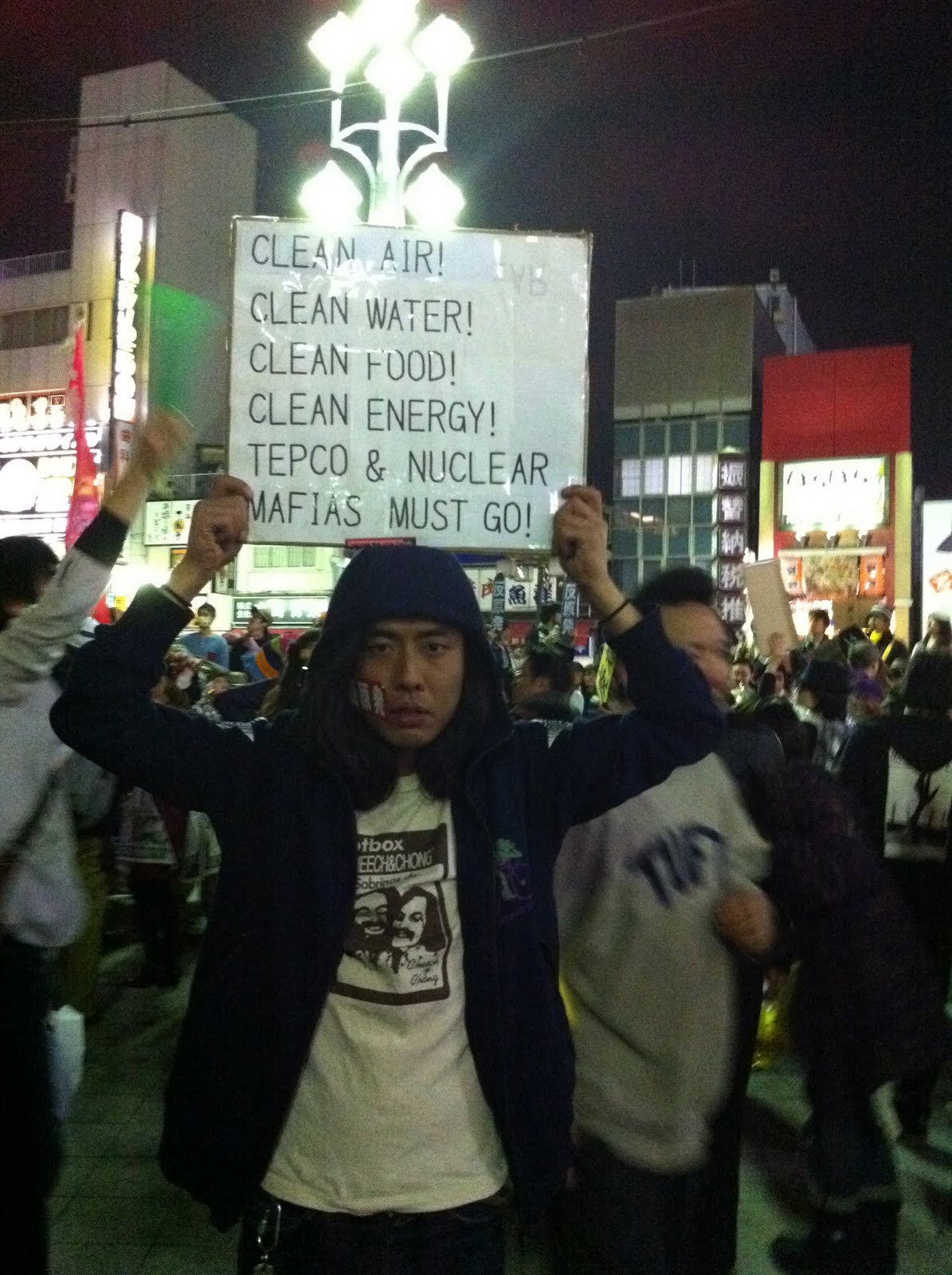
Meanwhile, some 15,000 attendees—mostly young people in their 20's and 30's who learned about the event online—added fresh energy to Japan’s often traditionally somber demonstrations at a colorful parade and live music gathering in the artsy neighborhood of Koenji in western Tokyo. Parade-goers carried signs with all manner of creative self-expression regarding the tragedy, and many dressed in costumes or decorated their face masks with designs and slogans as the event pulsated with energy and emotion from the early afternoon on into the night.
 Banner reading “We Prioritize Life Over Electricity”, lovingly handcrafted by Crystal Uchino, author of “Rise Like Tsunamis After the Earthquakes”
 The group I marched with chanted slogans that included the following:
Give us back our land30 year-old Japanese-Brazilian Sheila Yamamoto de Souza, a Tokyo resident who took part in the parade, said, “When I heard others starting to chant ‘Give us back our lives,' it really hit me hard. Even in Tokyo, our daily lives have been completely changed as we deal with fears of radiation, and I fear things will never go back to the way they were before. And we have it easy compared to others. I can’t even begin to imagine how the people who have been affected by the earthquake and tsunami in Tohoku, as well as those living near the nuclear plant in Fukushima, must be feeling right now.”
Give us back our work
Give us back our lives
Give us back Fukushima
Radiation is dangerous
How can this possibly be “ecological”?
We don’t need nuclear power
Nuclear power is dangerous
Stop Hamaoka
Stop the Monju reactor
Don’t build the Kaminoseki plant
Stop nuclear power
The demonstration was organized by Hajime Matsumoto, owner of a small recycled goods shop in Koenji called Shiroto no ran (Amateur Revolt), that also serves as an artist and activist collective. He wrote on his blog the day after the event: “The great thing about the event was it proved that anyone can organize something similar. I am a shop owner, and although some politicians did end up coming, I didn’t put together the event through any type of organization or structure. Truly, anyone can do this.”
Many participants had never attended any kind of demonstration before, but were inspired by fears brought on by the ongoing nuclear crisis in Fukushima. A young couple from Chiba prefecture marching near me in Koenji among first-time attendees told me they were unsure of what to expect at the event—but felt they had to show up to voice their concerns about the dangers of nuclear power.


Right: “The cows, dogs and cats are all crying too”
Also spearheading the event were members of the Human Recovery Project, whose website describes their network as follows:
The Human Recovery Project /DIY music network "nobody for everybody" outreach is a loose group of DIY punk band people, rising up in support for victims of the earthquake/tsunami/nuclear power plant catastrophe in north-east Japan. We are based in Tokyo and work in solidarity with our nation-wide/worldwide network of DIY musicians and have already started our "gigs" to the disaster areas with band-vans full of supplies for the victims. Donations welcome!A local musician involved with the event tweeted afterward, “The mass media in Japan is clearly afraid that the anti-nuclear wave created in Koenji today would turn into a tsunami that would reach every corner of the country, and so they just ignored us. This is no different than the fear we have seen recently on the part of dictator-led governments regarding the small struggles for freedom in Middle Eastern countries spreading elsewhere like wildfire.”

Watch the website of the April 10th 'Stop Nuclear Power Plants! Global Action Day' for updates on solidarity actions that took place in countries around the world including Canada, France, Germany, Korea, Mexico, the United Kingdom and the United States, as well as cities throughout Japan.
Your assistance in spreading the word regarding the "Stop Hamaoka!" petition will also be greatly appreciated.
—Kimberly Hughes

Thursday, September 24, 2009
Japanese Groups working for a Nuclear-Free World
Iwashima Island residents are not the only Japanese citizens opposing the construction of a new nuclear power plant in their area. Elsewhere Japanese citizens have formed a number of grassroots groups opposing existing and proposed nuclear power plants. The Citizens' Nuclear Information Center (CNIC) profiles the following:
They include:
• "Know Pluthermal" Shiribeshi Citizens' Network (Hokkaido)
• the National Network Against Nuclear Energy (formed in March 1978)
• The Committee to Consider Pluthermal and Saga's Next 100 Years (although Genkai-3 in Hokkaido is scheduled to become the first nuclear power plant in Japan to implement pluthermal, many people are continuing to raise concerns about issues of safety, economics, and whether pluthermal is necessary in the first place)
• Kariwa Women for the Protection of Life
• Anti-Nuclear Kagoshima Network
• Daichi Stop Nuclear Power Committee ("Nuclear energy is incompatible with organic agriculture)
• Stop Rokkasho Japan (initiated by musician Ryuichi Sakamoto)
• No to Radioactive Waste! Committee for a Prefectural Ordinance
• KO-OK Productions: film-makers who say, "Radiation is not OK"
• Phase-Out Nuclear Energy Downtown Network
• Kansai Relief for Chernobyl Hibakusha: linking Hiroshima, Nagasaki and Chernobyl to create a world without nuclear victims
• The Shizuoka Network of Citizens Opposed to the Hamaoka Nuclear Power Plant (focuses on the question of whether the Hamaoka NPP is capable of withstanding the widely predicted Tokai Earthquake
• The Iwate Committee to Protect the Sanriku Sea from Radiation (concerned about ocean pollution from radioactive liquid waste from the Rokkasho Reprocessing Plant)
• The Chernobyl Children's Fund
• Acorn Forestry Club (doing business while opposing nuclear power in a nuclear town)
• Nagano Soft Energy Resource Center (a meeting place for people thinking about and taking action on energy and environment issues)
• The Association for the Preservation of Nagashima's Nature
They include:
• "Know Pluthermal" Shiribeshi Citizens' Network (Hokkaido)
• the National Network Against Nuclear Energy (formed in March 1978)
• The Committee to Consider Pluthermal and Saga's Next 100 Years (although Genkai-3 in Hokkaido is scheduled to become the first nuclear power plant in Japan to implement pluthermal, many people are continuing to raise concerns about issues of safety, economics, and whether pluthermal is necessary in the first place)
• Kariwa Women for the Protection of Life
• Anti-Nuclear Kagoshima Network
• Daichi Stop Nuclear Power Committee ("Nuclear energy is incompatible with organic agriculture)
• Stop Rokkasho Japan (initiated by musician Ryuichi Sakamoto)
• No to Radioactive Waste! Committee for a Prefectural Ordinance
• KO-OK Productions: film-makers who say, "Radiation is not OK"
• Phase-Out Nuclear Energy Downtown Network
• Kansai Relief for Chernobyl Hibakusha: linking Hiroshima, Nagasaki and Chernobyl to create a world without nuclear victims
• The Shizuoka Network of Citizens Opposed to the Hamaoka Nuclear Power Plant (focuses on the question of whether the Hamaoka NPP is capable of withstanding the widely predicted Tokai Earthquake
• The Iwate Committee to Protect the Sanriku Sea from Radiation (concerned about ocean pollution from radioactive liquid waste from the Rokkasho Reprocessing Plant)
• The Chernobyl Children's Fund
• Acorn Forestry Club (doing business while opposing nuclear power in a nuclear town)
• Nagano Soft Energy Resource Center (a meeting place for people thinking about and taking action on energy and environment issues)
• The Association for the Preservation of Nagashima's Nature
Subscribe to:
Posts (Atom)