Links

Showing posts with label Kaminoseki. Show all posts

Saturday, July 14, 2012

The Inland Sea, Kaminoseki, Japan's Future, & Yamaguchi's gubernatorial election

This clip from Hitomi Kamanaka's Ashes to Honey gives voice to locals who have long opposed the destruction of Iwaishima island to make way for a nuclear plant in Japan's beautiful Inland Sea, and suggests alternative paths to a renewable energy future for Japan and the world. (NOTE: Swedish-born, Japan-based eco-blogger Martin Frid says that, in the Swedish deregulation booster spotlighted in the clip, who paints a rosy picture of Sweden's energy politics, is misleading: "Sweden has 12 nuclear reactors, 10 still up an running, and a new law that says new reactors can be built to replace the aging ones. So Sweden has not abandoned nuclear power - still some 30-40% of the nation's energy comes from nuclear, I'm ashamed to say. The referendum in 1980 was a sham with 3 different voting alternatives that made it possible for the people-in-power to keep the nuclear power plants up and running.)

The diverse candidates in the upcoming (July 29) Yamaguchi gubernatorial election reflect parallel disjunctures in Japan's political economic and cultural landscape. The outcome in the prefecture just south of Hiroshima prefecture could influence national energy policy (& whether Tokyo implements a US military plan to test V-22 Osprey throughout Okinawa & the mainland), according to Kyodo (via JT):
An advocate of renewable energy, two former bureaucrats and an ex-Diet member declared their candidacies Thursday for the July 29 Yamaguchi gubernatorial election.

The campaign is expected to focus on whether to approve a plan to construct Chugoku Electric Power Co.'s Kaminoseki nuclear plant, with political observers saying the outcome could affect national energy policy.
Since the 1980's, Chugoku Electric has wanted to build the nuclear plant on landfill at Nagashima Island in the seismically active Inland Sea, epicenter of the 1995 Kobe earthquake. Likewise, local residents, fisher people, environmentalists, and nuclear-free activists have fought the plant for three decades. The beautiful Inland Sea, revered for centuries in Japanese culture, and made famous abroad by Donald Ritchie's eponymous travelogue, is also known as Japan’s Galapagos because of its diverse species, including the black finless porpoise.

In 2010, the Kaminoseki struggle went global when a coalition of activists submitted a petition with 860,000 signatures to the Ministry of Economy, Trade and Industry. They announced this at a press conference that coincided with the UN Convention on Biological Diversity, held in Nagoya; and placed an ad in the Asian edition of the International Herald-Tribune. The ad presciently expressed concerns about earthquake damage that would result in nuclear plant damage and the release of radiation.

Hitomi Kamanaka's 2010 film, Ashes to Honey, explored the Kaminoseki struggle from the personal perspectives of local residents. Among them: the fisher people of Iwaishima (Iwai Island), most of whom oppose the construction of a nuclear plant just four miles from their ancestral community. Ashes to Honey is the last film in the filmmaker's trilogy of documentaries on nuclear issues including Hibakusha at the End of the World (about victims of nuclear radiation exposure from Japan to Iraq to the U.S) and Rokkasho-mura Rhapsody, about the decrepit nuclear reprocessing (plutonium) plant at the northeastern tip of Tohoku. Through making these films, Kamanaka has become an expert in nuclear issues and a prophetic voice.

In "Tokyo art and music event mourns disaster victims, raises seriousness of nuclear power and radiation issues" posted here on April 5, 2011, Kim Hughes quoted Kamanaka speaking at Spring Love Harukaze, an arts and music eco-festival held at Yoyogi Park in Tokyo in the spring:
The industry has long been releasing propaganda saying that nuclear power is safe, and now, following the accident, they have continued with the same lies by declaring that the radiation being released is also nothing to worry about. People prefer to believe the propaganda because it’s easier, but unless they face reality, they won’t be able to protect themselves.

Here in Japan, we have been led to believe that the matter of electricity simply involves flipping on a switch, and people do not think about where it comes from. My latest film takes up the issue of the radiation emitted from nuclear power plants on a regular basis—as well as during accidents like the one we are now experiencing—which is something that people here have not been educated about whatsoever.
Besides exploring the ongoing struggle over nuclear power in Kaminoseki, Ashes to Honey suggests an alternative path: the example of Sweden where citizens, by referendum, abandoned the dangerous technology in 1980.


(Photo: Kimberly Hughes)

In "Amidst hopeful signs, activists continue impassioned efforts to stop nuclear power plant in gorgeous Seto Inland Sea," Kim writes about her intimate visit with Masahiro Watarida and other Kaminoseki activists:
Watarida retired early from his nearly twenty-year career in the organic produce distribution industry in order to spend a year in the United States learning English and studying food security issues before returning to Hiroshima to become a full-time activist...

He told me that since the plant site was not in direct view of residents in the town of Kaminoseki, it was easier for the Chugoku Electric Power Company to buy them off and keep them quiet about nuclear power's potential dangers. “The fishermen’s cooperative from Kaminoseki sold their fishing rights around the plant site for hundreds of millions of yen, and the people have also gotten quite used to the cushy arrangement whereby the power company hands out huge subsidies for road repairs and other local projects,” he explained.

Watarida told me that the town of Kaminoseki and its environs are a “hotspot for biodiversity”, rich in seaweed and aquatic creatures such as the sunameri (finless black porpoise), and featuring one of the last pristine untouched spots in the entire Seto Inland Sea. “This was an extremely important area from around the 17th to the 19th centuries in terms of communication and transportation, so there is also enormous potential here in terms of tourism and history,” he explained. “We still have hopes that the local community here will wake up to these possibilities and stop being so dependent upon corporate handouts.”

The story was a completely different one, however, Watarida said, for those living on the nearby island of Iwaishima (mostly fishermen, and their wives), who literally find the proposed nuclear power plant site staring them directly in the face. He said that they had been loudly protesting the plant—which sits a mere four kilometers away from their island—since its inception some thirty years ago. Its fishing cooperative members staunchly refused to sell their rights to the electric power company, choosing instead to put up an impassioned fight to protect their natural way of life.

“Since the islanders of Iwaishima do not have many employment opportunities other than fishing due to being separated from the mainland, many men have gone on assignments to work in nuclear power plants in Shikoku or other parts of Japan,” Watarida explained. “They know the dirty truth of the industry firsthand, and in fact, a majority of these men have already died from cancer.”
Read more about Kim's journey to the Iwaishima and meetings with other locals (notably Yoshito Kanaka: “If this plant is built and something goes wrong, the entire Seto Inland Sea will be completely destroyed") here.


(Image: Yale 360)

(July 30, 2012 Update: Nuclear-free candidate Tetsunari Iida lost in a close outcome. His Liberal Democratic Party (LDP) opponent Shigetaro Yamamoto, going against his party's record of strong support of the nuclear power industry, promised to freeze the proposed nuclear plant.)

Friday, March 9, 2012

New York Peace Film Festival - this weekend @Unitarian Church, NYC


New York Peace Film Festival

"Reconciliation Efforts Throughout World"


Sat. March 10 & Sun. March 11, 2012
1:00PM-9:00PM

UNITARIAN CHURCH OF ALL SOULS
1157 LEXINGTON AVENUE ((between 79th and 80th Streets)

Admission: $12 in advance/$15 at the door (cash only day-of)
The 5th Annual New York Peace Film Festival (NYPFF) commemorates the nuclear disaster in Fukushima with several films that address the issue of nuclear power and nuclear weapons.

The festival kicks off at 7:00 p.m. Friday night with a gala featuring several of the filmmakers whose works will be screened this weekend. These artists will have the opportunity to discuss their films. The kickoff party is free but an RSVP is requested. Send an e-mail to info@nypeacefilmfest.com or call 917.692.2210.

On Saturday and Sunday, festival organizers will screen ten films, including documentary shorts, full-length documentaries, an animated short, and the 1975 anti-nuke classic Who Will Be Next? which includes portions of an interview with Major General Charles Sweeney, the pilot of the plane that dropped the atomic bomb on Nagasaki. Saturday’s films focus on peace efforts in Africa and the Caribbean and reconciliation in Japan, and Sunday’s screenings are dedicated to the nuclear issue – both nuclear power and nuclear weapons.

In addition to Who Will Be Next?, there are three other Japanese-related films in the festival’s lineup.

In the documentary short Return to Hiroshima, Takashi Tanemori and his sister survived the Hiroshima bombing as children only to be estranged as adults for 50 years. Their reconciliation mirrors the forgiveness they promote in world affairs. Q&A with the filmmaker follows the screening.

Recruited from internment camps, Japanese Americans reflect on the accomplishments and the horrors of their battalion’s experience during World War II in 442: Live with Honor, Die with Dignity.

Ashes to Honey chronicles one Japanese island’s struggle to halt a nuclear power plant and build a sustainable future.

To purchase tickets in advance for each day’s festival, go to http://nypff2012.eventbrite.com/. Ticket prices, whether in advance or at the door, are for an entire day’s screenings.

Friday, August 12, 2011

Hiroshima 2011 Citizens' Peace Declaration - 広島 2011 市民による平和宣言


Via Peace Philosophy Centre...The "Citizens Peace Declaration 2011," by a group of NGOs including The Article 9 Group Hiroshima and Peace Link Hiroshima/Kure/Iwakuni, who organize the annual 8/6 Hiroshima Gathering for Peace.

This year, 2,000 people gathered at the "die-in" demonstration at the A-bomb dome, followed by a protest walk to the headquarters of Chugoku Electric to oppose nuclear power and the plan to build a new nuclear power plant in Kaminoseki.
The 2011 Citizens’ Peace Declaration

August 6, 2011

In 1938, with the help of Lise Mitner, the German chemist Otto Hahn discovered the nuclear fission of uranium. Just seven years later, atomic bombs were dropped on Hiroshima and Nagasaki, indiscriminately killing many civilians in these two cities. This criminal act of mass killing with a tsunami of radio-active fire can only be described as “human madness.” Yet sadly more madness was to follow, as the nuclear powers of the world, particularly the U.S. and Russia, developed and produced further nuclear weapons. As a consequence, radioactive contamination rapidly became a serious global problem, due to uranium mining, production of nuclear weapons, and the nuclear tests conducted in various parts of the world.

In December 1953, at the U.N. General Assembly, the U.S. President, Dwight D. Eisenhower, unexpectedly launched the policy “Atoms for Peace,” a concept to promote “the peaceful use” of nuclear energy. The primary reason for launching this policy was an attempt by the U.S. Government to curtail the power of the Soviet Union, which had carried out its first hydrogen bomb test in August that year. “Atoms for Peace” was devised to persuade Western nations to accept plans by the U.S. government and American investments to produce nuclear fuel and technology. Japan was among the most important of the targeted nations. Indeed, it soon became subjugated to the U.S. in two crucial ways: it came under the U.S. nuclear umbrella as part of the military strategy that evolved; and nuclear fuel and technology became part of its energy policy. This has had profound ramifications. On the one hand, U.S. military bases located in Japan, particularly that in Okinawa, were extensively used for many wars that the U.S. engaged in, such as those in Korea, Vietnam, the Gulf and elsewhere. On the other hand, the building of nuclear power plants induced the structural corruption among collaborating politicians, bureaucrats and entrepreneurs, and caused severe environmental problems. As a consequence, the U.S. – Japan Security Treaty, based on the nuclear deterrence strategy, as well as the leak of radiation from nuclear power plants and accumulated nuclear waste have long been threatening the livelihoods and well-being of the Japanese people. Despite this, the Japanese government firmly established, and continues to maintain, a political system which permits little criticism of these two issues.

The Japanese government, together with the electric power companies and the nuclear industry, has for many years promoted the myth that nuclear power is clean and safe, covering up various accidents at nuclear power plants and related facilities. The danger manifested by major accidents such as those at Chernobyl and Three Mile Island have also been consistently ignored. The fatal accident at the Fukushima No.1 Nuclear Power Plant was not in fact an “accident” caused by a natural calamity, but rather a pending time bomb of “self destruction” which was destined to go off. Through its policies the Japanese government is now punishing its own people, as well as those in neighboring nations, with dangerous doses of radiation.

Despite the national crisis, however, not only Japanese cabinet members, but most Diet members, too, are now busy with their own power politics and are therefore totally incapable of dealing with the grave situation that confronts the victims of the earthquake and nuclear accident. As these politicians have neither the strong political commitment to protect civilians, nor any long-term vision on energy and environmental issues, the government countermeasures for this disaster have been less than effective, and there is political chaos. This state of confusion has provided an ideal environment for U.S. military forces to carry out training of their own special troops, specializing in radiation problems, as well as Marines, under the misleading name “Operation Tomodachi.” Every year Japanese taxpayers pay almost US$ 2.5 billion to maintain such U.S. troops in Japan.

Many A-bomb survivors from 1945 have died – often after a lifetime of suffering - or are still suffering from various diseases caused by the blast, fire or radiation. They live with the constant fear that they may suddenly be struck down by a fatal disease like cancer or leukemia. The use of nuclear weapons, which indiscriminately kill large numbers of people for decades afterwards, is clearly “a crime against humanity.” Yet the scale of damage to people and the environment that could be caused by a major accident at a nuclear power plant, where radiation is emitted either from the nuclear vessel or spent fuel rods, may be comparable. In this sense, a nuclear power accident could be seen as an “act of indiscriminate mass destruction” and so “an unintentionally committed crime against humanity.” The Japanese government is trying to cover up this event, adopting an inappropriate protection standard set by the ICRP (International Commission on Radiological Protection).

The wisdom of Hiroshima – that human beings and nuclear power, whether in the form of weapons or energy, cannot co-exist – must be reaffirmed and should be utilized to strengthen and expand our anti-nuclear and anti-war movements. We need to reflect on our hitherto narrow application of the expression “No More Hibakusha (victims of radiation)”, so that it covers not only A-Bomb survivors, but all victims of radiation, including those of nuclear power plant accidents. We need to consider the pain of all the victims of radiation and to think about drastically changing our society that so heavily relies on nuclear technology. Not only do we need to abolish nuclear weapons and nuclear power plants, but we must also devise ways to initiate a hitherto impossible, totally new, peaceful and environmentally harmonious society.

(Coordinator and Author: Yuki Tanaka)

Friday, June 17, 2011

Filmmaker Hitomi Kamanaka on the effects of nuclear weapons & nuclear energy plants

Interview with filmmaker Hitomi Kamanaka featured in "Atomic Mom" (a documentary about two mothers: a scientist who facilitated the US nuclear bomb program and a survivor of the Hiroshima bombing).

In this clip filmed shortly after 3/11,  prophetic filmmaker Hitomi Kamanaka talks about her trilogy of documentaries exploring the effects of nuclear weapons and energy industry on the lives of people worldwide.

They include Hibakusha at the End of the World (about victims of nuclear radiation exposure from Japan (nuclear bombings) to Iraq (depleted uranium) to the US (nuclear test bombings), also called Radiation: A Slow Death), Rokkasho-mura Rhapsody, about the decrepit nuclear reprocessing (plutonium) plant at the northeastern tip of Tohoku, and Ashes to Honey, about local residents' and environmentalists' 30-year resistance to the planned Kaminoseki nuclear plant in the Inland Sea National Park.

Kamanaka concludes by predicting the revival of active grassroots democratic participation in Japan. (The mass protests of the Hydrangea Revolution are not new to Japan. In the late 1950's and 1960's, millions of Japanese people from all walks of life demonstrated against the US-Japan Security Treaty (ANPO) which allowed the US to maintain nuclear weapons and military bases in the mainland Japan and Okinawa. The impetus behind this earlier movement was the same as today's: the desire to live a nuclear-free, peaceful life. Despite the protests from all sectors of Japanese society, Prime Minister Kishi rammed ANPO through parliament; it was during this same period that the first nuclear power plant in Japan (Tokai) was built in the 1960's in Ibaraki.)

Background: 

Hitomi Kamanaka's website: http://kamanaka.com/

 "Complicity and Victimhood: Director Kamanaka Hitomi's Nuclear Warnings" published at The Asia-Pacific Journal last year.

Thursday, May 26, 2011

Amidst hopeful signs, activists continue impassioned efforts to stop nuclear power plant in gorgeous Seto Inland Sea

Movement supporters' kayaks lined up near site of the proposed Kaminoseki nuclear power plant, Yamaguchi Prefecture, March 2011

A movement to stop construction of a nuclear power plant near the town of Kaminoseki in Yamaguchi prefecture saw a hopeful development late last week when the governor announced that it was considering to refuse any further lease of the land for the plant’s construction. According to an article in The Japan Times:
The Yamaguchi Prefectural Government might invalidate Chugoku Electric Power Co.'s license to reclaim land in the Kaminoseki area for a nuclear power plant, Gov. Sekinari Nii said Thursday.

Nii also told reporters the prefecture will set its policy direction "while examining developments" related to the government's review of nuclear energy policy in light of the crisis at the Fukushima No. 1 nuclear plant.
This news was welcomed with cautioned joy by a group of activists whom I met with in March after deciding to leave Tokyo during the initial bewildering days following the earthquake and tsunami, when the nuclear crisis in Fukushima was still unfolding. At this time, throngs of so-called genpatsu nanmin, or “nuclear power refugees”, headed westward from the greater Tokyo metropolitan area for safer climes when it appeared likely that a cloud of deadly radiation could be well on its way toward the Kanto region. At the invitation of a friend in Hiroshima, I boarded an early morning train—well aware of the irony given my destination—to seek refuge and also meet with local anti-nuclear activists, including those involved in trying to stop the Kaminoseki nuclear plant in neighboring Yamaguchi prefecture.

After spending several days and nights in an internet café glued to the news in order to try and make sense of the crisis, one of the first organizers I ventured out to speak with was Shoji Kihara, the author of a book called Nuclear Scandal, which outs the entire system whereby payouts are made to bribe people into supporting nuclear power despite its dangers. At the time, Kihara’s sense was that the Yamaguchi prefectural government would indeed eventually prohibit the plant from being built.

“It is a tragic irony, but in a sense the Fukushima accident probably had to happen in order to wake people up regarding the need for nuclear power policies to change,” he told me. “Electric power companies presently allocate nearly their entire energy budget toward nuclear power, with close to nothing at all for any sort of alternative energies. If the industry had not been so intent upon pushing nuclear power, what happened in Fukushima could have been avoided altogether. But now, people living near the Fukushima plant will experience the same cycle of worry, anxiety and fear that hibakusha have had to endure for more than 65 years, whether in Hiroshima, Nagasaki or Chernobyl.”

Several days later, I had an opportunity to chat with several more anti-nuclear activists while visiting the Hiroshima Center for Nonviolence and Peace, headed by Dr. Mitsuo Okamoto—a professor of Peace Studies under whom I studied while an exchange student in Hiroshima nearly twenty years ago. The professor's wife Tamayo is a committed campaigner against nuclear power, and through her introduction, I received an opportunity to actually visit the proposed plant site together with another dedicated member of the 'Stop Kaminoseki' movement, who travels to the site at least once every week to support the locals in their struggle.

Masahiro Watarida, my host for the day, picked me up several days later in the early morning for the three-hour drive to the plant, located at the tip of a peninsula facing the gorgeous Seto Inland Sea. An extremely kind and soft-spoken man, Watarida retired early from his nearly twenty-year career in the organic produce distribution industry in order to spend a year in the United States learning English and studying food security issues before returning to Hiroshima to become a full-time activist. He was extremely generous with his knowledge regarding the workings of the nuclear power industry and it's effects upon ordinary peoples' lives.

He told me that since the plant site was not in direct view of residents in the town of Kaminoseki, it was easier for the Chugoku Electric Power Company to buy them off and keep them quiet about nuclear power's potential dangers. “The fishermen’s cooperative from Kaminoseki sold their fishing rights around the plant site for hundreds of millions of yen, and the people have also gotten quite used to the cushy arrangement whereby the power company hands out huge subsidies for road repairs and other local projects,” he explained.

Watarida told me that the town of Kaminoseki and its environs are a “hotspot for biodiversity”, rich in seaweed and aquatic creatures such as the sunameri (finless black porpoise), and featuring one of the last pristine untouched spots in the entire Seto Inland Sea. “This was an extremely important area from around the 17th to the 19th centuries in terms of communication and transportation, so there is also enormous potential here in terms of tourism and history,” he explained. “We still have hopes that the local community here will wake up to these possibilities and stop being so dependent upon corporate handouts.”


The story was a completely different one, however, Watarida said, for those living on the nearby island of Iwaishima (mostly fishermen, and their wives), who literally find the proposed nuclear power plant site staring them directly in the face. He said that they had been loudly protesting the plant—which sits a mere four kilometers away from their island—since its inception some thirty years ago. Its fishing cooperative members staunchly refused to sell their rights to the electric power company, choosing instead to put up an impassioned fight to protect their natural way of life.

“Since the islanders of Iwaishima do not have many employment opportunities other than fishing due to being separated from the mainland, many men have gone on assignments to work in nuclear power plants in Shikoku or other parts of Japan,” Watarida explained. “They know the dirty truth of the industry firsthand, and in fact, a majority of these men have already died from cancer.”

After winding our way to the end of the peninsula, we parked the car and headed to an impressively constructed log house that a group of activists had built as their headquarters of sorts. Almost immediately, we came across a friendly looking man who was cutting down some bamboo trees. Watarida told me he was a fisherman from Iwaishima who was helping to lead the movement against the plant. When he heard I was a journalist, he remarked, “tell those people in the big cities if they need so much electricity, they can take this ugly nuclear plant and put it in their own backyard!”

In addition to the fishermen and their wives from Iwaishima, I learned that the movement had also recently gotten a fresh infusion of energy from a cadre of young kayakers concerned with environmental destruction, who began coming in from all around the country to lend their voices and support. Several of them were inside the log house when we arrived, and invited us in to chat over steaming cups of organic biwa (loquat) tea harvested from Iwaishima island—one of the local, small-scale sustainable industries that the islanders were trying to emphasize in their fight against the plant.

One of the youth, I was told, was a twenty year-old who spearheaded a ten-day hunger strike two months earlier with four other young activists in an effort to try and stop construction of the plant. The young man, whose name was Naoya Okamoto but was known mostly by the nickname "Kin", told me that he knew absolutely nothing at all about nuclear power until a year prior; but after learning about it from a friend who had heard a speaker on the issue, he knew he had to act. “Radiation affects young people the worst, but most youth have no idea about this issue,” Kin said. “I wanted to do something to try and change the world before I turned twenty, and I figured that a hunger strike might work in terms of shocking people into paying attention to this critical problem.”


Right to left: Kin,Watarida, and another young movement supporter

After finishing our tea, we made our way down a steep path to the plant site at the peninsula’s tip. Although a moratorium was called on further construction at the Kaminoseki site following the disaster at the Fukushima plant, the Chugoku Electric Power Company tried to find a loophole by sending a crew to the site to conduct “research”, which consisted of blasting dynamite into the ground and then clearing the rubble. “Clearly, this is not ‘research’; it is construction,” Watarida observed. “Just one more of the company’s lies.”

Ignoring both the posted signs and the periodic loudspeaker outbursts telling non-workers to stay away, we proceeded to the water’s edge. Coming down the path, we held on to bamboo railings that had been crafted by the man we ran into earlier, whose name I learned was Yoshito Kanata. We found him sitting on the edge of a kayak, drinking a beer.

“The people who are supporting this plant have been completely brainwashed by money, and are now totally dependent on it,“ he told us after motioning us over. “On Iwaishima, we fish for our own dinner, because nothing tastes better than something you have worked for and gotten through your own sweat and hard work.” He snorted with laughter, raising his beer into the air, but then grew serious again. “If this plant is built and something goes wrong, the entire Seto Inland Sea will be completely destroyed.”

Watarida told me later that Kanata once worked at a nuclear power plant on nearby Shikoku Island, but found the conditions so horrifying there that he lasted only one month, and never returned.

We sat for awhile, watching a bora fish arcing across the bay in a series of graceful, energetic leaps. “These islanders know how to live in harmony with nature, and we need to learn from them,” Watarida finally said slowly, looking off into the distance. “The seashore—it’s a part of the commons.”


Masahiro Watarida points toward Iwaishima from the proposed plant site


Yoshito Kanata standing next to construction clearly underway


Back at the log house, another activist named Yota Nakayama was busy e-mailing and making telephone calls. He said that after the Fukushima accident, he had been contacting the Chugoku Electric Power Company and the Ministry of the Economy every day to demand that construction at the Kaminoseki plant be stopped immediately.

When I told him that I was from Arizona, he told me he had been to the Hopi and Navajo reservations several times as a participant in the Longest Walk, an event organized to raise awareness and facilitate social action regarding various issues facing Native Americans. He was in touch with friends who were on the walk, and told me that when they learned of the disaster in Japan, they had just arrived onto the Hopi reservation.

We both noted that the timing of this was an interesting convergence in light of the Hopi Prophecy, which is a message passed down through several generations that tribal elders decided to release publicly after being horrified to learn that plutonium and uranium taken forcibly from their land (an act that they described as “carving out the earth’s vital organs”) were used to create the atomic bombs that destroyed Hiroshima and Nagasaki—themselves actions that were part of the prophecy.

Their message described how humankind had come to stand at the crossroads of two possible futures, depending on which actions were taken: either peaceful sustainability or total annihilation. I had learned about this from a 1986 documentary film titled Hopi no yogen (The Hopi Prophecy), a classic among social activists in Japan that I had seen the previous year at an arts festival. Unsurprisingly, some were now saying that the recent disaster in Japan was further evidence of the world now having arrived at this moment of truth.

After chatting a bit more with the group, Watarida and I made the drive back to Hiroshima—stopping first on the waterfront in Kaminoseki, where a young man called Nobu—a long-haired musician who was one of the core activists from the log house—had gone to play his guitar and sing in the hopes of reaching out to locals with his message. Although he rarely attracted an audience, he said, still he continued going to sing in the town every day in the hopes that even one local would be touched by his music and consider joining the movement.


Nobu singing for the cause in Kaminoseki

Nobu's melodies were hauntingly beautiful, and while we listened—each of us sitting apart from each other along the dock with our own thoughts, and yet very much together—I felt an incredible sense of oneness with this group and its purpose. I wanted to stop time to keep the feeling, to explore the region further, to go deeper with the connections I had begun to forge. I knew, however, that the time was approaching for me return to Tokyo in order to move on with life—in whatever direction that would turn out to be.

This post was excerpted from 'Finding Hope in Hiroshima,' a photo-essay presently awaiting publication. Kimberly Hughes is a Tokyo-based writer, freelance translator, and university educator. Her writings may be found at http://kimmiesunshine.wordpress.com.

Wednesday, May 25, 2011

Live streaming of Greenpeace Japan's report on nuclear contaminated waters around Fukushima- May 26 (Sign petition please!)

See you later nuclear power!

The nuclear disaster in Japan continues to unfold as Tokyo Electric Company (TEPCO) has also confirmed meltdowns in reactors 2 and 3, after just releasing information on May 15th that reactor 1 of the Fukushima power plant had indeed experienced a meltdown as early as 16 hours after the earthquake.

Koichi Nakano, a political scientist at Sophia University in Tokyo, told Reuters, "In the early stages of the crisis TEPCO may have wanted to avoid panic. Now people are used to the situation … nothing is resolved, but normal business has resumed in places like Tokyo."

The slow pace at which information is being released is hindering efforts to contain radiation and ensure that residents living in reach of contamination are evacuated to safe locations. Citizens across Japan and the world have been raising their voices against the continued use of nuclear power and the concealment of information (See photo essay on demonstrations against the proposed Kaminoseki nuclear plant in Seto Island, and Ten Thousand Things posts on marches in Jeju Island (Korea), Kyoto, Osaka, Shizuoka, and Tokyo (April 10th and May 7th ).

In response, Greenpeace asked the Japanese government for permission to conduct a survey of the radiation in the coasts surrounding Fukushima.The government only permitted them to survey the ocean 22 kilometers from the shore from May 3rd through 6th. With the help of local fishing cooperatives in Fukushima Prefecture and Miyagi prefecture, Greenpeace examined the levels of radioactive contamination present in marine life.

Here is a video of their activities near the Fukushima coast:


"We are talking here about long lived radioactive materials that might accumulate in the food chain and cause threats to the health of the Japanese people for the coming decades...Although the Japanese government gave us only very limited permission to do our marine research, we did find radioactive seaweed with alarming high levels of contamination." - Female Greenpeace Researcher

"We demand that the Japanese government conduct more serious investigations of the levels of contamination in the ocean" - Male Greenpeace Researcher (Translation of Japanese)
The results will be reported at a press conference on Thursday May 26, from 11:30-12:30 (Tokyo Time). For those unable to attend the press conference, it will be screened live at the following link: http://www.greenpeace.org/japan/ja/library/ustream/

Greenpeace is also collecting petition signatures online calling for:
  • no more nuclear plants
  • a permanent halt to the use of nuclear plants currently operating
The petition is in Japanese, but it is simple to add your name.
  1. Click on orange button.
  2. The first field is for your name, the second for your address, and the third for your email address.
  3. Choose the second circle in the fourth column if you do not want to receive Greenpeace's mail magazine in Japanese.
  4. Then click the orange button under that and you are done.
In order to prevent the next nuclear disaster, Greenpeace is also urging concerned individuals to email the boards of international banks that are funding the construction of a nuclear power plant in Jaitapur, India. These are some of their talking points found here:
* Since the Fukushima nuclear disaster countries such as Germany and China have put moratoriums on nuclear expansion, but India and South Africa announced plans to further develop their nuclear energy programmes. The most worrying of these is situated in a place called Jaitapur in India. Which if completed will be the world's largest nuclear power facility.

* Two of the world’s largest banks, HSBC and BNP Paribas, are part of a group of banks looking to invest in this project.

* The proposed reactors would be built on a high risk earthquake zone on the coast - leaving it vulnerable to earthquakes and potential Tsunamis and flooding.

* The project faces very strong local opposition, as it would have huge impacts on the local environment and economy, affecting more then 20.000 farmers and fisherman.

* HSBC's climate investment update has show that nuclear power is considerably more expensive then renewable solutions, like wind power.

* By removing nuclear power from their investment portfolios, these two banks can be leaders in the clean, safe energy future. We need them to only invest in renewable and energy efficiency technologies.

* For those of you who are clients of the banks you can communicate that you do not want your savings to be used in financing dangerous nuclear projects like Jaitapur, you want your bank to support clean, safe and sustainable energy.
Germany, China, and Italy have laid to rest plans to build new nuclear plants. Toshiba has recently announced that they will turn the focus of their kaleidoscope away from nuclear energy and instead concentrate on renewables. However, Prime Minister Kan and Japanese bureaucrats ignore the tell-tale signs that nuclear power is morally, functionally, and ethically extinct, and instead continue to insist that nuclear power can be used safely in the future.

The funding currently being channeled into nuclear in Japan, can be shifted to renewables like photovoltaic and wind energy instead. This will allow Japan to realize its proposal to equip all new buildings with solar panels by 2030, even sooner. Plus, the loss of more lives and the destruction of livelihoods can be prevented.

- Posted by Jen Teeter

Monday, April 11, 2011

17,500 gather in Tokyo on Sunday in lively events to demand clean energy, urge halt to Hamaoka nuclear power plant!


Demonstrators flanked by police in Tokyo's Koenji neighborhood

Residents from Tokyo and nearby prefectures poured into the streets on Sunday for the April 10th 'Stop Nuclear Power Plants! Global Action Day', issuing impassioned calls for the Japanese government to stop its reliance on nuclear power.

Two separate events were held in Tokyo on Sunday, with organizers estimating a total of 17,500 people in attendance—more than twice the numbers who attended a No Nukes Festa in 2009. While NHK reported that only 2000 attended, some organizers estimated the total figure at something closer to 20,000.

The first event was held in Tokyo’s Shiba Park, where 2,500 people showed up to call on government and electric power company officials to immediately stop the Hamaoka nuclear power reactors. The plant sits atop the junction of two tectonic plates in the prefecture of Shizuoka, where—in addition to presently ongoing aftershocks from last month's quake—a large earthquake is said to be overdue. A petition to stop the plant is now circulating widely throughout Japan, and supporters from overseas are urged to add their voices. More information about the plant, as well as the petition itself—which will be submitted to the Japanese government, electric power companies, local authorities in Japan and related companies—may be found here at the Stop! Hamaoka Nuclear power plant website.

Meanwhile, some 15,000 attendees—mostly young people in their 20's and 30's who learned about the event online—added fresh energy to Japan’s often traditionally somber demonstrations at a colorful parade and live music gathering in the artsy neighborhood of Koenji in western Tokyo. Parade-goers carried signs with all manner of creative self-expression regarding the tragedy, and many dressed in costumes or decorated their face masks with designs and slogans as the event pulsated with energy and emotion from the early afternoon on into the night.

Banner reading “We Prioritize Life Over Electricity”, lovingly handcrafted by Crystal Uchino, author of “Rise Like Tsunamis After the Earthquakes”

The group I marched with chanted slogans that included the following:
Give us back our land
Give us back our work
Give us back our lives
Give us back Fukushima

Radiation is dangerous
How can this possibly be “ecological”?
We don’t need nuclear power
Nuclear power is dangerous

Stop Hamaoka
Stop the Monju reactor
Don’t build the Kaminoseki plant
Stop nuclear power
30 year-old Japanese-Brazilian Sheila Yamamoto de Souza, a Tokyo resident who took part in the parade, said, “When I heard others starting to chant ‘Give us back our lives,' it really hit me hard. Even in Tokyo, our daily lives have been completely changed as we deal with fears of radiation, and I fear things will never go back to the way they were before. And we have it easy compared to others. I can’t even begin to imagine how the people who have been affected by the earthquake and tsunami in Tohoku, as well as those living near the nuclear plant in Fukushima, must be feeling right now.”

Video of Koenji demonstration

The demonstration was organized by Hajime Matsumoto, owner of a small recycled goods shop in Koenji called Shiroto no ran (Amateur Revolt), that also serves as an artist and activist collective. He wrote on his blog the day after the event: “The great thing about the event was it proved that anyone can organize something similar. I am a shop owner, and although some politicians did end up coming, I didn’t put together the event through any type of organization or structure. Truly, anyone can do this.”

Many participants had never attended any kind of demonstration before, but were inspired by fears brought on by the ongoing nuclear crisis in Fukushima. A young couple from Chiba prefecture marching near me in Koenji among first-time attendees told me they were unsure of what to expect at the event—but felt they had to show up to voice their concerns about the dangers of nuclear power.


Top: Demonstrators carrying sunflowers with nanohana (field mustard) designs sewn on their masks—both plants are said to mitigate the effects of radiation


Right: “The cows, dogs and cats are all crying too”


Also spearheading the event were members of the Human Recovery Project, whose website describes their network as follows:

The Human Recovery Project /DIY music network "nobody for everybody" outreach is a loose group of DIY punk band people, rising up in support for victims of the earthquake/tsunami/nuclear power plant catastrophe in north-east Japan. We are based in Tokyo and work in solidarity with our nation-wide/worldwide network of DIY musicians and have already started our "gigs" to the disaster areas with band-vans full of supplies for the victims. Donations welcome!
A local musician involved with the event tweeted afterward, “The mass media in Japan is clearly afraid that the anti-nuclear wave created in Koenji today would turn into a tsunami that would reach every corner of the country, and so they just ignored us. This is no different than the fear we have seen recently on the part of dictator-led governments regarding the small struggles for freedom in Middle Eastern countries spreading elsewhere like wildfire.”


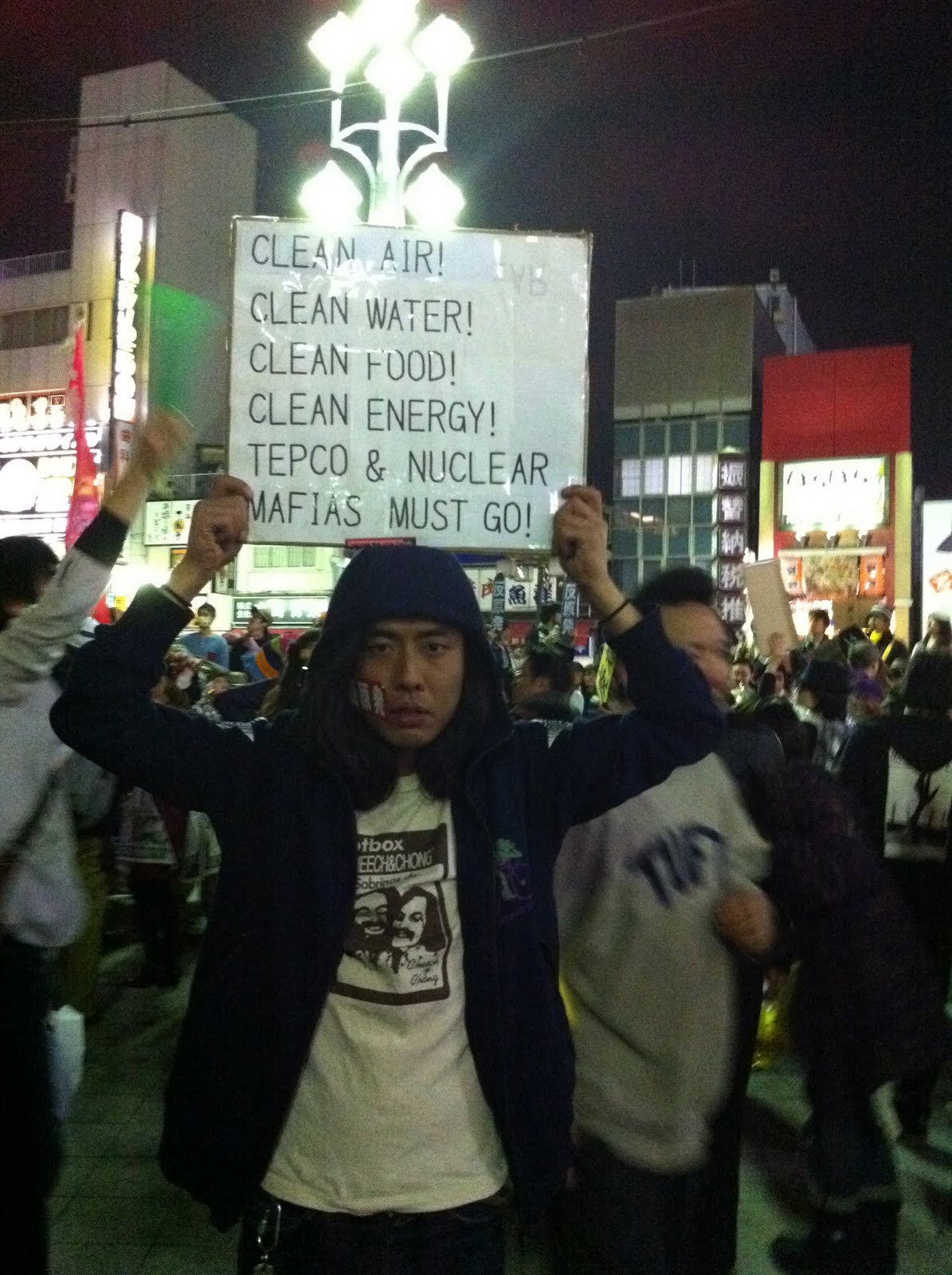
"TEPCO and nuclear mafias must go"


Watch the website of the April 10th 'Stop Nuclear Power Plants! Global Action Day' for updates on solidarity actions that took place in countries around the world including Canada, France, Germany, Korea, Mexico, the United Kingdom and the United States, as well as cities throughout Japan.

Your assistance in spreading the word regarding the "Stop Hamaoka!" petition will also be greatly appreciated.

—Kimberly Hughes

Thursday, March 17, 2011

Some good news: Planned Kaminoseki nuclear plant (in Japan's beautiful Inland Sea) construction suspended


( Photo: Hiroshima-Kaminoseki Link: No Nuke Kaminoseki)

Two days ago construction on a planned nuclear power plant in seismic-intense, water-surrounded Kaminoseki was suspended.

For 30 years, Japanese fishermen, environmentalists, and citizens concerned about the safety of nuclear power have been protesting the proposed construction of a nuclear power plant at a small island in Japan's beautiful Seto Inland Sea National Park. The Seto Inland Sea is sometimes referred to as Japan’s Galapagos because of its rich biological diversity. Hiroshima-based Chugoku Electric Power Company, unresponsive to local choice (by villagers descended from area inhabitants for over a thousand years) and environmentalist concerns, even started landfill during an international biodiversity conference held in Nagoya last fall.

Chugoku operates two nuclear power plants and is now constructing a third in Matsue City, on the coast of the Japan Sea. On the other side of western Honshu (Japan's main island). The power company has planned to build two nuclear power plants on the Seto Inland Sea coast in Kaminoseki Town.

A Pan Orient News report on a hunger-strike earlier this year summarizes alarming unaddressed environmental risks and the history of the local unanimous protests.


(Photo: Martin Frid's eco-blog, Kurashi)

A recent hunger strike activist statement:
We decided to take this action because we do not want the radioactive waste that will arise and the radioactivity that will accumulate in the sea and the atmosphere as a consequence of constructing and operating this nuclear power plant to be left to our own and our children’s generations.

Radioactive waste continues to release radioactivity for thousands of years, but no means of disposing of it has been established. Furthermore, although nuclear power plants can only be operated for about 40 years and the buildings themselves become radioactive in the process, no safe method of decommissioning them after they are shut down has been found.

Nevertheless, they are going ahead with a plan to construct a new nuclear power plant at Kaminoseki Town in Yamaguchi Prefecture. To construct a new nuclear power plant when there is neither a method of disposing of the radioactive waste that will be produced in the process of operating the plant, nor a method of decommissioning the plant after it is shut down is to bequeath the problems to generations of young people to come.
Caroline Fraser writes on Kaminoseki at Environment 360:
The nuclear power industry, a powerful player in Japan’s politically dominant construction industry, has pressed ahead with its plans — endorsed in 2006 by the Ministry of Economics, Trade and Industry’s “New National Energy Policy” — to mold the country into a “nuclear state.” In addition to 54 existing nuclear power plants that until last week supplied 30 percent of the country’s electricity, a dozen new nuclear plants are planned or under construction.

One in particular has exposed a deep public divide. The proposed Kaminoseki nuclear plant is to be built on landfill in a national park in the country’s well-known Inland Sea, hailed as Japan’s Galapagos. For three decades, local residents, fishermen, and environmental activists have opposed the plant, saying it should not be built in the picturesque sea, with its rich marine life and fishing culture dating back millennia. The Inland Sea has also been the site of intense seismic activity, including the epicenter of the 1995 Kobe earthquake that killed 6,400 people...

“We have to stop it,” Masae Yuasa, a professor of International Studies at Hiroshima City University and a leading opponent of the plant, told me when I visited Japan last fall. In words that have a chilling resonance now, she continued, “Once an accident happens, there is no border. I want to be more polite, but we have to stop it. I am a person from Hiroshima. I cannot be quiet about it.”
Read the entire must-read article here. In an even broader framework, Allison MacFarlane explores the risky mix of geologic uncertainties and hazardous industries at The Bulletin of Atomic Scientists.

Wednesday, October 20, 2010

Appeal to Tokyo to comply with its "Satoyama Initiative" & stop biodiversity destruction at the Kaminoseki Nuclear Power & Henoko, Okinawa

An appeal from the Japan Environmental Lawyers' Federation (JELF) and JUCON (Japan-US Citizens' for Okinawa Network):

At the tenth meeting of the Conference of the Parties (COP10) on the Convention on Biological Diversity (CBD), held in Nagoya, Aichi, from October 18 to 29, host nation Japan announced its “Satoyama Initiative,” expressing Tokyo's intention to lead global projects related to the Convention.

At the same time — even as the COP10 is underway — Tokyo is pushing government projects that will destroy biodiversity in Japan: the construction of Kaminoseki Nuclear Power Plant in a biodiversity hotspot in Yamaguchi Prefecture and the plan to to reclaim land at Oura Bay in Henoko, Okinawa (the habitat of the critically endangered dugong and many other unique species) to build a U.S. Marine Corps air base. These are a couple of examples among many of the Japanese government’s policies that contradicts its official position and strategic objectives on preservation of the nation’s biodiversity. Tokyo's Official Development Assistance (ODA) policies also include those that contradict these biodiversity principles.

We, international NGOs, hereby issue a joint statement, to raise awareness about these realities, and to call for the Japanese government to review its policies.

Please read the appeal below and send the endorsement of your organization by 24:00 (in Japan) of 23th to jelf@green-justice.com.
Joint NGO statement to Japan, host nation of CBD-COP10, to call for reviewing environmental policies of Japan

On the following site, Japanese Government, the presidency of the 10th Conference of the Parties (COP10) of Convention on Biological Diversity, has pulished "Original draft of the post-2010 target (new strategy plan)" pamphlet: http://www.mofa.go.jp/mofaj/gaiko/kankyo/seibutsu_tayosei/pdfs/post2010.pdf

Five strategic targets are in this original daraft as of September 26, 2010.
Strategic target A: Deal with the primary cause for the loss of biodiversity.

Strategic target B: Decrease direct pressure to biodiversity.

Strategic target C: Improve the situation of biodiversity.

Strategic target D: Strengthen the benefit from biodiversity.

Strategic target E: Strengthen the execution of the agreement through the capacity building.
Moreover, it advocates the target of 20 items such as" All people recognize the value of biodiversity, the value of biodiversity is built into the plan of the government, and harmful measures to biodiversity is abolished."

The following two plans are proposed as "Mission (short-run target to 2020)".
Plan 1: Take effective and urgent actions to stop the loss of biodiversity.

Plan 2: Through the effective and urgent actions, stop the loss of biodiversity by 2020.
In addition, "Vision (mid/long-term target to 2050)"says that the vision of this strategy plan is "The world where people live in good harmony with nature" and "The biodiversity as natural capital is evaluated, maintained, recovered, used wisely, and thereby healthy earth is maintained and an indispensable benefit to all people is given."

Japan has named this approach "Satoyama Initiative", and tries to take related activities of the agreement globally from now.
However, Japanese Government is doing a lot of policies contradicting its standpoint and strategic target domestically. They are destroying biodiversity one after another. For example, they are reclaiming Oura bay in the east coast of northern Okinawa, a hot spot of biodiversity, to build the U.S. military Marine Corps airport. Moreover, various businesses in contradiction to this strategic target are done by official development assistance (ODA) in the foreign countries.

It is a problem for Japan to leave the ecocide go and not to stop the biodiversity destruction businesses only doing "Satoyama Initiative".

We enumerate the data of biodiversity destruction businesses from the next page to let COP10 attending countries and NGOs refer to them. And we request that the Japanese Government review businesses concerned at once and achieve the strategic target proposed in COP10. In addition, the signatures of the NGO groups that agrees to the request of stopping of businesses concerned are appended.