Links

Showing posts with label creativity. Show all posts

Sunday, November 17, 2013

"War is Over! (If You Want It): Yoko Ono" • Sydney MCA • Nov. 15, 2013 - Feb. 23, 2014


"WAR IS OVER! (IF YOU WANT IT)" opened Nov. 15, 2013 at the Museum of Contemporary Art in Sydney.  This is the first major survey in Australia of legendary artist, musician and peace activist Yoko Ono. "The exhibition encompasses five decades of practice in diverse media including eight participatory works. Themes include loss, conflict, humanity and the desire for world peace."  Ono designed the interactive parts of the exhibition to encourage collaboration, linked to a central theme of world peace.

Curated by MCA Chief Curator Rachel Kent, the title comes from a text by Ono and her late husband John Lennon that first appeared in 1969—in the middle of the Vietnam War—across public billboards in twelve cities worldwide, including Tokyo, Hong Kong, Toronto, Berlin, Paris, New York, and London.

While other visual artists have also engaged in peace art and activism, Ono is perhaps the most renowned peace artist of our time.  How did the impetus for her highly focused creative work originate?

Ono has explained that a childhood experience of the firebombing of Tokyo awakened her understanding of the human costs of military violence, fueling her peace art and activism for five decades.

Her father was an international banker and moved his family between the United States and Japan, so, as a child, Ono developed positive attachments to both countries. When the Pacific War broke out, she was eight-years-old, living in Tokyo.  She and her family survived (by taking shelter in a basement in their Azabu home) the firebombings of Tokyo, including the massive March 9-10, 1945 raid—the most destructive bombing raid in world history. At minimum, the napalm-fueled bombings destroyed 16 square miles (41 km2) of the city and killed 100,000 people.

In a 2007 interview with Amy Goodman:
I remember, when I was a little girl, a young — you know, when I was very young, one day I had high fever because of just a cold. You know, I had a cold.

And so, my family all went down into the basement to make sure that, you know, they’re alright. It’s a kind of shelter that they created in the garden actually. But I couldn’t go.

And I was just sort of in my bed, and I saw that all the houses next to us and all the places around me were just all fire. I go, "Oh." But, you know, when you’re young, and that’s the only reality you’re working through, you don’t really get totally scared or anything. You know, you’re just looking at it like an objective film or something like that. "Oh, this is what’s happening," you know?

And because of that memory of what I went through in the Second World War, I think that I really — it embedded in me how terrible it is to go through war.
To those who charge that she is "optimistic" or "naive," Ono points out that she is a simply a resilient pragmatist who cares about life and our planet—and does what she can do—which includes encouraging others to do what they can do to support peace building at multiple levels:
Well, you know, most people say, "Oh, you’re so optimistic. I mean, what’s wrong with you?" I’m not really that optimistic.

I am trying to make us survive. And in the course of survival, we don’t have the luxury to be negative. That’s a luxury that we can’t afford.

 And we just have to do what we can do. And I think that instead of getting so upset with some people, you know, or some countries which are doing this, doing that — "How dare they," whatever — I think we should just do what we can do.
 In a Reuters article about this current exhibition, she compares 1969 with 2013:
When John and I stood up, very few people were activists. Now I think 90 percent of the world is activists. If you're not an activist, you'd be considered a nerd maybe.

 (Image: Colin Davidson, The Guardian)

"Pieces of Sky"—WW II German helmets with blue jigsaw pieces inside.
Visitors are told, "Take a piece of sky. Know that we are all part of each other."


"Play It By Trust"/"White Chess Set"
(Photo: Iain MacMillan,© 1966 YOKO ONO)

Shinya Watanabe:"Through her simple alteration of the chessboard
 (a war strategy game), the artist made it extremely hard for the chess players to 
 fight each other, and this creates new relationships between the opponents."


Tuesday, November 5, 2013

Alex Kerr's beautiful old/new Japanese country houses and the movement to save traditional Japan

Great talk and breathtaking photos by author and historic preservationist Alex Kerr at TEDx in Kyoto on his mission to save Japanese country houses (minka).
Japan is so rich: the natural environment, the fantastic traditional culture, the wealth of beauty and materials and spirit of lifestyle that you find in these old places. It's there and it can be saved.
Kerr uses double-paned windows for energy conservation. If his country houses were updated for solar, renewable energy, that would be even more modernizing, given 3/11's call to shift, downsize energy usage.

The reason small towns in Japan (and elsewhere) are experiencing depopulation is because they were built around local (agricultural, fishing) economies that have been collapsing under the global food industry's drive towards ever-increasing expansion...Japan's food sufficiency is now at 39%; when Alex Kerr came to Japan as a child (1960's), the nation’s food self-sufficiency rate was around 80%.

Kerr's work to restore country houses is one facet of a larger grassroots-driven local revitalization movement that seeks to save traditional Japan's agriculturally-rooted, rural cultures.

Tragically, Tohoku, much of which was stricken by the 3/11 disasters, was the bastion of Japan's sustainable, slow life, organic and heirloom food movement.  Areas in Tohoku not affected by the catastrophes (Yamagata) continue pioneering these shifts.

Elsewhere, young Japanese people are leaving urban areas to return to their rural roots to farm and open organic retreats.  Japanese singer Yae and her mother Tokiko Kato (also a renowned singer) have a farming community in Kamogawa (near Tokyo) that opened during the 1970's.  It's a model of downsizing energy use, revitalizing traditional self-sufficiency, and cultivating simplicity.

During his youth, Alex Kerr fell in love with Japanese country houses and the traditional culture that make up their  landscapes.  He belongs to a distinguished tradition of foreign residents (Lafcadio Hearn, Ernesto Fenollosa...) who worked to preserve traditional Japanese culture because they found the passing of its richness and beauty unbearable.  One can sense this appreciation in the atmosphere of Kerr's restored and beloved country house, Chiiori, in western Tokushima, a prefecture in Shikoku, on the Inland Sea.

Kerr is now acting as an advisor to rural Japanese villages seeking to stem depopulation by building up local tourist economies through restoring country houses (for short-term stays) and revitalizing local culture.

Spurred on by different motives—profit-seeking (sometimes, but not always, mixed with sincere appreciation of Japanese architectural heritage)—foreign and Japanese investors who are renovating older homes for rental income are also part of the drive to save and restore older Japanese houses, especially in Kyoto and Kamukura.  It's great that these minka and urban traditional houses (machiya) are being preserved, however historic preservation springing from this limited motivation may lack the larger vision and quality of Kerr and others who appreciate the multidimensional contexts of traditional Japanese culture.

---

More about the country house that captured Kerr's imagination and heart as a teenager: "Bringing an 18th-Century Farmhouse Back to Life" (Liza Foreman, NYT, Dec. 27, 2012)


Chiiori: Alex Kerr's first Japanese country house. (Photo: Alex Kerr)


More about restoring Japanese traditional houses as a business: 

"Japan’s Forsaken Homes Restored to Historic Styles Yield 80%" (Kathleen Chu and Katsuyo Kuwako, Bloomberg, Nov. 20, 2012)

"Historic Homes in Tokyo Attract More International Buyers" (Desiree Quijalvo, realestateco.jp,  Oct. 30, 2012)

Thursday, October 31, 2013

Mayumi Oda: On Energy of Change, Feminization, and New Birth of Japan

"Earth Ship" by Mayumi Oda  (Image: Safe Energy Handbook

Longtime nuclear-free activist and visual artist Mayumi Oda shared her wisdom in "On Energy of Change, Feminization, and New Birth of Japan," a 2012 interview with Alice Miyagawa published at Kyoto Journal.  A few excerpts: 
You were interviewed previously for Kyoto Journal following the Tokaimura nuclear accident in the summer of 1999, when you lived in California. You said that you had come to Japan to help empower people, especially women, in response to the government’s negligence in handling the issue. Then, at the turn of the millennium, you moved from California to Hawai’i. That seems to have marked a turning point in your life...

Until 1999 I had really tried to focus my work to let people know the dangers of having nuclear [power plants] on earthquake faults. I couldn’t convince them. I already saw the possibilities of disaster. I thought it would be in Tokai, or Hamaoka, near Tokyo. I was terribly, terribly worried. I had worked nearly nine years in the antinuclear movement. I was very discouraged that Japan was not really responding to the danger.

 I was just very tired, and I felt like I had to rebuild a new life. So I chose Hawai’i to do sustainable living, making a farm, to show people that there’s another way to live. I felt like somebody had to be doing this — not just thinking about the possibility, but practicing it. Hawai’i taught me to live with aloha, within an island. In 2000 I bought the farm [Ginger Hill Farm and Retreat, in Kealakekua, meaning the Path of God], and for eleven years I have worked on it. I have probably educated about two hundred young people, just to live hopefully sustainably through farming, through eating the right things, making medicines, cleansing, healing oneself with herbs and the things that we grow.

I just finished painting a six-panel screen of mostly women marching towards Amaterasu the Sun Goddess — I painted about forty women, with a few men. They are all practitioners of my Goddess Academy, marching from the life they lived, to a more nature-based life, symbolized by Amaterasu — marching from an oil-based economy towards a solar-based economy...


...I painted a Sotatsu screen of the Gods of Wind and Thunder turned into females to bring more of the feminine into culture, especially Japanese culture, which really needs more feminine. Traditional culture has it, but somehow this modern culture in Japan became so Westernized that we gave up a lot of that stuff.

... I felt almost like the women in Fukushima all feel, and so it’s a lot of force and a strength — I felt that these Goddesses can somehow break through something that we are so up against. That’s how I painted those two Goddesses, to bring an energy of change that our country needs at this moment...

These are all yamato-e style paintings, the tradition is extremely old-fashioned. It’s been going on 1,300 years in Nara so I kept that tradition...So I decided that I will focus on this old beautiful tradition that our ancestors used, and with that how can I express who we are now in this time.

In 1993 I did some hand-scrolls called Random Kindness and Senseless Acts of Beauty [for] a story that was written by Anne Herbert and Margaret Pavel, right after I became an anti-nuclear activist, so my message was very anti-nuclear, anti-war and anti-violence, and how to live with the peace of others in the land. That was the story behind it. Now it’s a nine-meter scroll.

...So I did this work for the younger generations that we just deprived because of our own luxury, our own wantings, our own electricity, our rich food, we really just left such a legacy to these young people. It feels to me this is an apology — I’m sorry that we did so badly. I’m dedicating this to the younger generations. When I think about it, it just makes me so sad. Our generation was so bad, especially men in my generation, [they] could not think about anybody — they were so caught up in the Japanese becoming so wealthy, so luxurious, they were just awful, awful, so wrong...

...The people who can really make a choice will win, get out and start a new life somewhere in the country, or in other cities. Especially if they have parents in the countryside, they should go back, and start a new life...

Monday, August 26, 2013

Keiji Nakazawa in Barefoot Gen's Hiroshima: "I decided to use manga to confront the Bomb."


Trailer from director Yuko Ishida's Barefoot Gen''s Hiroshima (Hadashi no Gen ga Mita Hiroshima) a documentary film in which the camera man (Koshiro Otsu) follows "Barefoot Gen" creator Keiji Nakazawa as he visits neighborhoods throughout Hiroshima and recalls living through the nuclear explosion when he was six-years-old.

The film opened in Tokyo on August 6, 2011, and Nakazawa died of lung cancer a year later, on December 19, 2012.

Roger Pulvers' wonderful  film review at  the JT connects the nuclear radioactive dots between Hiroshima in 1945 and Fukushima in 2011:
When the bomb dropped in 1945, Nakazawa was a 6-year-old, first-year pupil at Kanzaki National Elementary School, which was a mere 1.2 km from ground zero. Luckily, on his way into school, he lingered by the wall adjacent to the front gate to speak with someone, and that wall saved his life...

Nakazawa’s father, sister and brother...were all crushed by pillars and beams, and killed. His father had been a vocal opponent of Japan’s war of aggression, and he had spent more than a year in prison as a result. The family had been ostracized by the community. This is a bitter irony of all indiscriminate bombing, since it murders many who are not only blameless non-combatants but also proponents of peace.

Nakazawa never forgot what he saw. He turned his personal experience and that of the people of Hiroshima into a series of manga that was carried in the magazine Weekly Shonen Jump for 12 years from 1973. The story of Barefoot Gen kept the plight of the victims of the bomb and its radiation in the minds of citizens of the nation that had become the most intimate ally of the country that caused that holocaust, the United States.

This fact led the Japanese government to isolate the issue as something local — to Hiroshima and Nagasaki, the other city atom-bombed by the U.S. three days after Hiroshima — as opposed to national. In addition, the vigorous pursuit of “atoms for peace,” an American initiative to promote nuclear power spearheaded in the early 1950s by President Dwight Eisenhower further divorced the radiation spread by the bombs from its possible spread by reactors generating electricity all around Japan.

It is thanks to Nakazawa, and eminent authors such as Kenzaburo Oe, Hisashi Inoue and, most recently, Haruki Murakami — all of whom have taken up the nuclear tragedies of 1945 — that the dangers of radiation lingering in our bodies, our soil, our water, and in the air, are now finally being understood by the Japanese people.

However, a truly remarkable aspect of the story of Barefoot Gen...is its message of optimism and hope. The hero, little Gen, stunned by the devastation and death surrounding him, says, “I’m going to live, to live! I’m going to live through this, you’ll see!”

In those pages...the stench of destruction are everywhere, just as in the prefectures of Tohoku most badly affected by the earthquake and tsunami of March 11. Yet Gen does not give up hope...

He goes on to point out that the gen in the name is the same character as that in the word genki, which means full of vitality and strong of mettle...

In his message to children, Nakazawa states, “If you come to feel that you wish for a world without war and without atomic bombs, for a world where peace is priceless...then the subject of this film, namely Keiji Nakazawa, will be content.”
Motofumi Asai's in-depth interview, "Barefoot Gen, the Atomic Bomb and I: The Hiroshima Legacy Nakazawa Keiji"i, translated by Richard H. Minear at APJ: Japan Focus explores the anti-war beliefs of Nakazawa's father as well as those of the writer himself who counsels us to be resilient and persistent in the support of respect of life, human dignity, and an ethos of peace:
In order to effect change, each person has to work away at it. I’m a cartoonist, so cartoons are my only weapon. I think everyone has to appeal in whatever position they’re in.

Wouldn’t it be nice if we gradually enlarged our imaginations! We have to believe in that possibility. Doubt is extremely strong, but we have to feel that change is possible. Inspire ourselves. And like Auschwitz, Hiroshima too must sing out more and more about human dignity.

Monday, July 23, 2012

Rose Welsch: Faces behind the 7.16.12 100,000+ Nuclear-Free Rally in Tokyo

Many thanks to Rose Welsch of Peace Boat, Global Article 9 Campaign and US for Okinawa for sharing these great photos from the 7.16.12 "Sayonara Nukes" rally in Tokyo and for cutting through to the crux of the issue: people in Japan and everywhere want to live democratically, by government "of the people, for the people, and by the people." In Japan and other nuclear nations, this means living without the threat of being nuked by their own nations' nuclear plants.


170,000 people gathered at the event,
including this character, who depicted an "Imperial Nuclear Japan."


Great atmosphere here at the event!
Really interesting booths, speakers and musicians.


Famous Japanese musician SUGIZO joined the event today
and gave a fantastic speech about the need to reclaim Japan
from those steering it down a dangerous course.


Yukawa Reiko, a famous songwriter and music specialist in Japan, joined today's event.
Upcoming and mid-level artists are often silenced in Japan
if they take a stand against nuclear energy,but people like Yukawa are undeterred.


These young people held up photographs of the domesticated animals
such as cows, dogs, cats that were left behind in the Fukushima evacuation zone
and have starved to death or are on their last legs. Their sign asks us to remember all the creatures besides humans who have been victimized by nuclear energy.


"The Government of the people, by the people, for the people."
This quote in English included in a Japanese newspaper article about widespread opposition
to the restart of Japan's 54 nuclear reactors caught my eye today.
From Japan to the US, from Canada to Egypt, isn't this basically what people are calling for?

Saturday, July 7, 2012

no nukes more heart - NO NUKES! ALL STAR DEMO 5 - Shibuya - 7.7.12

NO NUKES! ALL STAR DEMO 5: Shibuya, Tokyo on 7.7.12...

9.19脱原発デモ『NO NUKES! ALL ST☆R DEMO 2011』

Check out some of the music at the website, including "Wonderful World"...

Friday, July 6, 2012

"ODAKIAS" - Ryuichi Sakamoto's Remix of Demonstrators at the Oi Nuclear Plant restart protest chanting "Saikado Hantai!" ("Against the Re-start!")

Sounds for Our Generation: "ODAKIAS" - Ryuichi Sakamoto's haunting remix of demonstrators at the Oi Nuclear Plant Restart Protest chanting "SAIKADO HANTAI!" ("Against the Re-start!")

Friday, March 30, 2012

Voices & Spring Love Harukaze Explore 3.11 Issues @ Tokyo this weekend


It has been slightly over one year since the tragedy of 3.11. Two Tokyo events scheduled for this weekend will highlight ongoing themes of critical importance, such as reconstruction efforts in the Tohoku area and health concerns following the Fukushima nuclear accident. Both events will also raise awareness while featuring various music and arts performances, workshops, and much more.

The first event, Voices, will be held all day this Saturday, March 31st, in Tokyo's Shibaura district. It is a collaboration between the Namida Project—a non-profit, multicultural grassroots effort whose aim is to help empower people to turn tears of sadness into tears of joy—and the community event space Shibaura House. According to the event website:

VOICES is a gathering of narratives, ideas, knowledge, experiences, opinions and expressions that have grown out of the 3.11 disasters in Japan. In the unique open and inviting spaces of SHIBAURA HOUSE, join workshops, participate in talk sessions, listen to stories, view exhibitions and enjoy music as you reflect on and discuss what has happened over the past year and what should be done to create safe and sustainable communities.

The design of SHIBAURA HOUSE erases the inside/outside, us/them boundaries and brings everyone together in a warm space that offers us a chance to meet and share, and to open our imaginations to other possibilities.

In the evening there will be a special charity concert. It will feature renowned musician and composer Akira Inoue. He will be accompanied by shakuhachi performers, led by Ryozan Sakata, Grand Master of Tozanryu, and including Junya Ohkouchi, Kizan Kawamura and Keiko Higuchi. Guitarist Haruo Kubota and flutist Miya will also join Akira Inoue to create a wonderful windscape of sounds.

We hope you can join us on March 31st and help make VOICES a very special event.

Namida Project is a non-profit, multicultural grassroots effort. Our aim is to help empower people so we can turn «tears of sadness to tears of joy».

EVENT LIST

TALK SESSION 1 // 10:00-12:00
Voices of Health
TALK SESSION 2 // 13:00-15:00
Voices of Fukushima
TALK SESSION 3 // 16:30-18:30
Voices of the People

DOCUMENTARY &
DIRECTOR´S TALK // 11:00 - 12:00

PERFORMANCE // 15:15-16:00
Contellusion

PERFORMANCES // 10:00 -18:30
Accumulating Voices

WORKSHOPS
Take Action Workshop // 10:00-12:00
Improvisational Game Workshop // 13:15-14:45
Connecting through badge-making // 16:00-18:00

PRESENTATION
Video Voices // 10:00-18:30

ART EXHIBITION
Voices of Kiri-e // 10:00-18:30

PERFORMANCES
Accumulating Voices // 10:00-18:30

WORKSHOP
I am here! // 10:00-18:30

DISPLAYS
Kids Voice // Shadowlands 10:00-18:30

BOOKSHOP  10:00-18:30

FOOD SALES 10:00-18:30
http://www.blogger.com/img/blank.gif
CHARITY CONCERT // Windscape 19:30-21:00
Among the day's events are a screening of Then and Now, an exquisitely filmed, brilliantly nuanced short film featuring interviews with Ishinomaki residents about issues that continue facing their community nearly one year following the March tsunami devastation. Following the film will be a talk with its director, Paul Richard Johannessen, and Ishinomaki community leader Toshihiko Fujita.


For detailed information in English and Japanese about all event sessions, as well as tickets and registration, see the official event website.

The second event, "Harukaze 2012: Think It!" will also be held this coming weekend, Saturday March 31st and Sunday April 1st, amongst the budding cherry blossoms in Tokyo's Yoyogi Park. The event will feature live music, DJs, an organic market, live painting, and talk sessions featuring speakers on sustainability-related issues, including Gota Matsumura from the grassroots reconstruction project Ishinomaki 2.0.

From the event website:
HARUKAZE: Think it !
Date/Time:
 Saturday, March 31st (noon to sunset)
and Sunday, April 1st (11AM to 8PM)
Venue: 
Yoyogi Park (Outdoor Stage area)* Rain or shine!!
Admission: Free!! (Donations kindly accepted)

Event will feature:

* Three stages (Spring stage, Love stage and Peace Dome)
* The Unnamed Parade
* Skate Ramp powered by Buena Suerte
* Kids activity area
* NPO/NGO booths
* Spring Love Market
* Food/drink stalls featuring healthy/organic ingredients
* Chillout Flea Market
* Talk session on sustainability-related issues
* AND MORE!

The legendary free urban party, Harukaze, is back for its fourth year. This year’s event will be held on Saturday, March 31st and Sunday, April 1st in Tokyo’s Yoyogi Park. If our streak of luck continues this year, the weekend will again feature the cherry blossoms at their full peak!

Enjoyed by many event-goers during its first run from 1998-2002, the festival returned in 2009 together with Peace Not War Japan as “Harukaze Spring Love.” Discussions on issues related to peace were added to the lineup that year and the next, and donations were also collected for grassroots peace organizations. Following the Great Eastern Japan Earthquake last March, the 2011 event included a candlelight memorial and song tributes for disaster victims from the amazing VOJA (Voices of Japan) led by gospel singer (and festival director) Yuka Kamebuchi, as well as panel discussions on issues related to nuclear power and alternative energy.

The 2012 Harukaze event is titled “Think It!”, and will encourage festival-goers to consider issues from alternative cultural perspectives such as where we have been and where we are headed in our world today. The amazing weekend exthttp://www.blogger.com/img/blank.gifravaganza will again feature top-rated musical and dance performances, organic food and goods stalls, speakers on sustainability-related issues, and much more. Come out with your family, friends, or on your own to enjoy the cherry blossoms while feeding your mind and soul with some Spring Love!!

For more information, see the official event website.

For highlights from past events, see these articles from 2011, 2010 and 2009.

Why not make a weekend of it and attend both events!!

Sunday, March 11, 2012

"human ERROR" (by Frying Dutchman) - 1 Million Person Virtual Parade


Via Frying Dutchman:
HOLDING OF THE "human ERROR Parade"

It is our desire for people to utilize the song, "human ERROR" by "FRYING DUTCHMAN" during the humanERROR parade, as a sort of memorial to the victims of the 2011 Japan earthquake, as well as to deepen the considerations we must make towards the decommissioning and phasing out of nuclear power plants. By sharing these feelings and spirit, your participation in this event of freedom, we hope it will spread throughout the world.

Where to play this song:

Please play this song wherever you are; in the streets, shops, your car, your friend’s or colleagues’ cars. Even if you are alone at home, please play this tune in your room.

Of course, if you are at a large-scale gathering, such as a demonstration, rally, exhibition, etc., we hope humanERROR will be noticed.

But participation is not limited to where there are many people. Even listening on your media player, or your smartphone, pc, etc. is participation in the humanERROR parade.

●The parade kicks off on March 10 at noon (12:00 p.m.).

By playing “HumanERROR” at these events, you can spread this movement to even more people. During these 2 days, create a “virtualparade” by playing “HumanERROR” over and over. Share the music with friends and family memberswho haven’ t discovered it yet but who share your desire for a safe and peaceful world.

On March 11 (Saturday) at 1:00 p.m., at the Tidanowa Festival in Okinawa, all of us in Frying Dutchmanwill perform “HumanERROR” with all our soul for all of Japan. You can watch this performance live onUstream and synchronize your feelings with like-minded people all over the world. We believe thatrevolution begins when people’ s hearts unite.

Friday, December 16, 2011

“Atomic Café”: Japan’s entertainment personalities confront post-Fukushima sociopolitical realities, lament media silence during recent Tokyo event

Kenji Endo ("Enken"): "Living in this nuclear age and facing the dangers of radiation, it is important for each of us to do what fulfills us. My love is singing, and I will continue to do it passionately every day for the rest of my life."

Nine months following the triple earthquake, tsunami and nuclear disaster that struck Japan on March 11th of this year, life has largely returned to business-as-usual as far as most of the country is concerned. With the majority of those living outside the affected regions unable to fully register the scale of the tragedy to begin with, even Tokyo—which was largely paralyzed during the days following the accident at the Fukushima Daiichi plant due to fears of imminent large-scale nuclear emergency—now once again buzzes along obliviously in typical metropolis fashion as if nothing had ever occurred.

Helping to support this image of normalcy is a mainstream media that routinely downplays Fukushima’s ongoing health and environmental costs, despite ongoing bad news regarding leakages and radiation contamination, while a seemingly unrepentant Tokyo Electric Power Company (TEPCO) continues its pursuit of profit-making nuclear power over other possible sources of energy.

With notable exceptions such as a recent sit-in demonstration in front of the Ministry of Economy led by righteously angry Fukushima mothers, tremendous pressure is being exerted at most levels of society to tow the official line.

In few industries is this taboo stronger than in the world of entertainment, where media personalities are expected to keep critical thoughts to themselves lest they risk offending sensitive sponsors. In addition to a growing number of citizens, however, certain celebrities are violating this restriction to speak their minds against what they perceive to be strong injustice.

On a recent evening in Tokyo, several members of Japan’s entertainment and media industry who are all outspoken critics of Japan’s nuclear policies—broadcaster Peter Barakan, singer Tokiko Kato, citizen journalist Yu Tanaka, vocalist/guitarist Hiro Yamaguchi and actor Taro Yamamoto—gathered at a live music space in the artsy neighborhood of Daikanyama to do this very thing.

The November 23rd event, titled Atomic Café after the 1982 documentary film that satirized the nuclear fervor of 1940s and 1950s America, began with a powerful performance from rocker Kenji Endo (known as “Enken”). This was followed by an engaged two-hour discussion facilitated by lawyer/musician Kikujiro Shima, as panelists delved into the complexities of the social and political landscape that continue to define post-3.11 Japan.

Atomic Cafe panelists (L-R): Kikujiro Shima (facilitator), Peter Barakan, Tokiko Kato, Yu Tanaka, Taro Yamamoto, Hiro Yamaguchi

Perhaps the most egregious example of what can happen if one flouts the established rules of enforced silence surrounding the nuclear power industry may be seen in the case of Yamamoto, who lost his scheduled role in a forthcoming television drama after speaking his mind following the Fukushima disaster.

“Prior to 3/11, I had only ever expressed myself on an intellectual level; and as an actor, I had lived exclusively through my sponsor,” he told the audience. “After the accident occurred, however, I came in touch full-force with my emotions—which included extreme anger in addition to regret for not having spoken out sooner against nuclear power.”

Specifically, Yamamoto incurred the wrath of the scandal-shy media establishment by attending an anti-nuclear demonstration held in Tokyo on April 10th that drew some 20,000 people—announcing beforehand to his Twitter followers: “I can’t stay silent while Japan continues the state terrorism of nuclear power."

“I knew I was bound to lose work after making my views known, but it was shocking how quickly it actually happened,” Yamamoto told those in attendance. “Although it was an incredibly difficult thing to do given the constraints I was under, I thought about the possibility of another Fukushima occurring, and finally realized that I had no choice but to speak out.”

Despite differences in age, career and backgrounds, one common thread uniting all of the panelists was a passionate sense of righteous anger toward a bureaucratic system that has consistently protected the interests of the powerful corporate nuclear industry, while silencing any and all dissent regarding the human suffering that has transpired as a result of the Fukushima crisis.

Journalist and environmentalist Yu Tanaka, who has been speaking out against the dangers of nuclear power and radiation for decades, spared no contempt for those responsible for the recent tragedy, and its effect on the lives of society’s most vulnerable. “I recently took a group of Fukushima children to Okinawa, and they displayed obvious fear toward both the ocean and the rain, in addition to being afraid to stay outdoors more than ten minutes at a time,” Tanaka recounted. “They finally realized they were safe, but we had to send them back to Fukushima at the end of the trip knowing that they would once again be returning to this kind of stress and fear. These children have been robbed of their lives, and we must look clearly at who and what is responsible for it.”

Tanaka emphasized, however, that we now have a golden opportunity to transcend tragedy by creating a society with radically different values. “Other countries are making the shift to alternative energies, so why can't Japan—the number one technologically advanced nation in the world—do the same?” he challenged. “An Internet-based business model created at the grassroots level could in fact make the energy industry profitable enough so that companies will want to fund it. However, it is critical that we first break out of the existing dictatorship whereby TEPCO (The Tokyo Electric Power Company)—an enormous media sponsor—threatens any information outlet that dares criticize it.”

Peter Barakan agreed readily about the issue of media control, with which he is intimately familiar as a broadcaster. Originally from the UK but having spent the better part of his life in Japan, he has consistently challenged the existing climate of both overt and subtle media censorship by featuring the music of politicized artists on his radio programs, along with his own commentary regarding government policies in areas such as war and nuclear issues.

Within this climate, broadcasters who are willing to challenge the official line are a precious resource to those with few other outlets for expression. During his weekday morning radio program, Barakan recently read an email message from a listener who had returned to his hometown of Minami-Soma, one of the areas most severely affected by the nuclear crisis, and said that he was “seething with anger” as a result of being forced to remain at the mercy of a system that could only be described as “nuclear fascism.”

“As a monopoly—not to mention one that is, incidentally, in debt—TEPCO should most certainly not be spending its money on PR, which I believe should more rightly be termed as ‘propaganda’," Barakan remarked.

“Musicians speaking out on social issues are a minority in any country,” he also noted, “with the notable exception of the Vietnam war era during the 1960s and 1970s, when a group of top-name artists gathered in the USA for a major concert held in New York City titled Musicians United for Safe Energy (MUSE).”

In Japan, one consistently similar voice in this regard is that of Tokiko Kato, who has combined singing with social activism since the era of the ANPO (Japan-U.S. Security Treaty) protests during the 1960s. Long having advocated the eradication of all things nuclear, she was among the lineup of artists participating in the first grassroots-level Atomic Café Festival held in Tokyo in 1984, which aimed to “call for the abolition of nuclear weapons and nuclear power through music."

Involved in sustainable organic farming movements together with her late husband for the past several decades, Kato’s echoed Tanaka during the recent event with the resounding message that we must now work to transcend the current nuclear crisis by completely transforming our social values. “Many Fukushima citizens have had no choice until now other than working at nuclear plants, but more and more people—including many youth—are now moving to the countryside in order to begin creating completely new lifestyles,” she told the audience. “In addition to being fun, growing your own food also empowers you to begin taking charge of your own food safety.”


Tokiko Kato, with backdrop photo of her writing a note of support for local citizens
 while visiting affected regions following the 3.11 disaster


Hiro Yamaguchi, who has traveled numerous times with his band Heatwave to play music for residents from the cities of Minamisoma and its neighboring Soma in Fukushima prefecture, agreed with this last point. “I’ll never forget the many young women I’ve spoken with who are agonizing right now regarding whether or not they will ever be able to have children,” he remarked.“While power company officials may clearly be blamed for this accident, each one of us also needs to think seriously about the impact of our individual actions on society at large, so that we can help create a hopeful future.”

Yamamoto, before having to leave early from the event to attend another engagement, delivered an impassioned final speech regarding concrete steps that are now being taken in order to make positive change in this regard. Specifically speaking, he announced an initiative that he is helping to spearhead along with a collection of other public figures, whereby signatures will be collected in Tokyo and Osaka to call for a citizen referendum regarding the issue of nuclear power.

“I would like to ask each one of you here today to go home and call the offices of lawmaker candidates to ask the following three questions," he said. “First, given the certainty of future earthquakes occurring in Japan, what is their concrete plan for closing nuclear power plants? Second, what is their stance on the situation facing families near the Fukushima nuclear power plant whom the government has yet to evacuate? And finally, what is their plan for dealing with nuclear waste? And those who do not give acceptable answers should expect to feel the heat come election time.

“Hibakusha (people affected by nuclear radiation) are now increasing by the moment,” he said before exiting the stage. “We really don’t have any more time to waste.”

Text by Kimberly Hughes

Images by Mari Onoda

Monday, November 7, 2011

Music and Art Peace Academy art exhibit and T-shirt contest for a sustainable future ~ Friday, November 18th @Tokyo


MAPA (Music and Art Peace Academy) will be holding a collaborative art event at M Event Space in Daikanyama on Friday, November 18th to promote a sustainable world. Artists are encouraged to submit their own original artwork that represents sustainability from October 21st to November 10th, 2011. All art forms are welcome - painting, digital art, collage, photos, recycled artwork- anything! All proceeds will be donated to the Global Conference for a Nuclear Power Free World coordinated by Peace Boat scheduled for January 14-15, 2012 in Yokohama.

As explained on the homepage for Parties for Peace, a groundbreaking group that envisions stimulating events which utilize art, music, and dance as a platform to "help raise awareness and fundraise for important International campaigns to promote environmental awareness, human rights and sustainability":

The MAPA project invites individuals, organizations, musicians, artists, photographers, designers, writers, actors, videographers and promoters who are interested in social and environmental issues to work together to promote a culture of peace through music and art and join the Peace Boat global voyage for the Music and Art Peace Academy onboard.

Peace Boat is a Japan-based international non- governmental and non-profit organization that works to promote peace, human rights, equal and sustainable development and respect for the environment. Peace Boat seeks to create awareness and action based on effecting positive social and political change in the world.
MAPA is also accepting entries for their Tshirt and Eco-bag design contest! They will choose one design to print on their Tshirts to be displayed at the event on the 18th of November.

To have your work displayed at the event or to enter the T-shirt contest, simply simply send your proposal for the event or T-shirt design to Emilie McGlone at parties4peace@gmail.com by November 10th.

Thursday, June 23, 2011

Call for Nominees: 2011 Yayori Awards seek to honor activists, artists, journalists working on women’s issues worldwide

The organizing committee for the Yayori Awards is pleased to announce that nomination forms are now available for the 2011 competition.

The Yayori Awards were created through the final will and funds of the late Yayori Matsui, a well-known journalist, feminist/human rights activist, and founder of the Asia-Japan Women’s Resource Center (AJWRC). Her profile may be accessed here.

The Yayori Awards are presented during each competition round in two separate categories:

1) The Women's Human Rights Activities Award (commonly referred to as the Yayori Award) is presented to a grassroots-level woman activist, journalist, or artist (either an individual or group) who works with socially marginalized peoples to solve serious social issues in Asia and other regions, and whose work helps to create a 21st century free from war and discrimination against women.

Nomination forms for this award must be submitted in English. Self-nominations will not be accepted.

2) The Yayori Journalist Award is presented to a woman journalist or artist (either an individual or group) who vividly portrays the situation of women from a global gender perspective. Self-nominations for this award are acceptable. Since the nominee’s future work shall be subject to publication in Japanese, all submissions must be in the Japanese language.

Winners in both categories will receive a certificate and a monetary award in the amount of 500,000 yen. In the event that multiple awardees are selected for the Yayori Journalist Award,the money will be divided amongst all recipients.

The organizing committee is seeking nominations from around the world for both awards, and will send printed leaflets upon request. The deadline for this year’s competition is August 25, 2011.

Detailed information regarding the awards, including a leaflet, nomination forms, and list of past award recipients are all available on the Yayori Award website.

Past winners have included a group of women working to bring justice to victims of sexual violence committed during the civil war in Guatemala, a feminist photojournalist from Nepal working on issues of peace and human rights, and numerous others doing important work for empowerment and justice at the grassroots level. The Japan Times did a feature story on the 2008 Yayori Journalist Award winner's work on the fight against nuclear power plants in a Japanese town.

[See this previous post at Ten Thousand Things for a description of the 2010 Yayori Award winners and their work for human rights.]

*************************************************
Mikiko Ishihara
Secretariat of the Committee for the Yayori Award
C/O Asia-Japan Women's Resource Center,
14-10-211, Sakuragaoka, Shibuyaku, Tokyo
150-0031 Japan
Tel: 81 3 3780 5245
Fax: 81 3 3463 9752
Email: info-award@ajwrc.org,
**************************************

Thursday, June 16, 2011

Citizens in Japan take proactive action as Fukushima radiation threats loom; ask for international support in signing petition, e-mailing officials


13 min. video showing highlights of Saturday 6/11 video in Shinjuku, Tokyo (shorter video may be watched here).

This past Saturday June 11th, which marked exactly three months since eastern Japan was struck in rapid succession by a devastating earthquake, tsunami and nuclear crisis, citizens gathered in cities and towns the world over in impassioned demonstrations to let their government officials know in no uncertain terms that the era of nuclear power is over.

The event, known collectively as 6.11 Anti Nukes Day, included solidarity demonstrations held in Canada, France, Germany, Mexico, Taiwan and the United States. In cities across Japan, the demonstrations were of course particularly poignant given the ongoing uncertainty of the Fukushima nuclear crisis. Several events were held in the nation’s capital of Tokyo alone, where the largest drew some 20,000 people to the central district of Shinjuku in a pulsing, unbarred, and at times raucous expression of emotion.

On one hand, recent weeks have seen several positive developments that are being cautiously celebrated, including the shutdown of the Hamaoka nuclear plant (dubbed the “world’s most dangerous”), the increasing likelihood that plans will be scrapped for the Kaminoseki nuclear facility, and Prime Minister Kan’s announcement of Japan’s serious commitment to alternative energies within the nation’s future energy policy. Unanswered questions continue to percolate, however, regarding the issue of Fukushima’s fallout (both literal and otherwise) underneath the surface of mainstream public discourse, which seems to have forgotten about the crisis altogether as daily life has shifted back to “normal”.

This state of collective denial seems exactly the way that officialdom in Japan wants to keep things, judging by the number of baton-wielding police officers sent out to cover Saturday’s event—which far surpassed what would have been necessary for the ostensible purpose of “traffic control”. When I arrived for the evening portion of the Shinjuku demonstration, I was stunned to be greeted by an ocean of blue cop uniforms literally as far as I could see. This served two purposes: first, making the general public unaware of what was actually happening, since several layers of officers were surrounding the demonstrators, thereby blocking the action from view (and making it inaccessible to would-be participants); and second, giving the impression that whatever was going on was so “dangerous” as to necessitate such intense police coverage.


When I was finally able to join the event—after taking a circuitous route and ducking in between cops to reach it— I found instead a chilled-out atmosphere including a reggae singer performing anti-nuke songs atop a sound truck, people waving creative signs and handing out flyers, and others holding candles in silence. It was a peaceful, artistic and inspiring gathering—and the average passerby did not even know that it was going on.


Illustrated downloadable information guide for first-time protest-goers, also available via the website of Hajime Matsumoto, who runs the Shiroto no ran ("Amateur Revolt") shop and social collective in the Tokyo neighborhood of Koenji where 15,000 people gathered in April for an anti-nuke demonstration that he organized.

Among the many other Japanese cities hosting demonstrations on Saturday was Koriyama in Fukushima prefecture, where Tokyo resident Hideaki Matsuura decided to offer support to those who have been facing the disaster more intimately. “I thought the demo would be quite big since Koriyama has suffered significant radiation damage, but I was surprised to see that there were only around two or three hundred people there—and further shocked to see that almost no one was wearing face masks,” he told me. “During speech time, however, people gave very moving appeals about how their lives have been damaged, and how they and their families continue to fear for their safety.”

He also told me that he spoke after the event with a woman who described the culture of silence and complicity that continues to reign in Fukushima whereby people are culturally obliged to follow their elders—most of whom get their information from the mainstream media rather than the internet, and thereby believe the official assurances that radiation from the plant is “safe.” As a result, she said, anyone who goes against this prevailing logic—by wearing a mask, for example, or expressing a desire to move to a safer area—risks bullying and/or ostracization from the community.

An international collective known as “Todos Somos Japon: Fissures in the Planetary Apparatus” organized following the 3.11 disaster released a statement in support of the June 11th demonstrations in Japan that included the following:
Our thoughts should go especially to the women of Japan who, we are told, are those who are most strongly opposed to the government propaganda about patriotism and sacrifice. We understand they are struggling to resist this suicidal logic, which demands their families consume radioactive products to show the world that all is well in this country and a nuclear disaster is something we can live with. Their struggle is our struggle and their resistance needs our support.
Indeed, with official information non-forthcoming regarding the actual level of dangers, average citizens have had to take matters into their own hands in order to protect their safety and livelihoods. A friend of mine who is an organic farmer and surfer living along the coast of Chiba prefecture—which lies due south of Fukushima—has purchased a Geiger counter, as have many other farmers, in order to regulate the levels of radiation that may be affecting her fields. “I moved away from the city because I wanted a more natural lifestyle, but as soon as my dream was achieved, we suddenly had to begin living with all the fears and unknowns of radiation,” she lamented. “As a surfer, the idea of having to stay away from the ocean is unthinkable. Due to the real possibility of radiation contamination, however, I and most other surfers I know try to limit the time spent in the water—and then make sure we are living healthy lifestyles in order to limit any potential negative effects to our health.”

“In fact, this whole scare has made me appreciate the ocean—as well as life itself—even more deeply,” she added. “If it becomes too dangerous I may eventually have to move elsewhere, but I love living here and will do everything in my power to stay.”

The internet has been a powerful ally to citizens in Japan who seek to bypass official media channels in order to find and share information regarding what is actually happening with regard to the ongoing nuclear disaster. With the installation of a live webcam aimed directly at the Fukushima Daichi plant, for example, citizens are now able to monitor the situation and send out alerts via e-mail and Twitter when—as happened last week, for example—smoke was seen being emitted from one of its reactors.

A message that has recently been circulating around the Japanese Twittersphere calling for action reads as follows:
Here are a few examples of what is happening now in Japan:

1. The Japanese government allows fresh food to be on the market although it contains radiation 20-30 times higher than the global safety standard.

2. The Japanese government does not do anything even with food that contains radiation higher than Japanese safety standards.

3. The Japanese government does not inform its citizens of the results of the seafood radiation investigation, and does not allow Green Peace to conduct a thorough investigation of the sea environment around Japan.

4. According to UK researchers, more than 400,000 additional cancers will occur within the next 50 years on account of the radiation if no preventive efforts take place.

5. Air dose levels of radiation do not reflect the actual doses. Official air doses are half or quarter of the actual doses.

6. The Japanese government insists that 20mSv/year is safe for children at a school yard. The amount is 20 times higher than previous safety standards.

7. Data and information about Fukushima has been hidden, although radioactive particles keep spilling into the water and air every day.

8. Several millions of residents who evacuated from the area surrounding Fukushima still live in public buildings,gymnasiums, and such. There is no plan for them yet.

9. Several millions of Geiger counters donated by foreign counties are sitting, unused, in a warehouse.

Please send an email about these issues to the following Japanese officials:

Mr. Naoto Kan, prime minister (for all of the above): kan-naoto@nifty.com

Mr. Hosokawa, Ministry of Health, Labour and Welfare (Points 1.2.3.4): h04091@shugiin.go.jp

Mr. Takagi, Ministry of Education, Culture, Sports, Science and Technology (Points 5, 6): g02653@shugiin.go.jp

Mr. Kaieda, Ministry of Economy, Trade and Industry (Points 7, 8) office@kaiedabanri.jp

Mr. Matsumoto, Foreign Ministry (Point 9): info-matsumoto@memenet.or.jp

Please urge them to:

1) Conform to global standards on radiation safety in terms of food, water, and the environment

2) Check radiation levels in the air and water, and on the ground, which are more suitable to protect human life

3) Make all updated radiation information easily available to everyone

4) Disclose information and data regarding the Fukushima plant to Japanese and also the world

5) Take appropriate care of residents who have evacuated and who want to evacuate from Fukushima prefecture

6) Utilize the Geiger counters and other resources donated from foreign countries
Itsumi Kakefuda, a researcher with the Digital Human Research Center (affiliated with the National Institute of Advanced Industrial science and Technology), who translated the above appeal into English, said this with regard to fears among parents in Fukushima/Tokyo:
While different from the PTSD that is occurring within the afflicted areas, many parents of schoolchildren in the Tokyo metropolitan are also expressing fear, anger, and anxiety because of the confusion and lack of information. Clearly, the fundamental problem is the government and TEPCO, because of their horrible crisis communication. Sometimes this stress turns into cognitive/emotional overload, which can then lead instead to denial. Many interpersonal conflicts have also been increasing between those who are extremely concerned and are calling for action, vs. those who have chosen not to worry about the situation.
Others challenging the official line that radiation is safe and harmless are many artists and musicians, including Rankin’ Taxi, who performed at last Saturday’s gathering in Shinjuku. The group teamed up with the Ainu Dub band for the powerful “You Can’t See It and You Can’t Smell It Either," that minces no words (nor images) in its criticism of nuclear power and the handling of the Fukushima crisis:


Internationally renowned author Haruki Murakami delivered a speech last week in Barcelona upon receipt of the Catalonia International Prize wherein he interrogated the values of “efficiency” and “convenience” that he argues led to the Fukushima crisis via Japan’s passive acceptance of nuclear power. He then went on to poignantly challenge human beings across the globe to together create a future that instead prioritizes life and humanity. An English translation of Murakami’s speech is available at the “A Daily Life in Uptown Tokyo” blog .


Further information on what actually occurred at the Fukushima nuclear power plant in the days and weeks following the crisis, which went unreported in establishment news for months, is available in CNN interviews with physicist Dr. Michio Kaku and nuclear engineer Arnie Gunderson.

For more on radiation and precautions against its potential negative effects, see thes essays from herbalist Ingrid Naiman and this lecture by Kyoto University Professor Hiroaki Koide.

Additional reports on Saturday’s demonstrations across Japan may be read in the New York Times and Tokyo Progressive. Paul Jobin's "Dying for TEPCO? Japan's Nuclear Contract Workers" published at The Asia-Pacific Journal providess disturbing insight into the top-down workings of the nuclear power system as it plays out in Japan, and Dahr Jamail's "Fukushima: It's Worse Than You Think" at Al Jazeera online powerfully discusses the Fukushima disaster in its historical context.

Your signing a petition to stop the remaining nuclear reactors in Japan and a transition to clean, safe energy sources would be greatly appreciated. It may be accessed here.

- Kimberly Hughes

Sunday, April 24, 2011

"We are not powerless": Shizuoka Residents Voice Fears, Hopes at “Nanohana Parade Hamaoka”

People of all ages gathered in Shizuoka City this past Sunday, April 24th in a lively gathering to call for an immediate halt to the Hamaoka nuclear plant, as well as to begin forging alliances for creating new alternative energies. Sitting atop the juncture of two tectonic plates within the prefecture on a fault line that is now overdue for a major earthquake, residents fear that if the plant is not stopped now, another Fukushima-like tragedy could occur.

Around 800 people attended the event, making it the largest ever such gathering for Shizuoka prefecture. In addition to a parade calling for the plant to be shut down, attendees also assembled in Aoba Park to the backdrop of lively music to share information and listen to speakers calling for an end to Japan’s reliance on nuclear power. Many also displayed creative signs and artwork voicing their fears for another accident—as well as their hopes for a future of clean energy.

The name of the parade comes from the nanohana (field mustard) plant, which many say can help mitigate the negative effects of radiation.


Bouquet of field greens including nanohana


The powerfully-written press release for the event explains the name and the ethos for the event as follows:
Following the earthquake in Northern Japan, a group of young people called Fukinotou (butterbur sprout) in Shizuoka organized ‘Nanohana Parade Hamaoka (Field mustard flower Parade Hamaoka).

The situation at the damaged Fukushima nuclear power plants remains critical, and there has been enormous suffering and anxiety caused as a result of the accident on many levels. This has made us realize that the Hamaoka nuclear power plants are still operating in our Shizuoka prefecture where we live.

Concerned about this, some of us rang Chubu Electric Power Company and checked their website. We found out that the electricity generated from the Hamaoka plant is only 14% of the total supply for the area, which means it could be possible to stop the Hamaoka plant. (Hamaoka plant was built on fault line and in the Tokai area where M8 earthquake has been expected to happen with a probability of 87% within next 30 years.)

We are raising our voices to ask: ‘Why is the Hamaoka plant still operating?’ We need to say our message loudly; otherwise it will not be heard and no change will come. We have organized this parade to show our deep concern at the continued operation of the Hamaoka plant. As we raise our voices, we are also questioning ourselves as to why are we not cutting down on our use of electricity. ‘Why are we not installing solar panels on our roofs', for example? We have realized that it is important to reflect on our daily lives to start making changes and do what we can to help.

We are hoping to set up a space for all residents to discuss new energy sources and about lifestyles which are green and sustainable as individuals, and also to look at organizing a citizen’s bank in order to design new natural energy plans from a grass-roots level.

After the earthquake in Northern Japan on 11 March, many of us were motivated to act. We believe that it is important to raise our voices outside, look into our own actions inside and discuss both approaches together. We feel we need to express this externally, and put this out to society as well as personally reflecting on our own lives.

Why “Nanohana”(field mustard flower)?

The field mustard flower is believed to have the highest capacity to absorb Cecium 137 and Strontium 90 in soil. Field mustard needs calium and calcium to grow, and they are similar in nature to cecium and strontium. Thus, they can absorb radioactivity in soil. We have not experimented with this ourselves to prove it scientifically. However, we decided to use “Nanohana” as a symbol of hope and solutions in thinking about the accidents at the Fukushima plant, and our Hamaoka plant in Shizuoka prefecture.

We have chosen to hold a parade so that we can encourage both children and adults to take part. We hope that every small step which all of us will make on this parade can change our world. We are not powerless; we all have some personal power. We dream and believe we can create a new society by gathering some small power from everybody. Thank you very much for your attention and support.

Nanohana Parade Hamaoka HP: http://parade-hamaoka.com/
Yukiko Hosomi, a native of Shizuoka City who has spent the last decade living in the United Kingdom, happened to be home visiting this past weekend, and attended the event in order to voice her concerns. “International news sources have called the Hamaoka plant the most dangerous nuclear power facility in the world, and so it is unbelievable to me that so many Japanese citizens—even ones in Shizuoka—seem to be quiet about it," commented Hosomi, who is pictured in the photo at the top of this post carrying her own handmade sign. "What frustrates me particularly is that many people do not realise that their complacency is actually supporting the continuation of the status quo. A new wave of demonstrations seems to be emerging, however, and so I truly hope that this event represents a new beginning whereby Japan will say a strong 'no' to nuclear power.”

Toby Siguenza, a teacher from the United States living in Shizuoka prefecture, agreed with Hosomi's optimism. "I saw everyone from octogenarians using walkers with protest signs strapped onto their backs to a baby wearing a home-made anti-radiation T-shirt—hardly people whom I would have imagined as 'protesters'", she commented. "More and more people are speaking out, and it is so inspiring to know that this issue has gone from faction to movement in a mere month."

One of the final speakers at the event emphasized to the crowd:“We have learned through the recent crisis that we cannot believe what the mainstream media tells us—so it is critical that we continue to share information amongst ourselves. Our struggle is not finished today when we disperse, however. Since the Hamaoka plant is still operating, it is just the start."

Top: Musicians adding energy to the day's events

Right: "Against Nuclear Power!"


Japan’s Mainichi Shimbun newspaper included this recent article calling for Hamaoka to be shut down, and the video below from Al Jazeera probes the dangers existing at the facility.

The next gathering in Shizuoka is scheduled for June 11th, exactly three months after the earthquake, tsunami and nuclear disaster occurred, with solidarity demonstrations occurring in other cities worldwide. Watch this site for further information.

If you have not yet signed the international petition spearheaded by local residents to stop the plant’s operation, please do so and spread the word! If you are on Facebook, please also click “like” on the Stop Hamaoka Nuclear Power Plant in earthquake zone in Japan page in order to bring more attention to this critical issue. Many thanks!


--Kimberly Hughes

Monday, April 11, 2011

17,500 gather in Tokyo on Sunday in lively events to demand clean energy, urge halt to Hamaoka nuclear power plant!


Demonstrators flanked by police in Tokyo's Koenji neighborhood

Residents from Tokyo and nearby prefectures poured into the streets on Sunday for the April 10th 'Stop Nuclear Power Plants! Global Action Day', issuing impassioned calls for the Japanese government to stop its reliance on nuclear power.

Two separate events were held in Tokyo on Sunday, with organizers estimating a total of 17,500 people in attendance—more than twice the numbers who attended a No Nukes Festa in 2009. While NHK reported that only 2000 attended, some organizers estimated the total figure at something closer to 20,000.

The first event was held in Tokyo’s Shiba Park, where 2,500 people showed up to call on government and electric power company officials to immediately stop the Hamaoka nuclear power reactors. The plant sits atop the junction of two tectonic plates in the prefecture of Shizuoka, where—in addition to presently ongoing aftershocks from last month's quake—a large earthquake is said to be overdue. A petition to stop the plant is now circulating widely throughout Japan, and supporters from overseas are urged to add their voices. More information about the plant, as well as the petition itself—which will be submitted to the Japanese government, electric power companies, local authorities in Japan and related companies—may be found here at the Stop! Hamaoka Nuclear power plant website.

Meanwhile, some 15,000 attendees—mostly young people in their 20's and 30's who learned about the event online—added fresh energy to Japan’s often traditionally somber demonstrations at a colorful parade and live music gathering in the artsy neighborhood of Koenji in western Tokyo. Parade-goers carried signs with all manner of creative self-expression regarding the tragedy, and many dressed in costumes or decorated their face masks with designs and slogans as the event pulsated with energy and emotion from the early afternoon on into the night.

Banner reading “We Prioritize Life Over Electricity”, lovingly handcrafted by Crystal Uchino, author of “Rise Like Tsunamis After the Earthquakes”

The group I marched with chanted slogans that included the following:
Give us back our land
Give us back our work
Give us back our lives
Give us back Fukushima

Radiation is dangerous
How can this possibly be “ecological”?
We don’t need nuclear power
Nuclear power is dangerous

Stop Hamaoka
Stop the Monju reactor
Don’t build the Kaminoseki plant
Stop nuclear power
30 year-old Japanese-Brazilian Sheila Yamamoto de Souza, a Tokyo resident who took part in the parade, said, “When I heard others starting to chant ‘Give us back our lives,' it really hit me hard. Even in Tokyo, our daily lives have been completely changed as we deal with fears of radiation, and I fear things will never go back to the way they were before. And we have it easy compared to others. I can’t even begin to imagine how the people who have been affected by the earthquake and tsunami in Tohoku, as well as those living near the nuclear plant in Fukushima, must be feeling right now.”

Video of Koenji demonstration

The demonstration was organized by Hajime Matsumoto, owner of a small recycled goods shop in Koenji called Shiroto no ran (Amateur Revolt), that also serves as an artist and activist collective. He wrote on his blog the day after the event: “The great thing about the event was it proved that anyone can organize something similar. I am a shop owner, and although some politicians did end up coming, I didn’t put together the event through any type of organization or structure. Truly, anyone can do this.”

Many participants had never attended any kind of demonstration before, but were inspired by fears brought on by the ongoing nuclear crisis in Fukushima. A young couple from Chiba prefecture marching near me in Koenji among first-time attendees told me they were unsure of what to expect at the event—but felt they had to show up to voice their concerns about the dangers of nuclear power.


Top: Demonstrators carrying sunflowers with nanohana (field mustard) designs sewn on their masks—both plants are said to mitigate the effects of radiation


Right: “The cows, dogs and cats are all crying too”


Also spearheading the event were members of the Human Recovery Project, whose website describes their network as follows:

The Human Recovery Project /DIY music network "nobody for everybody" outreach is a loose group of DIY punk band people, rising up in support for victims of the earthquake/tsunami/nuclear power plant catastrophe in north-east Japan. We are based in Tokyo and work in solidarity with our nation-wide/worldwide network of DIY musicians and have already started our "gigs" to the disaster areas with band-vans full of supplies for the victims. Donations welcome!
A local musician involved with the event tweeted afterward, “The mass media in Japan is clearly afraid that the anti-nuclear wave created in Koenji today would turn into a tsunami that would reach every corner of the country, and so they just ignored us. This is no different than the fear we have seen recently on the part of dictator-led governments regarding the small struggles for freedom in Middle Eastern countries spreading elsewhere like wildfire.”


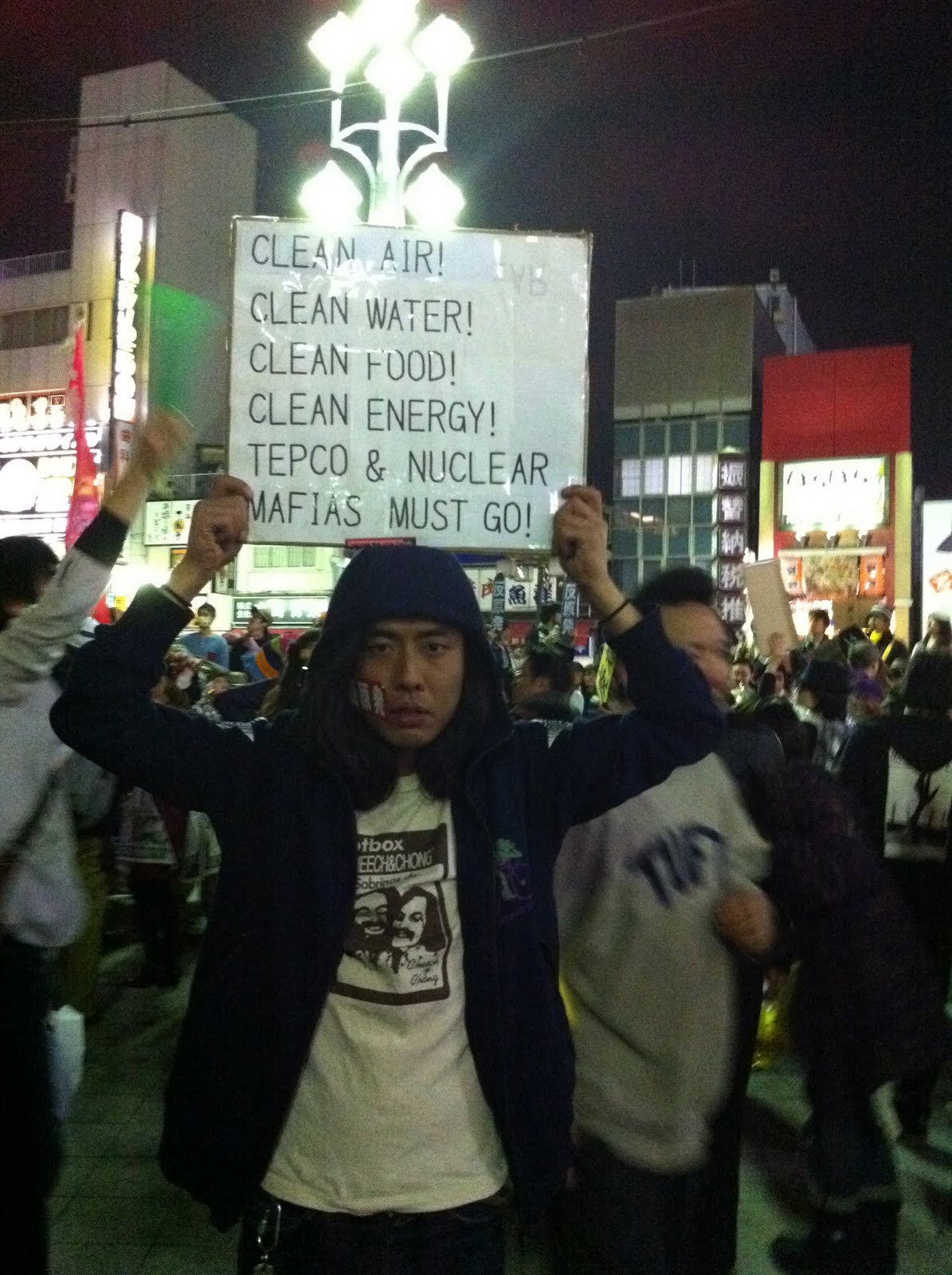
"TEPCO and nuclear mafias must go"


Watch the website of the April 10th 'Stop Nuclear Power Plants! Global Action Day' for updates on solidarity actions that took place in countries around the world including Canada, France, Germany, Korea, Mexico, the United Kingdom and the United States, as well as cities throughout Japan.

Your assistance in spreading the word regarding the "Stop Hamaoka!" petition will also be greatly appreciated.

—Kimberly Hughes