Links

Showing posts with label Tokyo. Show all posts

Thursday, September 17, 2015

Japanese citizens protesting as LDP/Komeito postpone Abe war bills until 8:50 a.m.; former Supreme Court justice warns the unpopular government that it is unlikely that the "unconstitutional" legislation would survive a legal challenge.


 (Photographer: Shinta Yabe)

Update: Sept. 18 - A citizens’ group is preparing a lawsuit to challenge the constitutionality of the national security laws that were enacted on Saturday to the Japanese government to send soldiers to fight in foreign wars. The suit now has 1,000 plaintiffs, according to Jiji via JT.

Update: Sept. 17 - The opposition parties submitted a no-confidence motion to the committee chair Yoshitada Konoike. Then Masahide ("Moustache") Sato took over the chairman's seat, after which opposition members made very long speeches to defend the motion. However, following the script, the committee voted against the motion.

Then as Konoike returned to his chairman's seat, dozens of opposition members rushed towards Konoike, appearing as if they were trying to stop the voting on the bills. The "scuffle" made worldwide newspaper headlines.

Some analysts are asking why the opposition parties stopped blocking the entrance, and allowed the September 17 committee meeting to take place, knowing their no-confidence motion was going to, of course, be defeated.

In the meantime, over 200 lawyers in Japan have issued a statement calling the "voting" among the wild scuffling at the special committee illegal and invalid.

Many are asking why opposition party members allowed this final assembly to happen after they said they would do everything to stop the bills.

Update: 5:10 a.m. - After opposition party members physically blocked the entrance to the special committee room on September 16, the special committee was delayed until 8:50 a.m.  The protest is still ongoing: http://iwj.co.jp/channels/main/channel.php?CN=4

The not-so-young politicians inside the building must be exhausted.

Update 2:05 a.m. - The Upper House Special Committee on the Abe war bills has not started yet as of 2 AM in Japan. LDP/Komeito is planning to get the committee to vote for the war bills tonight.

If it begins, it will be livestreamed here: http://www.webtv.sangiin.go.jp/webtv/index.php.

The protest outside of the Parliament is being livestreamed now at Iwakami Yasumi journal:
http://iwj.co.jp/channels/main/ .

Along with the majority of the Japanese mainstream citizenry, cultural figures such as Nobel Laureate Kenzaburo Oe and filmmaker Hayao Miyazaki, former prime ministers, the majority of Japanese lawyers, including former Supreme Court justices are protesting the bill as unconstitutional.

Former Japanese Supreme Court Justice Kunio Hamada on Abe War Bills called the bills "unconstitutional and "illegitimate."  Hamada warned that it is “extremely optimistic” for the Abe government to think that Supreme Court will not rule against the legislation if its constitutionality is challenged in court.

Monday, March 9, 2015

Tokyo fire bombing survivor: "Japan starting down road to war again" • Remembering the victims & survivors of the bombings of 67 Japanese & Okinawan cities from 1942 through 1945, & all bombing victims worldwide from 1911 to 2015

Katsumoto Saotome, a survivor of Great Tokyo Air Raids, wears a headband 
with words reading 'Kamikaze' on it, which he carried during an evacuation in the bombing.
(Photo: Reuters)

Reuters journalist Elaine Lies's article on the commemoration of the firebombing of Tokyo, "Tokyo fire bombing survivor fears Japan starting down road to war again," gives voice to one of the many Pacific War survivors warning us about the Japanese government's remilitarization.
Katsumoto Saotome was 12 the night he ran for his life through a sea of flames, jumping over smoldering railroad ties along a train track as U.S. B-29 bombers rained incendiary bombs down around him...

Now, as memories fade of how civilians suffered during World War Two - suffering Saotome blames on Japan's wartime leaders who thought of their citizens as "weeds" - the 82-year-old author fears Japan may be marching toward war again.

"I think we're turning backwards, down that road," said Saotome, citing Prime Minister Shinzo Abe's plans to change Japan's war-renouncing constitution, his more muscular security stance and a state secrets act passed last year.

"Everyone thinks at first that it's nothing, but more and more things accumulate, and then it's repression. I worry about what happens to women and children in this situation. We have to talk about it, maybe that will put a brake on things."

For Saotome and others of his age, the war stole their childhood. In school, before being conscripted to work in factories, they learned that the "kamikaze" divine wind would annihilate Japan's enemies. Should Japan lose, they would have to choose death over dishonor and kill themselves...

With more than 80 percent of Japanese, including Abe, born after the war, Saotome worries that reluctance to discuss painful issues may mean repeating past mistakes. Political apathy is also a worry, he says...

"Those of us who survived have a duty to become a voice for the voiceless," Saotome said. "If I'm quiet, it means I've accepted the situation. If we don't speak up, the past will be made to disappear."
As we remember the 70th anniversary of the March 9-10 all-night US firebombing of Tokyo, we also remember the largely forgotten firebombings of over 66 other cities in Japan and Okinawa. Historian Mark Selden has noted  that the scale of civilian casualties in Japanese cities "had no parallel in the history of bombing."

The US bombed Kobe, then the sixth largest city, with a population of one million, in 84 air raids, between April 18, 1942 to August 15, 1945. On July 24, 1945, a US B29 dropped 4 experimental "mock" atomic bombs ("pumpkin bombs") , with the same scale and weight as the "Little Boy" nuclear bomb dropped on Hiroshima, on Kobe. With a total death toll of more than 8,000, the death rate of civilians par square mile in Kobe was worse than that of Hiroshima and Tokyo.  Studio Ghibli's 1988 Grave of the Fireflies, an acclaimed animation about 2 child survivors of firebombings, was set in Kobe.

Before Tokyo and Kobe, on October 10, 1944,  US bombers began "softening up" assaults on Naha, the capital of Okinawa, destroying 80 to 90 percent  of the city. A thousand Okinawan civilians, twice as many as Japanese military personnel, were killed during the 10/10 raid. Colonel Yahara, the only surviving senior staff officer of Japan’s 32nd Army, wrote in The Battle for Okinawa (1972) that that the 10/10 destruction of Naha was “a sad foretaste of the tragedy to come” to Okinawa and mainland Japan. Yahara said Imperial Japan should have surrendered earlier to stem the loss of civilian life.  Most of the civilians who died during the Battle of Okinawa were killed by American bombardments.

The US bombings of Tokyo began in December 1944 and continued through August 13, 1945. March 9-10 was the worst of more than 60 air raids on Tokyo: over a hundred thousand civilians were killed and most of old capital was destroyed in one night.

In March 2007, 112 survivors and family members announced they would sue Japanese government for an apology and damages. The the plaintiffs, the oldest of whom was eighty-six and whose average age was seventy-four at the time, filed the suit with the Tokyo District Court in April. As expected, in 2013, the Japanese Supreme Court upheld the dismissal of the lawsuit.

However, the plaintiffs were able to tell their story, in their voices. Following this action, other lawsuits brought by Pacific War victims against the Japanese government, also raising the issue of war responsibility and accountability, followed, including actions by survivors of the Battle of Okinawa and the survivors of the Japanese fire bombings of Chongqing from 1938 to 1943 which killed 10,000 civilians.

Other Japanese cities the US bombed include Sendai (March 10 and July 19, 1945);  Osaka (March 13-14, 1945); Kagoshima (June 17, 1945); Moji, Nobeoka, Okayama and Sasebo (June 28); Takamatsu (July 4, 1945); Kofu (July 6, 1945); Gifu, Sakai, Sendai and Wakayama (July 9, 1945), Toyama (total destruction on Aug. 1-2, 1945).

According to the Shock and Awe Conference on Aerial Bombing held at the London School of Economics in November, 2011, the "development of aerial bombardment was more than just a military revolution.' [Aerial bombardment] "redrew the legal and moral boundaries between civilians and combatants, spread the theatre of war into new environments and expanded the battlefield, making cities into places of mass death and taking warfare into private, domestic spaces." This era began in 1911 when an Italian pilot, Guilio Cavotti, dropped the first bombs from a plane to the oasis of Tagiura outside Tripoli in north Africa during the Italian-Turkish War f ought between the Ottoman Empire and the Kingdom of Italy from September 29, 1911, to October 18, 1912 over the colonial control of Libya.

In the seventy years since the end of Pacific War, war memories and growing awareness of suffering of victims and survivors throughout the Asia-Pacific has continue to fuel peace building efforts by survivors and their descendants. Last June, 1,760,000 supporters of the Japanese Peace Constitution delivered a petition to Prime Minister Abe asking him not to change Article 9.

Background:

Film critic Roger Ebert - Grave of The Fireflies (video talk on Youtube)

"Tokyo fire bombing 70th anniversary: Survivors beg Japan to remember the forgotten 100,000" (David McNeill, The Independent, March 10, 2015)

"Saotome Katsumoto and the Firebombing of Tokyo: Introducing The Great Tokyo Air Raid" (Translation and Intro by Richard Sams, APJ, March 9, 2015)


"The Firebombing of Tokyo: Views from the Ground" (Brett Fisk and Cary Karakas, The Asia-Pacific Journal, Jan. 17, 2011)

"China and Japan at War: Suffering and Survival, 1937-1945" (Diana Lary, The Asia-Pacific Journal, Nov. 29, 2010)

"The Great Tokyo Air Raid and the Bombing of Civilians in World War II", The Asahi Shimbun, reposted at The Asia-Pacific Journal, March 11, 2010)


-JD

Saturday, July 12, 2014

Sunday, June 8, 2014

Jordan Sand: "Tokyo Vernacular: Common Spaces, Local Histories, Found Objects" - Author's Lecture at Sophia Univ, June 9, 2014


Today at 6: 30 p.m.. cultural historian Jordan Sand will give a public talk at Sophia University (Bldg. 10, Room 301) on his new book, Tokyo Vernacular: Common Spaces, Local Histories, Found Objects.

A must-read for anyone who lives in or is interested in Tokyo, Temple University historian Jeff Kingston's review at the LA Review of Books is a great synopsis/commentary:
TOKYO IS HOT these days, and not only because it has cutting-edge design, fashion, and more Michelin stars than anywhere else on the planet...Alas, it is also about 160 miles from the Fukushima Daiichi Nuclear Power Plant where there were three meltdowns in March 2011. There are still 100,000 nuclear refugees who have fled the adjacent hot zones, and it appears that many will never be able to return to their ancestral homes.

In his excellent new book, Tokyo Vernacular: Common Spaces, Local Histories, Found Objects, Jordan Sand, a Georgetown University professor of Japanese history and culture, draws our attention away from the headline hype to reveal what Tokyo and some of its denizens are really up to and what they care about. Drawing on extensive fieldwork, Sand slips us under the skin of this megalopolis and helps us understand how it has been evolving, focusing on the battles and passions that have animated neighborhoods, activists, and artists...

Controversy has clouded the euphoria that followed the winning bid for the 2020 games, as about 90 percent of Japanese don’t believe Abe’s reassurances to the International Olympic Committee that the problems at Fukushima are under control...

Tokyo’s Olympic slogan is “Discover Tomorrow,” a motto meant to convey an upbeat message about recovery from the 3/11 disasters and signaling that the story of Japan’s decline has been exaggerated, given bright prospects for its cutting-edge technologies and industries. But when Tokyo got the nod, NHK television showed images of what the snazzy Olympic athlete’s village will look like, then jumped to an interview with some displaced Fukushima residents forced to live in shabby temporary housing due to the reactor meltdowns. Unsurprisingly, they expressed envy and resentment while raising concerns about the diversion of resources and construction crews to Tokyo...

The extensive 1964 Olympic demolition and rebuilding was the third ravaging of the city during the 20th century, following the 1923 earthquake and the March 1945 firebombing that leveled vast swathes of eastern Tokyo. A fourth maelstrom hit with fin de siècle urban renewal, as the erection of shiny high-rises and tony shopping complexes transformed large areas of the formerly distinctive cityscape, making parts of Tokyo look like any city anywhere. The demolished low-rise, low-density neighborhoods of single-family homes and mom-and-pop shops might have been a bit dilapidated, but they exuded a coziness and sense of community that has been erased. Sand helps us understand what has been lost, as intimate exchanges of neighbors have given way to impersonal market exchanges...

Since so many people lost friends and family in the 1945 firebombing by the United States, it is one of the most retold stories in oral histories, with accounts of spectacular flames and the apocalyptic aftermath of a city reduced to ashes and panoramic vistas over smoldering ruins. But outside of Japan this is one of the forgotten horrors of WWII...

The battles over public spaces continue into the 21st century, especially in the wake of the Fukushima nuclear disaster...

Although much of this narrative dwells on loss and retreat, Sand closes on a rousing note:
Yet time plows forward, burying histories and throwing up new ruins in its wake. New groups of people will gather around surviving places and things, making them tell new stories of loss and redemption, and creating new societies of friends.

Thursday, May 1, 2014

Nobel laureate Kenzaburo Oe speaks out on Okinawa problem in Tokyo

Via Ryukyu Shimpo: "Nobel laureate Oe speaks out on Okinawa problem in Tokyo":

On April 26, Nobel laureate and novelist Kenzaburo Oe and other scholars discussed the Okinawa military base issue at a symposium held at a campus of the Hosei University in Tokyo...

A symposium on the Futenma-Henoko issue was held in Tokyo on April 26. Nobel laureate and novelist Kenzaburo Oe, Gavan McCormack, an emeritus professor of the Australian National University and Masaaki Gabe, a professor at the University of the Ryukyus, made the keynote lectures. After that, the participants discussed the relocation issue of the U.S. Marine Corps Air Station Futenma...

Novelist Oe visited Okinawa many times to conduct interviews with residents about mass suicides during the Battle of Okinawa for his book of essays, Okinawa Notes. “We should not allow the government to destroy democracy by exercising the right to collective self-defense. We are concerned that the people of Okinawa will suffer great damage,“ he said. “Let us protect our pacifist constitution. This is the action or struggle that we living in the mainland of Japan can take up for the sake Okinawan people.”

Friday, April 11, 2014

Cherry Blossoms in Hibiya Park

Cherry Blossoms in Hibiya Park, Tokyo (Photo: Kimberly Hughes) 

Monday, April 7, 2014

Cherry Blossoms in Shinjuku Gyoen

Cherry Blossoms in Shinjuku Gyoen, Tokyo (Photo: Kimberly Hughes) 

Tuesday, March 18, 2014

Kenzaburo Oe, Jakucho Setouchi, Masahide Ota found “1000-member committee to prevent Japan from entering wars" (Rally @Hibiya Park, March 20, 2014)


ARTICLE 9: Aspiring sincerely to an international peace based on order, the Japanese people forever renounce war as a sovereign right of the nation and the threat or use of force as means of settling international disputes. In order to accomplish the aim of the preceding paragraph, land, sea and air forces, as well as other war potential, will never be maintained. The right of belligerency of the state will not be recognized.
The Abe administration wants to reinterpret and revise the Japanese Peace Constitution to send the Japanese Self Defense Forces (JSDF) fight on behalf of other nations under the rubric of "collective defense."

This is not a new political struggle.  Okinawans have been on the front lines of the remilitarization of their prefecture since 1945, when the American military took over former Japanese bases and began a decade-long series of seizures (by force) of Okinawan farms and homes, for further base expansion. The ink was barely dry on Japan's pacifist Constitution, when in the early 1950's, Allen Dulles agitated for full Japanese remilitarization. The then Secretary of State wanted a Japanese military of between 300,000 and 350,000 men, to assist in US wars in Asia. Richard Nixon, as vice-president, supported Dulles, stating that Article 9 was a "mistake" while visiting Tokyo in 1953.

However, Dulles and other Cold War hawks were repeatedly thwarted by the majority of Japanese citizens who resisted the call to war (albeit during the sacrifice of Okinawa, which endured direct US military rule until 1972, serving as a major US weapons testing and combat training site during the wars in Korea and Vietnam).  Historian John Dower attributes Japan's pacifist policy to the democratically expressed will of the people, in John Junkerman's 2006 documentary film, Japan's Peace Constitution:
People who remembered what war was really like said, "We can't do this again. We have to cherish these ideals." The government, however, was saying, "Oh, we've got to go along with America." And so you have this split in Japan...
In the face of the Japanese citizenry's overwhelming support of Article 9, Japanese postwar governments fell into a gradual, barely noticeable process of chipping away at the prohibitions of Article 9 and growing JSDF capability. According to the Stockholm International Peace Research Institute, Japan now ranks in the top ten countries in the world in military expenditure.

This slow pace shifted when neo-cons wielded control of US foreign policy during the Bush-Koizumi years.  Not only did they instigate the invasion of Iraq, but they also resurrected Cold War tensions in Asia, after a decade of thawing relations between China and Japan. Former PM Koizumi bowed to American neo-con demands to hasten Japan's remilitarization, at the same time he began his controversial visits to Yasukuni Shrine, reopening wartime wounds. During the Japanese neo-con's tenure, he worked to erode the remaining vestiges of Article 9, going as far as to send 1,100 members of the Japan Self Defense Force to Iraq (ostensibly for non-combat support), even though Iraq has never posed a threat to Japan.

Perhaps because of ongoing remorse for the millions of people killed during the Second World War, and perhaps because of vivid memories of fire bombings of all of Japan's major cities, the Battle of Okinawa, and the nuclear bombings of Hiroshima and Nagasaki, the Japanese and Okinawan mainstream challenged Koizumi's support of the US invasion of Iraq, similarly to the ongoing challenge of the Abe administration's assaults on what's left of Article 9, the only thing that keeps Japan from falling into the abyss that is war.

Concerned about their nation, high profile Japanese figures are increasingly speaking out on behalf of Article 9, the peace clause. On the eve of his birthday in December, Emperor Akihito (tutored by an American Quaker during his youth) defended Article 9. Then, on the eve of his birthday in February, Crown Prince Naruhito attributed Japan's peace and prosperity to the pacifist Constitution.

And this month, The Asahi, the Japan Daily Press and the Ryukyu Shimpo (one of Okinawa's two major daily newspapers) reported on the establishment of a “1000-member committee to prevent Japan from entering wars." Founding members include Nobel Laureate Kenzaburo Oe, Buddhist nun Jakucho Setouchi, and former Okinawa governor Mashide Ota.

The Asahi:
"We have to stop the move to allow the Cabinet to undermine Article 9 simply by reinterpreting the Constitution," said constitutional scholar Yasuhiro Okudaira, professor emeritus at the University of Tokyo and one of the 16 founding members of the group...

"While Japan should contribute to world peace, it is becoming a country that can export arms and enter war," said writer Keiko Ochiai, another founding member.

Tetsumi Takara, a professor of constitutional law at the University of the Ryukyus in Okinawa Prefecture, commented, “For the Okinawan people who have experienced war, it looks as if war is imminent.”
JDP:
Distinguished writers, scholars and other academics in Japan have joined forces to challenge the government’s move to reinterpret the country’s Constitution. A group aiming to gather one thousand members, calling themselves the “1,000-member committee to prevent Japan from entering war..."

...Writer Makoto Sataka also reminded, “If the right to collective self-defense is granted, Japan would cross the line of ‘self-defense’ and also defend other countries, obliging Japan to engage in a war led by the United States.”

...Currently, 83 people have already signed the group’s appeal, including writer Jiro Akagawa, songwriter Reiko Yukawa and actor Bunta Sugawara.
Ryukyu Shimpo:
In an attempt to prevent the reinterpreting of Japan’s Constitution by the Abe administration to be able to defend allies who come under attack, on March 4, distinguished intellectuals set up a group called the  They proclaimed, “We will step up our criticism of and protest action against the government which has been trying to change Japan to enable it to enter wars. They treat Article 9 as a dead letter and approve the use of the right of collective self-defense.”

Founders of the committee are cultural workers and intellectuals such as writer Kenzaburo Oe, Buddhist nun Jakucho Setouchi and play writer So Kuramoto. Tetsumi Takara, a professor of graduate school of law of the University of the Ryukyus took part in the press conference. Former Okinawa Governor Masahide Ota also joined as a founding member.

In their announcement, they referred to Okinawa, which hosts U.S. military bases, as being closely related to the issue of collective self-defense. They criticized the government, saying, “Without lessoning Okinawa’s burden of hosting the bases, they are forcing through building a new base in the Henoko district of Nago."

The committee will hold a rally on March 20 at the Hibiya Open-Air Concert Hall in Tokyo. In addition, they will work to collect signatures and set up committees across the country."
Background:

John W. Dower, "Asia and the Nixon Doctrine: The New Face of Empire, Open Secret: The Kissinger-Nixon Doctrine in Asia, Eds. Virginia Brodine and Mark Selden, 1972. 

Japan's Peace Constitution (Transcript), Director: John Junkerman, 2006.

More Info: 

Article 9 Association 

Global Article 9 Campaign

Colin P.A. Jones, "Japan’s Constitution: never amended but all too often undermined," The Japan Times, March 26, 2014. 

Lawrence Repeta, "Japan’s Democracy at Risk – The LDP’s Ten Most Dangerous Proposals for Constitutional Change,The Asia-Pacific Journal: Japan Focus, July 15, 2013.

John Junkerman, "The Global Article 9 Conference: Toward the Abolition of War," The Asia-Pacific Journal: Japan Focus, May 25,  2008.

Yoshikazu Sakamoto, "The Postwar and the Japanese Constitution: Beyond Constitutional Dilemmas," The Asia-Pacific Journal: Japan Focus, November 10, 2005.

Friday, February 21, 2014

IMA 3-Year Anniversary @ Tokyo this Sunday: Celebrating awakening, resilience, compassion, community as we transition to a Post-3/11 World

Right: Poster for Jeffrey's Jousan's "Tohoku Laughing"; Right: Dean Newcombe and Justin Berti of IMA. 

Until 3/11, nuclear plants supplied one third of Japan's energy; they're all offline now. However, they're poised for restarts in March. Instead of systemizing the radical energy conservation efforts instituted right after the Fukushima meltdowns and aggressively supporting a shift to renewable energy, the Japanese government and energy companies have turned to global-warming fossil fuels: oil, coal, LNG (liquified natural gas) to make up for the loss. Because of this increase in imported energy (compounded by a monetary policy aimed at devaluing the yen), Japan posted a record trade deficit in 2013, an economically unsustainable situation used to justify the planned return to nuclear power. 

However, the proposed restarts won't be met with complacence. Heightened awareness and social energy in post-3/11 Japan has given rise to deepening collaboration between old and new Nuclear-Free activists, Japanese people and expats, across interrelated issues (organic, local, slow, low-consumption, fossil-free, renewable energy, fair trade), and across borders.

This month a lot of this amazing energy is visible above radar. Canadian environmentalist Severn Cullis-Suzuki (daughter of David Suzuki) is traveling throughout Japan, screening Occupy Love, Velcrow Ripper's third film in his "Fierce Love" trilogy about nonviolent grassroots environmental and social change movements.

And one of the founders of Beautiful Energy, Dean Newcombe, has been spotlighted in a nice feature by Liane Wakabayashi at JTThe Japan-based Scottish model, founder of Intrepid Model Adventures, shared his story about how he was spurred to personal action after witnessing the plight of 3/11 survivors.

Knew Dean Newcombe and his colleagues are dynamic, but didn't realize the breadth, depth, interconnections of their activities. It's a little hard to keep up: volunteering and raising funds for reconstruction in Tohoku; bringing hot meals to and supporting nuclear evacuees from Futaba; supporting fair trade; raising funds for typhoon reconstruction in the Phillipines; instituting a scholarship fund for an orphanage in Bali; supporting Hafu David Yano's NGO which is building a school in Ghana; initiating Beautiful Energy's Nuclear Free/Renewable Energy advocacy every Friday in Tokyo; and screening socially significant films.

The charismatic leader and networker  explained how serendipity, combined with intentional support of authenticity, snowballed his initiative in Tohoku into many directions :
“One of the surprises that perhaps I didn’t expect,” says Newcombe, “is that the volunteers that worked with me in Tohoku would step forward to suggest Tohoku-related support projects that we could do in Tokyo.”

“I want them to apply skills they were born with to make right what they believe is wrong. Deep down we all see what is wrong and unjust in this world. It’s just our choice whether we do something about it!”
This Sunday, IMA and related groups are celebrating their three-year anniversary all day at the Pink Cow in Tokyo.

2pm – A documentary film "Tohoku Laughing" (笑う東北) by Jeffrey Jousan (30 minutes)

Events include the screening of Tohoku Laughing" (笑う東北), a 30-minute documentary by Jeffrey Jousan:
Filmed in September 2012 in Miharu, Fukushima, Ishinomaki, Kitakamigawa, Oiwake Hot Spring and Minami Sanriku

It took about 2 years after the Tsunami but people in Tohoku that we met started saying that they could finally laugh again,as if they had entered a new stage in dealing with their horrific experiences. Everyone's process of dealing with these events continues and will continue for some time.

This is a little film to share the healing and life affirming power of laughter, from the awesome people of Tohoku. Please come to Tohoku and laugh!
This post sounds like a valentine, because it is, to all at Beautiful Energy, Hot Meals for the People of Fukushima (双葉町交流プロジェクト( and IMA, MTM, et al., with appreciation for their efforts (born out of compassion), creating ripple effects, bringing people together in unexpected ways to help actualize the best in each other and a peaceful, affirmative, life-sustaining world.

(Photo: Beautiful Energy)

Sunday, February 9, 2014

Snowy Weekend in Tokyo

"Snowy Weekend in Tokyo" (Photo: Kimberly Hughes) 

Monday, January 6, 2014

Shiho Fukada: Japan's Poor, Homeless, Outcasted and Forgotten


Japan's structural economic problems are further alienating its already marginalized populations.

Photojournalist Shiho Fukada goes beyond the bright lights of Tokyo to document the country's unemployment crisis: disposable workers who are easily fired and live without a social safety net. They are usually shut out from the rest of the society, living in poverty but rarely acknowledged by their fellow citizens.

Fukada's photographs add a human face to widely discussed issues—from day laborers living on the streets to educated women taking banal jobs. She reveals the other side of Japan where alcoholism, hopelessness and suicide are increasingly commonplace.

This report is part of a Pulitzer Center-sponsored project, "Japan's Disposable Workers: Lost in the Global Unemployment Crisis."

Hiromi, 58, an unemployed day laborer, picks through garbage to see if he can find anything of value to sell. 
(Image by Shiho Fukada. Japan, 2009)


People wait in line to sleep inside a labor center in Kamagasaki. 
The center used to attract workers from all over Japan for high-paying day labor,
 but with jobs so scarce today it is used as a homeless shelter during the evening. 
(Image by Shiho Fukada. Japan, 2009)


A picture of Mount Fuji hangs under a highway where a homeless man sleeps in Osaka.

Sunday, November 17, 2013

"War is Over! (If You Want It): Yoko Ono" • Sydney MCA • Nov. 15, 2013 - Feb. 23, 2014


"WAR IS OVER! (IF YOU WANT IT)" opened Nov. 15, 2013 at the Museum of Contemporary Art in Sydney.  This is the first major survey in Australia of legendary artist, musician and peace activist Yoko Ono. "The exhibition encompasses five decades of practice in diverse media including eight participatory works. Themes include loss, conflict, humanity and the desire for world peace."  Ono designed the interactive parts of the exhibition to encourage collaboration, linked to a central theme of world peace.

Curated by MCA Chief Curator Rachel Kent, the title comes from a text by Ono and her late husband John Lennon that first appeared in 1969—in the middle of the Vietnam War—across public billboards in twelve cities worldwide, including Tokyo, Hong Kong, Toronto, Berlin, Paris, New York, and London.

While other visual artists have also engaged in peace art and activism, Ono is perhaps the most renowned peace artist of our time.  How did the impetus for her highly focused creative work originate?

Ono has explained that a childhood experience of the firebombing of Tokyo awakened her understanding of the human costs of military violence, fueling her peace art and activism for five decades.

Her father was an international banker and moved his family between the United States and Japan, so, as a child, Ono developed positive attachments to both countries. When the Pacific War broke out, she was eight-years-old, living in Tokyo.  She and her family survived (by taking shelter in a basement in their Azabu home) the firebombings of Tokyo, including the massive March 9-10, 1945 raid—the most destructive bombing raid in world history. At minimum, the napalm-fueled bombings destroyed 16 square miles (41 km2) of the city and killed 100,000 people.

In a 2007 interview with Amy Goodman:
I remember, when I was a little girl, a young — you know, when I was very young, one day I had high fever because of just a cold. You know, I had a cold.

And so, my family all went down into the basement to make sure that, you know, they’re alright. It’s a kind of shelter that they created in the garden actually. But I couldn’t go.

And I was just sort of in my bed, and I saw that all the houses next to us and all the places around me were just all fire. I go, "Oh." But, you know, when you’re young, and that’s the only reality you’re working through, you don’t really get totally scared or anything. You know, you’re just looking at it like an objective film or something like that. "Oh, this is what’s happening," you know?

And because of that memory of what I went through in the Second World War, I think that I really — it embedded in me how terrible it is to go through war.
To those who charge that she is "optimistic" or "naive," Ono points out that she is a simply a resilient pragmatist who cares about life and our planet—and does what she can do—which includes encouraging others to do what they can do to support peace building at multiple levels:
Well, you know, most people say, "Oh, you’re so optimistic. I mean, what’s wrong with you?" I’m not really that optimistic.

I am trying to make us survive. And in the course of survival, we don’t have the luxury to be negative. That’s a luxury that we can’t afford.

 And we just have to do what we can do. And I think that instead of getting so upset with some people, you know, or some countries which are doing this, doing that — "How dare they," whatever — I think we should just do what we can do.
 In a Reuters article about this current exhibition, she compares 1969 with 2013:
When John and I stood up, very few people were activists. Now I think 90 percent of the world is activists. If you're not an activist, you'd be considered a nerd maybe.

 (Image: Colin Davidson, The Guardian)

"Pieces of Sky"—WW II German helmets with blue jigsaw pieces inside.
Visitors are told, "Take a piece of sky. Know that we are all part of each other."


"Play It By Trust"/"White Chess Set"
(Photo: Iain MacMillan,© 1966 YOKO ONO)

Shinya Watanabe:"Through her simple alteration of the chessboard
 (a war strategy game), the artist made it extremely hard for the chess players to 
 fight each other, and this creates new relationships between the opponents."


Friday, November 15, 2013

Beautiful Energy - 1st Anniversary Celebration - Tokyo - Nov. 30, 2013

(Photo: Beautiful Energy)

Via Jacinta Hin and Natsu no Color of Tokyo-based Beautiful Energy/The Stand for a Nuclear-Free World.
Beautiful Energy is... born out of the weekly Friday anti-nuclear demonstrations in Tokyo in front of and around the prime minister's residence and Parliament. Through inspired, peaceful action we stand for a nuclear-free world that thrives on renewable energy.

Our current, ongoing project is Candles for Peace. Every Friday, from 6-8pm Japan time, we gather in front of parliament in kokkai gijido, joining the weekly anti-nuclear protest, and create a beautiful display of candlelight to symbolize our intentions...
This group of visionary citizen activists in Tokyo radiate positive (and beautiful) emotional, ethical energy and holistic vision.  They're engaged in outreach and support for Fukushima nuclear refugees, (including bringing hot meals to elder refugees living in a shelter).  Sharing their kind of healing, constructive worldview is a first step in our collective transition from toxic to nontoxic, renewable energy production and use.
In November it will be one year since we lighted our Beautiful Energy candles for the first time. Time for a little celebration!

You are invited to our anniversary party in Tokyo on November 30. Join us for an intimate evening with live music, delicious graceful vegan foods and of course candles!

Date: November 30 (Saturday), from 19.00 – 22.30pm
Place: Bar GariGari (Tokyo, Setagaya-ku, Daizawa 2-45-9, .. Building B1 /

http://tabelog.com/tokyo/A1318/A131801/13126176/dtlmap/ / opposite Ikenoue Station, Inokashira-line (2 stops from Shibuya)

Charge: 2,000 yen (inclusive vegan buffet foods, music charge and charity donation).

* Vegan foods provided by our Friday neighbors Yuko Ogura and Yayoi Ito of Guerilla Café

* Drinks are not included. Please order at least one drink at the bar

* 500 yen will go to Share Your Christmas (SYC). SYC collects and brings Christmas presents from around the world to people in Tohoku affected by the 3/11 earthquake, tsunami and nuclear disaster (https://www.facebook.com/shareyourchristmaswithtohoku)

Please bring your own chopsticks, so we may reduce waste and spread eco-energy!

19:00 Start

19:20 Anniversary Speech

19:30 Special Message from people from all over the world♪

19:45 Music time: nuclear-free world songs by Natsu, Chris and other Beautiful Energizers! (details to follow)

20:30 Enjoy conversation with each other!

22:30 End

Kindly let us know no later than November 20 if you plan to attend (and sooner if you can).

Tuesday, November 12, 2013

7th Organic Film Festival - Tokyo - Nov. 23-24, 2013


Via Organic Consumers Union:
The 7th organic film festival will be held in Tokyo on November 23-24, 2013.

This will be a great opportunity to catch up with recent trends and watch documentaries from Japan and abroad. The theme this year is “Holding on to the Soil” to reflect the hardships many farmers are experiencing, with special focus on Okinawa and Fukushima.

Location: Hosei University, Sotobori Campus (between Iidabashi and Ichigaya stations on the Sobu line)

Tickets: 1800 Yen (pre order) 2500 Yen ( at the entrance)

For more information please check the official website (J): http://www.yuki-eiga.com/

Wednesday, October 16, 2013

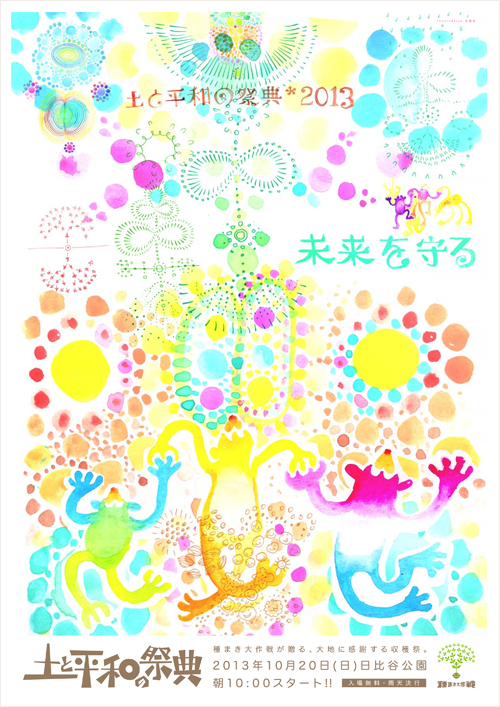
World Food Sovereignty Day • Soil and Peace Festival @Hibiya Park, Tokyo - Oct. 20, 2013


soil and peace festival 2013

Today is the international family farmer movement Via Campesina's World Food Sovereignty Day; and this weekend, Japanese organic family farmers and their supporters will join in a celebration of the best of visionary Japanese (organic, recycling, nuclear-free, GMO-free, fair-trade, Slow Life, satoyama, Tohoku-supporting) culture.

Via the Consumers Union of Japan:
There will be a Soil and Peace Festival in Hibiya Park, Tokyo, on Sunday October 20, 2013. Starting at 10:00 hundreds of farmers and activists and artists will hold a great event until the evening.

A great opportunity to meet your favourite NGOs and learn more about organic food, anti-nuclear campaigns and the future of Japan. Look forward to lots of inspiration! Music by Kato Tokiko and many others throughout the day, starting with a taiko performance by Gocco.

Website with more info (J) here.

Monday, October 14, 2013

40,000 rally in Tokyo for a nuclear-free and war-free Japan (and World); Global Article 9 gathering in Osaka

(Via Jacinta Hin and Beautiful Energy)

Good Morning world! Today is NO NUKES DAY in Tokyo, the day of the big demonstration. Many people from all over Japan coming together in protest to ask for a nuclear-free Japan.

If you're in Tokyo, JOIN, be seen, be heard, make a difference!

If you cannot join in person, be with all of us in spirit and heart.

To get you in the mood, we have the perfect song for you. Talented musician Natsu of our Beautiful Energy core group, has created a NO NUKES version of a famous pop song. Listen to her beautiful voice and soulful NO NUKES, BABY and be connected with us today!
At the end of September, nuclear-free supporters held two rallies after TEPCO asked for permission to restart TEPCO on Friday asked Japan's nuclear watchdog for permission to restart its Kashiwazaki-Kariwa nuclear power plant in Niigata Prefecture.

Since September 15, all of Japan's nuclear plants have been in shut-down for maintenance.
---

Also over the weekend, the Global Article Nine Campaign held 
its second international conference  supporting a (nuclear-free) world without war:  

Friday, March 1, 2013

Tokyo Waka: A (cinematic) poem about a city, its people, and 20,000 crows


Thanks to Aki Gibbons, SF-based visual artist and writer, who blogs  at Tokyo Dreaming and Okinawa Blue, for the head's up on Tokyo Waka: A City Poem, screening at the International Buddhist Film Festival, which opens in San Francisco today.

A  meditative exploration of Tokyo and post-Bubble, post-3/11 Japan.

Tuesday, February 19, 2013

3/11 Anniversary Remembrance by Beautiful Energy • 3/11 • Tokyo & Anywhere in the World


Via our friend, Jacinta Hin


下の方に簡単な日本語版があります。また編集します!

We are planning a series (day) of events on March 11 both in remembrance of the Tohoku Earthquake, Tsunami and the Fukushima Nuclear Plant disaster, and in support of the global stand for a nuclear-free world.
Please join us on this special day, either in person or remote from anywhere in the world.

Join in person, in Tokyo:

We will get together from 1.30pm in Yoyogi Park. At 2.46pm, the time that the Earthquake struck, we stand still in silence and meditation to honor those who lost their lives and everyone affected by the horrendous events of March 11.

From 6pm we will get together for an evening of candlelight, music and…being peacefully together with people who share the vision for a nuclear-free Japan and world.

簡単な日本語版です。後日また編集します。
来る3/11に、私たちは連続したイベントを計画しています!
東北震災や津波や福島の原発事故を忍び、世界中で核をもたないことに賛成している人たちに
賛同し、支持するためのイベントです。この特別な日にぜひ皆さんでご参加ください!
イベントに直接お越しいただいても、遠隔で世界中からこのイベントページに参加いただく形も
大歓迎です!

直接お越しいただける方:
3/11 13:30~ 代々木公園集合
14:26 震災が起きた時刻ちょうどに黙とうを
ささげ、震災でお亡くなりになった方や被災した方々
のために瞑想します。

18:00~ キャンドルライトや音楽などで平和をいのり、
核のない日本や世界へのビジョンをピースフルに共有します!
(場所や正確な時間は後日UPします。)

Join from anywhere in the world:

We want to create a chain of 311 candles around the globe. People can join the chain anytime on March 11, preferable from 2.46pm Japan time onward. For this we will be inviting people from around the world to participate. Please help us by suggesting anyone or any groups who might be interested. Post here or facebook message or email Jacinta (jacinta.hin@embrace-transition.com).

More details will be announced shortly.

About us:

Beautiful Energy is an IMA project and movement born out of the weekly Friday anti-nuclear demonstrations in Tokyo in front of and around the Prime Minister Residence and Parliament. Through inspired, peaceful action we stand for a nuclear-free world that thrives on renewable energy. Our current, ongoing project is Candles for Peace. Every Friday, from 6-8pm Japan time, we gather in front of parliament in kokkai gijido, joining the weekly anti-nuclear protest, and create a beautiful display of candlelight to symbolize our intentions. Intrepid Model Adventures (IMA) is a nonprofit, open community of hundreds, supporting thousands, standing for positive social change. IMA members share a desire to help and strive to live their lives in such a way that they may act as a positive influence.

Visit our Facebook pages: https://www.facebook.com/BeautifulEnergyTokyo
https://www.facebook.com/groups/BeautifulEnergy/