Links

Showing posts with label local. Show all posts

Tuesday, April 22, 2014

Helena Norberg-Hodge: On Earth Day, an Economics for People & Planet

Helena Norberg-Hodge's summary of the clash of two major worldviews we now see in play throughout our planet:
Much has changed since the first Earth Day in 1970. Not only have our ecological crises come into sharper focus, it has also become obvious that we need to rescue not just the Earth, but also its people from the clutches of an economy gone mad. Worldwide, more and more people are recognizing that fundamental changes to that economy are urgently needed if our most pressing problems – ecological, social, economic, and even spiritual – are to be solved. Instead of trying to tackle a seemingly endless list of separate problems, strategic shifts in economic policy would put us on a path that is good for both people and the planet.

Over the past decades, globalization, or the continued deregulation of trade and finance, has created a world dominated by giant banks and corporations. Because governments almost everywhere have catered to their demands, we are now faced not only with global warming, extinction of species and dramatic increases in pollution, but also with financial instability, endemic unemployment, increased conflict, and epidemics of ill health and depression...

We need to move in exactly the opposite direction – away from economic globalization and towards the local. This doesn’t mean eliminating all trade or adopting an isolationist attitude – it simply means shortening the distances between consumers and producers wherever possible....

The localization movement is beginning to bridge the divides between groups that are working to make the world a better place: environmental activists, small business owners, community leaders, educators, social justice campaigners, farmers, workers’ rights advocates, religious and spiritual groups. An exciting, once-in-a-generation coalition is emerging: a coalition that offers real hope for broad-based and lasting renewal.

Read the rest here: http://www.commondreams.org/view/2014/04/22-1

Monday, February 24, 2014

Kyoto Journal: Emerging Futures From Tohoku

Rensho-an, Koriyama, Fukushima (Photo: Kyoto Journal)

Great interview with Tohoku volunteer Bob Stilger by Mizuho Toyoshima and Lucinda Cowing at KJ.  In " Emerging Futures From Tohoku," Stilger describes how the vibrant and diverse civil cultures of Tohoku, a center for the slow and local movement, are rebuilding a post-3/11 Japan from the grassroots in myriad ways:
A week ago, Sunday, we had a delightful small, reflective dialogue at a place called Rensho-an in the town of Tamura near Koriyama, Fukushima. There was a group of maybe twenty people, most of them from the Tamura area, a few from other parts of Fukushima and elsewhere. Rensho-an is a beautiful space built by one Watanabe Shumei, a prolific artist and a man who enjoyed life. Over the course of Watanabe’s life — he died 7 years ago — it was a retreat space for people who knew of Watanabe’s work to come and spend time with him and Jinko, his wife. Jinko is now turning Rensho-an into a “learning center for life.” So, people came together just to be with each other, and to look back over their journeys these past few years.

After that dialog, I hosted a gathering of leadership from the Transition Town Movement in Japan and others from our Tohoku Futures Network. We spent two days to exploring what has transitioned in learning that might be useful in Tohoku at this important time.

After my meetings in Fukushima, I went to Otsuchi for the last of a series of four Future Sessions meetings, where people had come together to discuss what they could do themselves to make Otsuchi a better place to live. Some people in Otsuchi complain there that there are no longer any jobs; almost all fishing boats were destroyed in the tsunami. But those who attended the meeting are taking a different perspective and saying, “What do we have and how can we use it?” One of the ideas that they are working on is to make use of a local network of underground streams known to be incredibly pure and fresh, which enabled them in the past to cultivate wasabi, and also produce tofu. Now one idea is to recreate an industry centering on wasabi and tofu that last existed in the 1800’s, and tourism as well...

...one thing that has come up in many conversations is that conditions in each part of Tohoku are extraordinarily different. It is evident the coastal areas of Miyagi and Iwate have more in common with each other than they do with more inland areas of those same prefectures. When you visit Sendai, which is inland Miyagi, you find most people just want to get back to the old normal, whether or not they liked the old normal. That is not what is going on in the coastal areas. There is a sense that 3/11 opened up a new future, now it is a matter of finding out what it is and how to we create it...

There is a growing discontent over globalization, and in Japanese businesses much of this stems from not feeling connected to the people who buy and use their goods and services. Many are asking, “How do we relocalize?” This is one example of collective culture, in which the good and relationships of the whole takes precedence over that of the individual. The negative side of that is of course the idea that “the nail that sticks out gets pounded down” and feelings of “I don’t want to stand out.” That said, I have noticed over the past three years that the challenge of individuating from a collective culture is smaller than that of creating a collective out of an individualistic culture. 3/11 was a kick in the ass for people to stand up for what they believe, but they are doing this while staying connected to the collective at the same time. I think this is the energy we need all over the world: the capacity to differentiate while staying connected.
Bob Stilger charts his observations in "Fukushima's Future," published at Open Democracy:
In less than a day, nearly 18,000 people were dead or missing, and almost 300,000 were homeless. The old normal was gone. Today, communities in the region are struggling to reinvent their lives, but what will their future look like in a context that is permanently changed?

...People in Fukushima live in one of three broad realities.  Some are still overwhelmed with despair, since everything they know and love has vanished.  Some would leave Fukushima in an instant if they had a way to relocate elsewhere.  And others have declared that “this is our home, so we will make a new life here together.”  They know that the past is gone and that an unknown future is waiting to be born.

For many, this is not just a matter of regaining property or livelihoods, it’s a profoundly spiritual question that centers on the meaning of happiness and the quality of life...

This transformation is one of ordinary people who are raising their voices and using their hands, reaching out to each other, taking one step forward and then another, to build new lives in a place that they call home.

Monday, February 10, 2014

Severn Cullis-Suzuki "Love is the Movement" Japan Tour • Simultaneous screenings of Velcrow Ripper's Occupy Love


"If you can’t fix the environment, please stop breaking it!” Severn said to the world leaders at the Earth Summit in Rio in 1992. She was only twelve years old. A video of her speech presenting environmental issues from a youth perspective went viral, and Severn Cullis-Suzuki became known around the world as “The Girl Who Silenced the World for 5 Minutes." 

Severn, daughter of Japanese Canadian scientist and environmentalist David Suzuki, is now 34-years-old and an environmental activist, speaker, television host and author. She has spoken around the world about environmental issues, urging listeners to define their values, act with the future in mind, and take individual responsibility. 


For the first time in six years, Severn returns to Japan for “Love is the Movement” – a series of talks about the future of the human race in the face of global environmental crisis. Issues covered include the localization movement, the fair trade movement, and other movements that focus on quality of life for our children and future generations. 

Severn Suzuki will be at Kyoto's Ryukoku University on February 21st.
Details (in Japanese) here: http://kokucheese.com/event/index/141937/

Other stops include Tokyo, Nagoya, Kyoto, Fukuoka, and Shiga. 


Simultaneous screening of Canadian filmmaker Velcrow Ripper's Occupy Love, the third film in the inspirational "Fierce Love" trilogy about global grassroots nonviolent environmental and democratic movements. 

Schedule (Japanese):  http://unitedpeople.jp/occupy/jouei

Details on the "Love is the Movement" Tour (in Japanese) here: http://www.sloth.gr.jp/events/sev2014/

All about Severn Suzuki here: http://severncullissuzuki.com/bio
"Love is the Movement" on Facebook (in Japanese): https://www.facebook.com/sev2014

Tuesday, November 26, 2013

Final Staw: "What a Natural Farmer Eats"

(Video: Final Straw)

Via Final Straw, a documentary by Patrick Lydon and Suhee Kang:
This series of 'Short Take' interviews offer sneak peaks of characters from the upcoming documentary film, which explores Japanese natural farming and the relationships between people and the environment.

This time around, we meet Osamu Yoshino, a natural agriculture farmer, and Keiko Domae a food activist who started one of Japan's first Community Supported Agriculture (CSA) networks. These two individuals worked together to build a successful natural farm by fostering a strong consumer awareness of the relationship between food, farm, and people...

Natural Farming was brought to the modern day agricultural world by two Japanese farmers, Masanobu Fukuoka and Mokichi Okada, and since its introduction has been slowly making its way into communities around the world who wish to create a more sustainable life, and to create closer connections with the land in our towns and cities.

More about Final Straw:
Due for initial screening in Spring of 2014, Final Straw is a cinematic exploration of Japanese natural farming, and...individuals who offer simple solutions to modern issues of sustainability, both on the farm and in the city. The film interacts with a cast of office workers, chefs, musicians, and farmers alike, all of who are students of the late Japanese farmer/philosopher, Masanobu Fukuoka.

It all started on a small mist-covered mountain farm in South Korea, and continued to include over 20 natural farmers in East Asia and the USA...And today, with over 1/2 of the world’s population living in urban areas, it seems we need to revisit this connection with nature more than ever before.
More about Osamu Yoshino, Keiko Domae, and the development of CSA in Japan:

Natural Agriculture farmer finds locating a market more challenging than letting go of chemicals (Lisa M. Hamilton, Newfarm.org, Feb. 13, 2004)

Friday, November 22, 2013

Community-Supported Agriculture in South Korea: "Ground Zero for Food Sovereignty..."

The Korean Women’s Peasant Association (KWPA), a national organization of women farmers
 based in Seoul receive the 2012 Food Sovereignty grand prize. 
(Photo: Grist)

In "South Korea: Ground Zero for Food Sovereignty and Community Resilience," published last week at The Nation, Christine Ahn and Anders Riel Muller describe how South Korean small farmers and the communities, food buyers supporting them are challenging the country's industrial elite who want to end traditional organic Korean agriculture and outsource food production to corporate-owned plantations in Africa, Southeast Asia, and Latin America.  These visionary small farmers helping to pioneer the direction of sustainable agriculture for the world:
...And yet, despite a series of domestic and international policies that have sought to systematically eliminate them, South Korean farmers and peasants are fighting back. They have protested the WTO and bilateral free trade agreements (FTAs) for two decades, inspiring peasant farmers throughout the global south to mobilize against the free trade regime. At home, they are trying to build a domestic food sovereignty movement that is ecologically sustainable, socially equitable and economically resilient by producing healthy food, creating dignified rural livelihoods and reviving farming communities.

Instead of being blinded by South Korean high-tech bling, our eyes should be on South Korea’s food sovereignty movement. It offers the rest of us robust alternatives to the highly consolidated, industrialized, energy-intensive and chemical-dependent globalized food systems that dominate all of our lives.

In August, we co-organized and participated in a Food First Food Sovereignty Tour where we visited South Korea’s leading organic farms and progressive farmer-consumer cooperatives. South Korea is now a leader in the Asian region in organic production, so much so that the International Federation of Organic Agriculture Movements set up its offices there. And while there were many inspiring organic farms and gardens, two organizations stand out: the Korean Women Peasants Association (KWPA) and Hansalim.

“The food that is being sold by capitalism is sold as a commodity instead of food that sustains us,” explained Jeong-Yeol Kim of My Sister’s Garden, a KWPA project. “That’s why we believe that helping farmers thrive is the only way to fix this food crisis, and the pathway to do so would be to ensure that consumers and every citizen join us in the process of making this come true....

“Children today have no connection to the rural land,” explains Jeong-Yeol. Unlike previous generations, many children today no longer have grandparents or relatives living in the countryside who are connected in any way to farming. “So part of the effort of this partnership is to expose children to food production.”

...hese KWPA projects seek to radically alter the structure of the Korean food system and to de-commodify the linkages between consumers and producers. It has not been in vain. In 2012, KWPA was awarded with the Food Sovereignty Prize for their work to defend the rights of small-scale women farmers in Korea and preserve the cultural heritage of Korean native seeds.

In 1986, even before farmers’ markets and CSA programs became popular in the United States, South Korean farmers and consumers began Hansalim. “Han” in Korean means great, one, whole and together, and refers to all living things on earth. “Salim” refers to domestic activities that must be managed to care for one’s home, family, children and community, as well as to revive and give life.

With 2,000 growers and 380,000 consumer members, Hansalim is among the world’s largest and most successful agricultural cooperatives, creating an alternative economy that supports organic farmers and local agriculture, producing healthy food and protecting the environment in the process. Despite the global financial crisis, its sales have been growing annually by 20 percent.

Tuesday, November 19, 2013

Restoring the Soil, Restoring Ourselves: Yoshikazu Kawaguchi

Great photography and content about Yoshikazu Kawaguchi 
at filmmaker and photographer Patrick M. Lyndon's website
 Lyndon's and Suhee Kang's film, Final Straw, 
explores natural farming in Korea, Japan, and the U.S.

Ted Taylor's beautiful essay at KJ, "Even in 'Just Enough' There is Abundance," follows farmer Yoshikazu Kawaguchi's return to traditional organic farming and the development of his natural philosophy:
In fact, all life in the natural world is lived, as demonstrated in the interrelationship of all living things. Plants cannot exist without animals, and vice-versa. If there is good harmony between the organisms, plants, and animals, the cycle of life continues. As a farmer, Kawaguchi's role is simply to nurture this natural order, by cutting the weeds back just enough so that new rice shoots can grow, but later her allows the weeds to grow along with the rice in harmony. This leads to wholeness, with everything living together.
Final Straw, an upcoming documentary by Patrick M. Lyndon and Suhee Kang, also explores Kawaguchi's world  (and that of Seonghyun Choi and other natural farmers in Japan and Korea):


Environmental artist duo Patrick Lydon and Suhee Kang... are now in the final post-production stage for the Final Straw documentary. Due for initial screening in Spring of 2014, Final Straw is a cinematic exploration of Japanese natural farming, and a philosophical ride through the minds of amazing individuals who offer simple solutions to modern issues of sustainability, both on the farm and in the city. The film interacts with a cast of office workers, chefs, musicians, and farmers alike, all of who are students of the late Japanese farmer/philosopher, Masanobu Fukuoka.

It all started on a small mist-covered mountain farm in South Korea, and continued to include over 20 natural farmers in East Asia and the USA. The Final Straw is a story about food, life, and philosophy from individuals who have a great deal of delicious secrets, and a great deal of wisdom to impart about life. Yet, while the Final Straw is a deeply rooted exploration of natural farming, it’s also a film which teaches equally as much about how to live life as it does about how to grow healthy food. And today, with over 1/2 of the world’s population living in urban areas, it seems we need to revisit this connection with nature more than ever before.

Over the past 100 years, our gradual reliance on industry and separation from the natural world have pushed us into the most epically unsustainable and unhealthy time period yet known to humanity.

Food and diet have quietly become the leading cause of death in the U.S., and on a world scale, intensive chemical-based industrial agriculture have caused the deterioration of billions of acres of farmland, the starvation of millions of human beings, and the loss of over 75% of our planet’s agricultural diversity.

The destruction of natural resources continues at an alarming rate, and both governments and food producers are looking for answers to questions of human health and ecological sustainability, with a multi-billion dollar industry leading the charge to find the most economically profitable answer.

It’s slightly amusing then, that that on a few small farms tucked away in the mountain valleys of Japan and South Korea, Patrick and Suhee found a very simple 4,000 year-old answer to this very perplexing modern question.

Tuesday, November 12, 2013

7th Organic Film Festival - Tokyo - Nov. 23-24, 2013


Via Organic Consumers Union:
The 7th organic film festival will be held in Tokyo on November 23-24, 2013.

This will be a great opportunity to catch up with recent trends and watch documentaries from Japan and abroad. The theme this year is “Holding on to the Soil” to reflect the hardships many farmers are experiencing, with special focus on Okinawa and Fukushima.

Location: Hosei University, Sotobori Campus (between Iidabashi and Ichigaya stations on the Sobu line)

Tickets: 1800 Yen (pre order) 2500 Yen ( at the entrance)

For more information please check the official website (J): http://www.yuki-eiga.com/

Thursday, November 7, 2013

Keibo Oiwa on the Localization Movement & Heirloom Vegetable Revival in Yamagata


In Keibo Shinichi Oiwa Tsuji's (14-min.) talk, "Cultural Creatives and Localization Movements in Asia," at the 2013 International Society of Economics and Culture (ISEC)  Economics of Happiness conference, the slow life advocate explores the heirloom vegetable revival in Yamagata, a prefecture in northwestern Tohoku:
Many people feel that localization is isolation. This is totally wrong. In fact, localization is to rediscover and recreate relationships. It restores meanings to relationships.

I will try to illustrate this with one example from Japan.

Shonai is the northeastern part of Japan, in Yamagata Prefecture. At the center of this local food movement is a charismatic chef and restaurant owner, [Masayuki] Okuda. Today he is one of the most renowned chefs in Japan and recognized as one of the slow food master chefs. He is known for his cooking philosophy: The distance that ingredients travel from field to table should be as short as possible. Dinners are served with the freshest of local ingredients, brimming with life energy.

When I met Okuda, he was a young and unknown chef and had just opened his own restaurant in Tsuroka City. He was active in a citizens' group called "Good Water Fan Club" protesting the construction of a dam and trying to preserve underground water wells that were soon to be destroyed.

I asked him why he got involved in this kind of movement. And his answer was, "The kernel of cooking is water." In fact, the region of Shonai was known for good water throughout history, and good sake.

The name of his restaurant, Al che-cciano, sounds to Japanese like Italian, but is actually an expression in Shonai dialect, meaning "It's been always here, hasn't it?".

Just after he opened his restaurant, he became good friends with one of his regular customers, [Hiroaki] Egashira, an agronomist from Yamagata University. Okuda would tell Egashira that, "My mission as a chef is to let people rediscover the quality of almost forgotten local foods, to encourage and support local farmers, and to create a community with a vibrant local economy."

So this rediscovery is what Okuda really meant by Al che-cciano.

Egashira was so happy learning about his new friend's mission as he himself was just launching production of a variety of heirloom vegetables.  Inspired by each other's passion for heirloom crops, Egashira and Okuda formed a team and started to explore the Shonai region, looking for farmers still preserving heirloom seeds...Egashira formed the Yamagata Forum for Indigenous Crops, with a magazine called Seeds...The forum's researchers have identified already more than 160 varieties of plants which had been, at one point, heirloom crops, transferred from generation to generation, but which had been almost forgotten.  Today, the forum's membership amounts to almost 400 citizens with many different backgrounds.

Kusajima, one of the key figures in the Shonai local food movement, and now a member of the prefectural parliament, is a good example of the new political activism. At the time of the Great Kobe Earthquake in 1995, Kusajima left work in Tokyo, and went to work in the disaster zone in Kobe. It was there he felt, for the first time, that he was part of a community where people willingly helped and supported one another.

He decided to return to his native region, Shonai, where he got involved in environmental issues, and found himself in a community of ecologically conscious people like Okuda and Egashira. With the support of this group, he was elected as a city councilor, and later a prefectural member of parliament, independent of any political party.  Since he played a leading role in the Good Water Fan Club, Kusajima's main campaign was about safeguarding the natural water system.

His thinking has not only been influenced by modern Western teachings, but also stemmed from the ancient nature religion of the region. He's a believer and practitioner of Shugendo...of which one of the traditional centers is the holy mountains of Haguro, in the middle of the Shonai region.

Shugendo is an ancient religion that originated in ancient Japan. It's an amalgamation of Taoism, Buddhism, and Shintoism...In this tradition, enlightenment is achieved by attaining oneness with the kami (deity...or spirits). This enlightenment is achieved by understanding the relationship between human beings and nature...

Another member of the local food movement is [Satoshi] Watanabe, a Shonai native and professional filmmaker. Her second feature documentary is Reviving Recipes, a colorful portrait of a community in the making. The protagonists of this film are Okuda, Egashira, and a local businessman and partners whose mutual collaboration leads to the emergence of a new local economy.

Watanabe explains, "In plants are a living cultural heritage that have been passed through decades and centuries, to provide generations not only food...but also farming methods and cooking methods.  In this day of globalization, however, that heritage had been overshadowed by big-scale market agriculture and was on the brink of being forgotten."

Watanabe shares the view with fellow members of this movement: An understanding of heirloom plants leads to an understanding of food, farming, and all the people involved. To revive and pass on local heirloom plants is not just a means to enjoy the bounty of food, but also to create and strengthen bonds among local people.

He and all the supporters of the film hope that Reviving Recipes will help remedy the serious problems surrounding food and farming today, not only in Japan, but throughout the world.

It is important to note that the local food movement in Shonai has its roots in the movement to safeguard the communal access to deep underground water and seeds. The sense of the commons is the foundation of a community. Starting with air, water, and seeds. This is what global corporations are trying to commodify.

The sense of the sacred is essential for community, especially in a time of global market economy when nothing is sacred and everything is translated into monetary value.

The local food movement in Shonai is inseparable from the local spiritual tradition like Shugendo. I recently interviewed one of the leaders of this tradition, Hoshino...and he defined what the meaning of yamabushi [practitioner of Shugendo] is.  It is a connector. Anybody who connects things and people: that's yamabushi...

It is a connector, anyone who connects.  All of us here might be yamabushi.  It is a community of prayer.

The word for happiness in Japanese is shiawase.  Awase means to relate and to bring together. This implies that being slow is an essential part of happiness.  A slow life is a happy life. A slow economy is not a bad economy. A slow business is not a bad business.  It is an art that restores, discovers, and creates meaningful relationships between humans and nature, humans to the land, to the community...

As we get local, we get better connected.  Our life gets more interesting and exciting. A slow life is an exciting life. But I'm afraid it might be a busy one.
Oiwa Tsuji is a professor of international studies at Meiji Gakuin University, and the co-author (with David Suzuki) of The Japan We Never Knew: A Journey of Discovery (with David Suzuki), a groundbreaking travelogue/history/exploration of Japan's indigenous, environmentalist, peace, and nuclear-free movements.

More: 

"Japan's Heirloom Vegetable Revival" (April 6, 2012, Slowfood.com)

Sloth Club (Japanese)

Slow Japan (Sloth Club blog in English)

More great speakers from the 2013 Economics of Happiness conference on video:  http://www.theeconomicsofhappiness.org/conference-video-gallery-2013.

Tuesday, November 5, 2013

Alex Kerr's beautiful old/new Japanese country houses and the movement to save traditional Japan

Great talk and breathtaking photos by author and historic preservationist Alex Kerr at TEDx in Kyoto on his mission to save Japanese country houses (minka).
Japan is so rich: the natural environment, the fantastic traditional culture, the wealth of beauty and materials and spirit of lifestyle that you find in these old places. It's there and it can be saved.
Kerr uses double-paned windows for energy conservation. If his country houses were updated for solar, renewable energy, that would be even more modernizing, given 3/11's call to shift, downsize energy usage.

The reason small towns in Japan (and elsewhere) are experiencing depopulation is because they were built around local (agricultural, fishing) economies that have been collapsing under the global food industry's drive towards ever-increasing expansion...Japan's food sufficiency is now at 39%; when Alex Kerr came to Japan as a child (1960's), the nation’s food self-sufficiency rate was around 80%.

Kerr's work to restore country houses is one facet of a larger grassroots-driven local revitalization movement that seeks to save traditional Japan's agriculturally-rooted, rural cultures.

Tragically, Tohoku, much of which was stricken by the 3/11 disasters, was the bastion of Japan's sustainable, slow life, organic and heirloom food movement.  Areas in Tohoku not affected by the catastrophes (Yamagata) continue pioneering these shifts.

Elsewhere, young Japanese people are leaving urban areas to return to their rural roots to farm and open organic retreats.  Japanese singer Yae and her mother Tokiko Kato (also a renowned singer) have a farming community in Kamogawa (near Tokyo) that opened during the 1970's.  It's a model of downsizing energy use, revitalizing traditional self-sufficiency, and cultivating simplicity.

During his youth, Alex Kerr fell in love with Japanese country houses and the traditional culture that make up their  landscapes.  He belongs to a distinguished tradition of foreign residents (Lafcadio Hearn, Ernesto Fenollosa...) who worked to preserve traditional Japanese culture because they found the passing of its richness and beauty unbearable.  One can sense this appreciation in the atmosphere of Kerr's restored and beloved country house, Chiiori, in western Tokushima, a prefecture in Shikoku, on the Inland Sea.

Kerr is now acting as an advisor to rural Japanese villages seeking to stem depopulation by building up local tourist economies through restoring country houses (for short-term stays) and revitalizing local culture.

Spurred on by different motives—profit-seeking (sometimes, but not always, mixed with sincere appreciation of Japanese architectural heritage)—foreign and Japanese investors who are renovating older homes for rental income are also part of the drive to save and restore older Japanese houses, especially in Kyoto and Kamukura.  It's great that these minka and urban traditional houses (machiya) are being preserved, however historic preservation springing from this limited motivation may lack the larger vision and quality of Kerr and others who appreciate the multidimensional contexts of traditional Japanese culture.

---

More about the country house that captured Kerr's imagination and heart as a teenager: "Bringing an 18th-Century Farmhouse Back to Life" (Liza Foreman, NYT, Dec. 27, 2012)


Chiiori: Alex Kerr's first Japanese country house. (Photo: Alex Kerr)


More about restoring Japanese traditional houses as a business: 

"Japan’s Forsaken Homes Restored to Historic Styles Yield 80%" (Kathleen Chu and Katsuyo Kuwako, Bloomberg, Nov. 20, 2012)

"Historic Homes in Tokyo Attract More International Buyers" (Desiree Quijalvo, realestateco.jp,  Oct. 30, 2012)

Thursday, October 31, 2013

Mayumi Oda: On Energy of Change, Feminization, and New Birth of Japan

"Earth Ship" by Mayumi Oda  (Image: Safe Energy Handbook

Longtime nuclear-free activist and visual artist Mayumi Oda shared her wisdom in "On Energy of Change, Feminization, and New Birth of Japan," a 2012 interview with Alice Miyagawa published at Kyoto Journal.  A few excerpts: 
You were interviewed previously for Kyoto Journal following the Tokaimura nuclear accident in the summer of 1999, when you lived in California. You said that you had come to Japan to help empower people, especially women, in response to the government’s negligence in handling the issue. Then, at the turn of the millennium, you moved from California to Hawai’i. That seems to have marked a turning point in your life...

Until 1999 I had really tried to focus my work to let people know the dangers of having nuclear [power plants] on earthquake faults. I couldn’t convince them. I already saw the possibilities of disaster. I thought it would be in Tokai, or Hamaoka, near Tokyo. I was terribly, terribly worried. I had worked nearly nine years in the antinuclear movement. I was very discouraged that Japan was not really responding to the danger.

 I was just very tired, and I felt like I had to rebuild a new life. So I chose Hawai’i to do sustainable living, making a farm, to show people that there’s another way to live. I felt like somebody had to be doing this — not just thinking about the possibility, but practicing it. Hawai’i taught me to live with aloha, within an island. In 2000 I bought the farm [Ginger Hill Farm and Retreat, in Kealakekua, meaning the Path of God], and for eleven years I have worked on it. I have probably educated about two hundred young people, just to live hopefully sustainably through farming, through eating the right things, making medicines, cleansing, healing oneself with herbs and the things that we grow.

I just finished painting a six-panel screen of mostly women marching towards Amaterasu the Sun Goddess — I painted about forty women, with a few men. They are all practitioners of my Goddess Academy, marching from the life they lived, to a more nature-based life, symbolized by Amaterasu — marching from an oil-based economy towards a solar-based economy...


...I painted a Sotatsu screen of the Gods of Wind and Thunder turned into females to bring more of the feminine into culture, especially Japanese culture, which really needs more feminine. Traditional culture has it, but somehow this modern culture in Japan became so Westernized that we gave up a lot of that stuff.

... I felt almost like the women in Fukushima all feel, and so it’s a lot of force and a strength — I felt that these Goddesses can somehow break through something that we are so up against. That’s how I painted those two Goddesses, to bring an energy of change that our country needs at this moment...

These are all yamato-e style paintings, the tradition is extremely old-fashioned. It’s been going on 1,300 years in Nara so I kept that tradition...So I decided that I will focus on this old beautiful tradition that our ancestors used, and with that how can I express who we are now in this time.

In 1993 I did some hand-scrolls called Random Kindness and Senseless Acts of Beauty [for] a story that was written by Anne Herbert and Margaret Pavel, right after I became an anti-nuclear activist, so my message was very anti-nuclear, anti-war and anti-violence, and how to live with the peace of others in the land. That was the story behind it. Now it’s a nine-meter scroll.

...So I did this work for the younger generations that we just deprived because of our own luxury, our own wantings, our own electricity, our rich food, we really just left such a legacy to these young people. It feels to me this is an apology — I’m sorry that we did so badly. I’m dedicating this to the younger generations. When I think about it, it just makes me so sad. Our generation was so bad, especially men in my generation, [they] could not think about anybody — they were so caught up in the Japanese becoming so wealthy, so luxurious, they were just awful, awful, so wrong...

...The people who can really make a choice will win, get out and start a new life somewhere in the country, or in other cities. Especially if they have parents in the countryside, they should go back, and start a new life...

Thursday, October 24, 2013

Singer & Organic Farmer Yae: "That's what I want to prove by living this way, to show how important it is to live in a system that is sustainable and not simply going on exploiting and harming the land..."


Via webdocumentary AU-DELA DU NUAGE °Yonaoshi 3.11, singer and organic farmer Yae—daughter of two renowned Article 9, nuclear-free, environmentalist activists—singer Tokiko Kato and the late author Toshio Fujimoto, who created Daichi-wo-Mamoru-Kai (The Association to Preserve the Earth), an organic farming and food distribution organization and the Kamogawa Natural Kingdom, an organic farm/community in Chiba:
There's certainly something in this soil that protects us. That's what I want to prove by living this way, to show how impt is is to live in a system that is sustainable and not simply going on exploiting and harming the land...

We need to share ideas and build a future together...

All this didn't begin with 11 March 2011.

For many years, we've been subjected to many forms of contamination without even realizing it.

An yet, we're still alive. It's still a mystery, the life force, the power of life. It has so much undiscovered potential.

In the next five or ten years, we still don't really have any idea what diseases or physical changes we might see in children. Perhaps some incurable disease.

But at this stage, we don't know anything yet. We will think about what needs to be done when such things do happen. Together with the parents of the  little children, we'll be looking for solutions.

People are quick to forget. With the passage of time, we forget the past and look towards the future without learning from our mistakes.

In Japan in particular we have allowed things to happen during and after the war as if we didn't learn from our mistakes. We haven't learned from our mistakes. It's as if we were made to forget.

Today, we should teach the true history of Japan, the things we have done for the sake of the children, as well as for people like me so that we can reflect together on how we should behave in the future.

Iitate mura is a wonderful village, so very beautiful...The people tried to be self-sufficient in energy production....But from one day to the next, it has become a radiation hotspot, with high levels or radioactivity. Despite this, people in the village yearn to return to their homes.

I read in a magazine about a 102-year-old gentleman who committed suicide in one of the temporary shelters....If ever he'd remain behind in the contaminated area, he would probably have been irradiated, but he certainly wouldn't have died immediately. He had lived for 102 years but ended up taking his own life.

My father used to say: "If you don't take pleasure in life, then you're not really living...

---

http://www.yonaoshi311.com

Singer and farmer, Yae is the daughter of the famous singer and anti-nuclear activist Tokiko Kato. Yae has written a song for UNESCO, dedicated to the children who were affected by the triple disaster of 11 March. She herself chose a different lifestyle when leaving Tokyo to live in the area referred to by her father as « the kingdom of nature of Kamogawa ».

We are in Chiba, two hours from Tokyo by train, where the land has also been affected by radiation. They can still plant the rice, and people come from Tokyo at each season to help and learn rice planting.
(Many more video interviews by Keiko Courdy at the AU-DELA DU NUAGE °Yonaoshi 3.11 website).

Some background on Yae, Tokiko Kato, and the late Toshio Fujimoto: 

"Soil and Peace Festival 2011 – it would never be the same again" (Keibo Shinichi Oiwa Tsuji, Slow Japan blog, Nov. 24, 2011)

"Hands-on farm training new path for city slickers" (Hayato Ishii, JT, Jan. 11, 2006)

"POWER TO THE PEOPLE: Tokiko Kato gives voice to anti-nuclear power movement" (Louis Templado, Asahi, Jan. 15, 2012)

Friday, October 18, 2013

Organic tea farmer Ayumi Kinezuka on protecting Japan's rich family farm culture, food safety, and the need for reconnection—with each other, with land and nature...


In this 5-min. video (via Reciprocity/Food Sovereignty Japan
Ayumi Kinezuka talks about her family farming cooperative; community-supported farming;  how her father embraced organic farming after reading Rachel Carson's Silent Spring,
 and Nouminren, the farmers' union.

Ayumi Kinezuka, after getting degrees in psychology and sociology at the University of California (Berkeley). returned home 10 years ago, to help carry on her family's organic tea farm near Fujieda, Shizuoka.

Her father, Toshiaki Kinezuka, is one of the pioneers of the global organic farming movement:  Thirty-seven years ago, he shifted his 2 hectare (5-acre) tea and orange farm to organic and founded a group with several tea growers that became Hito to No, Shizen wo Tsunagu Kai (Connecting People, Agriculture, and Nature). Their organic green and black teas are popular worldwide among tea enthusiasts.

In 2011, after they were hit (as was most of Japan) with fallout from the Fukushima meltdowns, the Kinezukas decided, at great financial loss, to destroy their entire crop from that year, even though the radiation readings of their tea were far below the Japanese government's safety standard.  The reason: as organic farmers, food safety is their integral to their ethos and they felt responsible to maintain their high standard of purity to protect their customers.

They are now continuing to recover from the accident, while strengthening organic food culture in many ways:  hosting WOOLF interns; deepening relationships with their consumers and other farmers, and welcoming urban dwellers in need of reconnecting with nature.

This is an inspirational family and community -- on every level.  The Kinezukas and their farming cooperative keep in contact with their customers and sell directly to them at their website, (naturalitea.com/), a trove of info on tea and the rich traditional Japanese way of life (reverencing nature, farming, food, relationships, and community).

In the second -part (5-min) of a 3-part series of video interviews,  
Ayumi Kinezuka relates why she became a farmer:
 it is a field in which she can help connect people with each other and with nature 

In the  final short video, she talks about miso-making, and rice-growing with friends (non-farmers who visit the Kinezuka farm during rice-planting, weeding, and harvesting seasons to enjoy connecting with the earth, others, and eating fresh, organic local foods).  She brings her social psychological and outreach skills to creating and deepening awareness, connections in all that she does.

Also in two (10- and 15-min.) videos at the same webpage, Toshiaki Kinezuka shares his story of why and how he became an organic farmer.

The above videos were made in January, 2011, during a peak  the Japanese organic farming movement, which had been developing steadily since the 1970's.  The multiple meltdowns at Fukushima Daiichi Nuclear Power Plant have hit farmers throughout Japan (not just in Fukushima) hard, especially organic farmers like the Kinezukas.

In this Women Rising radio interview (her interview begins at 20:30 of the tape), Ayumi Kinezuka describes her organic philosophy and how her family and their organic tea cooperative decided, at great financial loss, to destroy their entire 2011 crop  to protect the food safety of their customers.
I'm living in the community, hoping to protecting the rich culture we've inherited...There are not many young farmers...So when I came back ten years ago, one of the things I thought was very important was to have a network of young farmers because, first we need to share an understanding of our current situation...When I attended the youth meeting of Nouminren, I met a lot of young people and they are facing the same challenges.  As I talked to them, it was very inspiring, so I suggested to La Via Campesina to organize the youth...  Since 2008, we have started a regional youth gathering...

I think farming is not just the production of food. To produce the food is more like an expression of our own ideology or our own beliefs. So participating in La Via Campesina meetings and Nouminren meetings, I'm receiving a lot of information and education about how to perceive the world, how to perceive the current agricultural system, and so on. It's given me a lot of inspiration in that way...

I live in Shizuoka Prefecture, which is west of Tokyo, close to Mount Fuji. From the Fukushima nuclear power plant, it's about 400 km (260 miles) away.  I never imagined our farm would be affected when the accident happened. So after we harvested the tea, we sent our tea samples for testing and we found 350 becquerels of cesium in our tea. At the end of the second harvest season, after June, we found 150 becquerels. And the last harvest in October, there was 76 becquerels. Even though the government regulation at that time was 500 becquerels, and according to them, since it's below the regulation level, they say it's safe.

But as an organic farmer, we have never used any chemicals, herbicides, pesticides, or chemical fertilizers in our fields to ensure the safety of our tea and food, and also to protect the environment. It was a very difficult time for us. We did not know how to understand this reality that our tea was contaminated.

So, collectively, since we're a group of organic tea farmers, we discussed and decided we were going to destroy all the tea we produced that year. All together, we destroyed more than 20 tons of tea that was produced in 2011.  Since then, we've been testing the tea at least three times a year to make it obvious to the consumer the truth about the tea.

We are very upset at what happened because we have been working so hard to build a community of organic farming, and at the same time, we've been working very hard to build very good relationships with consumers and producers. But all of a sudden, without our control, this accident put radioactivity into our tea. What's scary about radioactivity is that you can't see it, feel it, taste it, smell it, but it's still there. The accident contaminated our soil, air, water, and also all the plants, and, of course, our bodies too. We have to be very clear that we can't co-exist with this dangerous generation of power.

Now many people in Japan are living in cities so they are detached from nature. Even though human beings are part of nature, we forget that, and that is driving people crazy. So organic farming has the responsibility of connecting people back with nature. It is very nice when people come to my farm and they have a very beautiful smile on their face, and their eyes are just bright. That really tells us what is really essential for us to live as a human being. It's not just money, goods, iPhones, and computers. So I want to provide, as an organic farmer, not just safe food, but an opportunity for people to come back to nature and feel for themselves what it is like to be alive.

The Kinekuza Family taking a break.
 (via Samovar Life: photo and (great blog post on the Kinezuka tea festival))

Thursday, October 17, 2013

Ayumi Kinezuka: "TPP and the dismantling of Japanese Agriculture"


Preface: The Trans-Pacific Partnership (TPP), perhaps the world's most ambitious free trade agreement, is currently under negotiation. What began as a small regional free trade agreement has become one of the primary tools in the United States' geopolitical pivot towards the Asia-Pacific region...

This "Food First Backgrounder" outlines the agreement's assault on democracy and food sovereignty and examines the TPP's likely impacts on food and agriculture in Japan, the latest country to join negotiations.


TPP and the Dismantling of Japanese Agriculture

By Ayumi Kinezuka

According to the Buddhist concept of “shindo-fuji,” a healthy body comes from healthy soil, so one must appreciate the environment one lives in. Japan has a strong food movement, rooted in shindo-fuji, promoting local production and consumption.

However, agricultural imports have been on the rise since World War II, severely undermining Japanese food production: in 1965, Japan’s food self-sufficiency rate was 73 percent, but by 2010, it had dropped to 39 percent. Japanese food self-sufficiency—now one of the lowest among OECD countries—is often explained as merely the result of changes in dietary preferences. Often missing in this discussion, however, is the tremendous pressure the US applied on Japan to accept surpluses of wheat, soybeans and corn following WWII.

The traditional Japanese diet—rice combined with locally produced vegetables and fish—constituted one of the biggest barriers to post-war US imports. To open up a market for US food products, Japanese diets had to change to include bread, meat and dairy products. Through the US-funded “Nutrition Improvement Action” program, people were told, “Eating rice makes you stupid! Eat Bread!” School lunch menus were westernized and “American Trains” and “Kitchen Cars” crisscrossed the country to promote a western diet.

Today, Japanese people consume 9.5 percent more wheat, 152 percent more animal products and 131 percent more fat than in the 1950s. According to the Japanese Ministry of Agriculture and Fisheries (MAFF), TPP would drop food self-sufficiency from 39 to 14 percent. Rice production would be hit severely. This could destroy Japanese agriculture and its rural culture.

Additionally, important land reform laws passed in the 1940s and 50s that safeguard farmers’ right to land have come under attack. Under pressure from the private sector, the government passed a revised land law in June 2009 cancelling the principle of “land to the tiller,” allowing non-farmers to own farmland and foreign capital to lease farmland. Deregulation under TPP would grant foreign investors further influence over national policies that protect farmers, farmland and rural communities.

The opposition against TPP in Japan encompasses a wide range of groups from progressive to conservative forces such as the Japan Agriculture and Fishery Organization, the Japan Medical Association and others. As much as 94 percent of prefectural assemblies and 80 percent of local city assemblies have passed resolutions against TPP. In Hokkaido, the opposition encompasses almost all groups and organizations in the prefecture, including the finance community.

Of the 13 political parties, seven are opposed to TPP and only one party is vocal about its support to TPP. Opposition transcends traditional political divisions, demonstrating that a broad political coalition against TPP is possible. To do that, we must increase international solidarity among farmers, citizens’ groups and local communities. The farmers of Japan hope to build strong alliances with groups and farmers in other TPP negotiating countries to stop corporate interests from destroying our agriculture and eroding our work for food sovereignty.

Ayumi Kinezuka is a young organic farmer in Shizuoka Prefecture. She studied psychology and sociology at UC Berkeley before returning home to carry on her family's tea farm.

She wrote this article for the Summer 2013 (Volume 19, No. 2) edition of Food First Backgrounder: "The Trans-Pacific Partnership: A Threat to Democracy and Food Sovereignty."  Food First Backgrounder is published by the Institute for Food and Development Policy, an Oakland-based think tank.

Wednesday, October 16, 2013

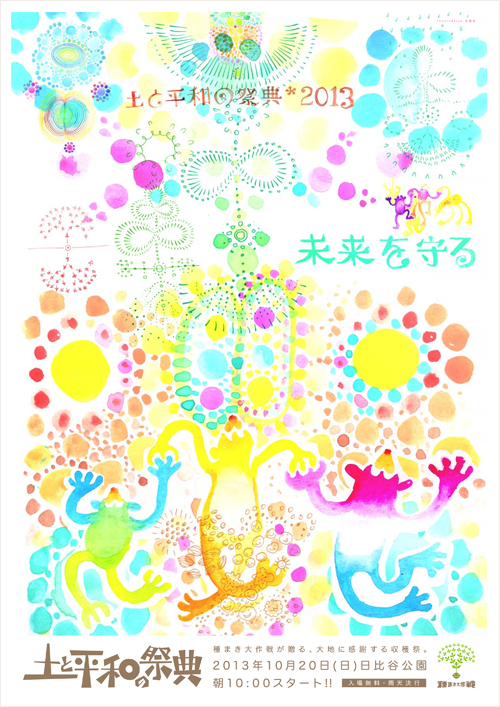
World Food Sovereignty Day • Soil and Peace Festival @Hibiya Park, Tokyo - Oct. 20, 2013


soil and peace festival 2013

Today is the international family farmer movement Via Campesina's World Food Sovereignty Day; and this weekend, Japanese organic family farmers and their supporters will join in a celebration of the best of visionary Japanese (organic, recycling, nuclear-free, GMO-free, fair-trade, Slow Life, satoyama, Tohoku-supporting) culture.

Via the Consumers Union of Japan:
There will be a Soil and Peace Festival in Hibiya Park, Tokyo, on Sunday October 20, 2013. Starting at 10:00 hundreds of farmers and activists and artists will hold a great event until the evening.

A great opportunity to meet your favourite NGOs and learn more about organic food, anti-nuclear campaigns and the future of Japan. Look forward to lots of inspiration! Music by Kato Tokiko and many others throughout the day, starting with a taiko performance by Gocco.

Website with more info (J) here.

Tuesday, October 1, 2013

First Slow Food International event opens in Asia; Can local, organic farming & food production be revived in South Korea? (90% of its food is imported; mostly from China & the US)

Just an hour outside of the chaos and pollution of Seoul, the city of Namyangju lies in an area known for its clean water, magnificent natural scenery and the health and longevity of its residents. It is here - where the long history of traditional handicrafts is still practiced by locals and an organic farming movement is growing rapidly - that small-scale producers from across Asia and Oceania have been arriving for AsiO Gusto,  what will be Slow Food’s first international event on the continent.

Asia is a continent where the issues that Slow Food is working on are highly evident: industrialization, monocultures, nutrition security…” said Paolo Di Croce, Secretary General of Slow Food. “South Korea imports 40% of its national dish, kimchi. It’s crazy that even a country with such strong traditions is still following the rules of the global market. Slow Food is less developed here compared to other parts of the world so AsiO Gusto is a great opportunity to bring together these delegates to share knowledge, build friendships and develop an understanding that farmers are facing the same problems everywhere.
---

Reading that South Korea imports more than 40% of its national dish, kimchee, was startling.  Where is most of South Korea's kimchee being made? China.

South Korea imports 90% of its food, much of it from China and the U.S. 

Seoul, the world’s second largest metropolitan area, is dominated by chain stores and franchises.  Seoul's restaurants serve kimchi made in China, vegetables from Australia,  fruit from Pakistan and the US, fish from Norway, rice from China and Thailand, and industrially farmed meat from the US.

Small-scale farmers and food processors are still a huge part of traditional Korean culture and an important part of food production.  The average farm is still between 2 and 5 acres and most food producers are family-run.

However local family farmers and food producers are under threat of "free trade" pacts (including with China) that have threatened their survival.  South Korean food self-sufficiency has dropped to the lowest level in history.  Farmland has dropped to the lowest level since 1970  because Seoul has incorporated vast amounts of farmland into commercial and industrial development projects and recreational “green spaces” for weekend urbanite tourists.  Namyangju, the "organic city," is one of South Korea's green travel destinations.

The Korean organic, slow, family farmer and food producer movement centers on food and cultural sovereignty and the survival of centuries-old food traditions. In parallel with the global movement, the movement is ultimately about democracy, environmental sustainability, simplicity, as well as safe and healthy food production.


---
Background:

" Cooperative Small-Scale Farming Movements Make Strides Around the World"
(Food Tank, April 3, 2013)
The Korean Women Peasants Association (KWPA), a organization of women farmers in South Korea, gained recognition recently when it won the Food Sovereignty Prize in 2012 for its work to promote food sovereignty, defend small-scale Korean farmers, and end violence against women. KWPA created the Sister Gardens initiative, which supports local food production by linking women farmers directly with local consumers. KWPA also began the Native Seed Campaign to safeguard biodiversity within agroecosystems and preserve native seeds.
"Korean Food, Land and Democracy: A Conversation with Anders Riel Müller* (Christine Ahn, March 19, 2013, Korea Policy Institute)
South Korea has been experiencing declining food self sufficiency for the past 20 years, and it has worsened over the past 5-6 years largely due to the new Free Trade Agreements with the United States and European Union. South Korea is also now in negotiations with Australia. These large agricultural exporting nations view South Korea as a major market for their agricultural products.

Korean agriculture is in crisis. First of all 40 percent of the agricultural population is over 60 years old, and average farm household debt has been exceeding annual total income since 2003. They carry a very heavy debt load. And the South Korean government is very limited in terms of what it can do to help farmers because of the restrictions placed by the World Trade Organization (WTO). For example, because South Korea is a party to the WTO, it means that virtually all of the old support programs that once protected farmers have been dismantled. The government is trying new ways to support farmers by helping them convert to organic and by emphasizing the aesthetic value of the rural countryside.

The agricultural sector is in decline. The amount of farmland in use is in decline, as is the land ownership among farmers. More farmers are now farming on rented land—in fact, 50% are now leasing land. Development policy has also changed so that more agricultural land has been opened up for urban and industrial development.
"South Korea's Food Security Alarm" (John Berthelsen, Asia  Sentinel, April 29, 2011)
...South Korea...imports more than 90 percent of its food from overseas, including almost all of its wheat and corn.

The government recently bought more than 325,999 hectares in Mongolia as part of its effort to develop an overseas food base to procure more food resources. That is after the Daewoo chaebol was stymied in its effort in 2008 to lease 1.3 million hectares of Madagascar – almost half the country's arable land -- for 99 years....As many as 60 South Korean companies are involved in farming in 16 countries, harvesting some 87,000 metric tons of grain from 24,000 hectares of farmland, according to Anders Riel Muller, a Research Fellow at the Institute for Food and Development Policy, USA...

... Samsung Economic Research Institute... issued a 16-page report on food security. The report, titled New Food Strategies in the Age of Global Food Crises...advocates that "it is necessary to secure foreign bases for food production through overseas agricultural development," providing comprehensive support for domestic firms striving to build food production bases abroad," and pay for it through overseas agricultural development funds. Among other things, the report advocates that the government draw up a roadmap for agricultural cooperation to develop food resources in the starvation-ridden North Korea "through inter-Korean agricultural cooperation is useful in the context of building South Korea's overseas food base, while at the same time preparing for surging food demand upon unification."

Food stability in South Korea has experienced a continuous decline, caused by rapidly increased grain price volatility and intensified import source concentration as the western countries, particularly the United States and the European Union, devote more and more of their corn production to biofuels. It is estimated that 35 percent of corn production is now going into biofuels. In addition, the report says, "food safety fell to its lowest level in 2008...

The report notes with something akin to alarm that the international grain market "is subject to an oligopoly of the four major global grain conglomerates: Cargill, Archer Daniels Midland, LDC, and Bunge," which have the power not only to perform grain trading functions but to "affect government policy with respect to international trade and agricultural markets using their massive capabilities to obtain information worldwide. South Korea imports 80 percent of its gran through the four. The four giants, the report continues, "exercise tremendous leverage over the worldwide food industry. Business for grain majors has expanded beyond traditional trading of crops to seeds, fertilizers, food and food processing, finance, and bio-energy production. At times, the four grain majors have encroached on consumer welfare by exerting their influence on agricultural producers, or by creating an oligopoly regime."

As food imports have increased, so has anxiety over agricultural product safety, the report notes, with "spiraling increases in the share of GMO food imports, which have risen from about 30 percent to over 50 percent in 2008, "posing a greater threat to food safety."

...South Korea's big problem, according to Anders Muller, is partly to history, in which Japanese colonizers'only interest was to convert Korea in to a supplier of food and other products to fuel their imperial ambitions. In doing so, the Japanese administrators allied themselves with the ruling landlord elite. By the 1920s, the majority of peasants in Korea had been reduced to tenant farmers delivering up to 50 percent of their harvests in taxes."

South Korea, Muller writes, "has historically shown little interest in its agricultural sector throughout the post Korean War period. The rural population and agriculture was primarily regarded as a source of cheap food and cheap labor for the country's dizzying industrial development." Agricultural investment dried up as successive dictators like Park Hung Hee neglected the countryside for industrialization...
"South Korean Food Imports At 80-90%" (Martin Frid, Kurashi, Oct. 6, 2011)
I was rather shocked to learn that South Korea imports almost all its food from China and the United States. Nearly 90% is imported, according to Asian Sentinel - and that includes almost all its wheat and corn, quoting a Samsung report from SERI World. Some 16 countries supply the country with other food items...

Sunday, August 4, 2013

Aspri: Building Hope in Fukushima (えすぺり 福島で希望を作る)


The government and the media, and the average Japanese person for that matter would like us to believe that everything is back to normal in Fukushima. That couldn't be farther from the truth. People continue to fight hard to regain a semblance of "normal" and there is still a long way to go. This is about a big step forward taken by local farmers.

This is a story about our friends the Okawaras, (Mrs. Okawara is featured in Women of Fukushima) organic farmers in Fukushima, who have, with the help of friends, family and other supporters, built a farmer's market, cafe, event/education space to restore hope and community to their local area. This is a completely grassroots effort that is injecting energy and spirit into the community.
Synopsis: This heartrending 5-minute video brings us an update on the Okawaras, who shared their lives in the aftermath of 3/11, in the powerful documentary film Women of Fukushima.  Organic farmers, they were traumatized not only by the natural and nuclear catastrophes, but also loss of livelihood when longtime customers abandoned them because of fears that their products have been contaminated by radiation.

However, their part of Fukushima has been only minimally contaminated; therefore they want to stay and work towards restoration, centered around a store and community center they have named "Aspri" which means "aspire" or "hope" in Esperanto.

Mrs. Okawara explains, "The year  after the plant exploded and last year, I would drive around and look at the scenery. Fukushima's mountains, skies, and fields. I couldn't stop myself from crying, when I thought such beauty was contaminated with radiation. To tell the truth, I cried every time I got in the car.

"But since year three, my thinking has changed. Even if it's contaminated, I really love this place. I don't cry anymore. I think it's because we decided to build Aspri. We will be selling many things, including vegetables, bread and fruit. It is also a place for learning. We will have study sessions about strategies for dealing with radiation. It will also be a place for performances...many things..."

They are receiving no support from the government, which refused to give them a loan. "So the politicians talk like the nuclear problem has gone away. But that's not true. Everyone is still really suffering."

At the grassroots, people are filling this gap,  donating money to help support Aspri, which opened on July 13, 2013.  This video is a request for a little more...

(Women of Fukushima is now streaming at Vimeo. Other films in their series on Tohoku may be viewed at the links listed at this  post:  http://tenthousandthingsfromkyoto.blogspot.com/2013/08/women-of-fukushima-our-tohoku-films.html

Monday, April 22, 2013

Happy Earth Day!

Via Keibo Shinichi Oiwa Tsuji on FB

We can't put this better than our friend, eco-blogger Martin Frid, at Kurashi
I was lucky enough to walk through the Earthday market in Tokyo today, a regular Sunday. If you haven't tried it, you haven't experienced the more aware youth in Japan, all the NGOs, the amazing farmers markets, the hemp clothes, the organic tea, the hippie vibe. This is a city that cares about the environment, the state of the planet, the wholeness. We are all connected.

Thursday, July 12, 2012

Alicia Bay Laurel at Roguii Cafe in Okinawa City, Okinawa - July 15, 2012


July 15 live at Roguii Cafe, Okinawa, with Amana band. Doors open at 19:00, show at 19:30. Cafe address: 1663 Yogi, Okinawa City, Okinawa. Hand craft and farmers market at the cafe from 15:00.

More about Alicia at Kim Hughes' post about the holistic practitioner's visit to Tokyo.