Links

Showing posts with label Hydrangea Revolution. Show all posts

Saturday, September 15, 2012

DiaNuke.org: Residents of Koodankulam, India protest in the sea against nuclear plant


Photo: Via DiaNuke.org via OutlookIndia.com via AP

For over two decades, Indian citizens across Tamil Nadu, the southernmost part of the Indian Peninsula, have been protesting against the Kudankulam Nuclear Power Plant (KNPP). Thousands have joined in the past month because they are concerned that hot, radioactively contaminated water discharged from the nuclear plant into the sea will poison fish and other marine life. They are also concerned forced displacement after a nuclear accident, as has happened to residents of Fukushima.

Patibandla Srikant details this history in "Twenty years of resistance at Koodankulam" published at InfochangeIndia.org in November, 2011:
According to the Atomic Energy Regulatory Board’s (AERB) stipulations, a 1.6-km radius around a nuclear power plant should have no habitation, while the next 5-km radius should have a small density of population; in a 16-km radius population must not exceed 10,000. Two reactors, Unit-I and Unit-2, are ready for testing in December this year, but no rehabilitation has been carried out to date. Government after government has changed in Tamil Nadu and in New Delhi, but the plight of the people struggling against the Koodankulam nuclear power plant continues. The central government finally seems to have taken cognisance of the protests thanks to a letter from the Tamil Nadu chief minister. But people in and around Koodankulam village continue to live with the fear of nuclear risk and threat to livelihoods.

The KNPP has its roots in the 1974 Pokhran [nuclear explosion] test conducted by India. Following the test, India came under the influence of the Soviet nuclear establishment because of its isolation from the West (the US had stopped fuel shipments to the Tarapur nuclear power plant after the 1974 test). Against this backdrop the nuclear deal with the Soviet Union was discussed as early as 1979 during Morarji Desai’s prime ministership. Finally, in 1988 the Soviet President Mikhail Gorbachev and Indian Prime Minister Rajiv Gandhi signed the Koodankulam Nuclear Power Project deal.

This triggered opposition in and around Koodankulam. The proposal to draw water for the nuclear reactors from the nearby Pechiparai reservoir and to discharge waste water into the sea threatened the livelihoods of the people. In May 1989, around 10,000 people assembled to protest against the plant under the banner of the National Fish Workers’ Union (NFWU). During this protest, police opened fire and disconnected the mike, preventing anyone from speaking. However, the disintegration of the Soviet Union, Gorbachev losing power and the assassination of Rajiv Gandhi stalled the Koodankulam nuclear power plant.
Unfortunately, the nuclear project picked up steam again. Over the past decade,Tamil Nadu residents attempted legal and environmental challenges, but were blocked by manipulative tactics.

Indians have engaged in popular resistance against nuclear plants throughout the country, but, as in Japan, they are up against "economic growth-oriented development" that require national sacrifice zones that will destroy natural environment and victimize locals. Srikant explains:
In the context of globalisation, government after government in India has pledged 8-9% growth rates. Such growth rates would naturally require more energy for consumption. Given increasing awareness of environmental issues, nuclear energy is often perceived as a viable alternative to high-polluting thermal power plants and big dams.

It is in this context that increased investments in nuclear power plants need to be seen. In spite of the high costs and risks involved, successive governments showed keen interest in pursuing nuclear energy.
Such a pursuit of growth rates is putting an enormous burden on many people, particularly the marginalised sections of society – rural populations, tribals, dalits, women, the poor and others. Big projects like nuclear power plants are posing a threat to the livelihoods of these people, while putting them in a hazardous situation in the long run.
Therefore the people of Koodankulam are fighting for their survival. During a brutal repression over the last two days by police, Anthony Samy, a fisherman, was killed.

Japan's ongoing nuclear melt-throughs have not only shocked almost everyone in Japan into nuclear-free action, but have spurred others everywhere, including those were previously silent about the nuclear radiation in their backyards, and those who have long been actively resisting nuclear power, as the people of Koodankulam, to see the interconnections of nuclear issues across borders and to work for a nuclear-free world.


On Aug. 7, 2012, people of Koodankulam, India praying for the
victims of the atomic bombing of Hiroshima
"We have chance to save Koodankulam...."
Photo: Amirtharaj Stephen, Dianuke.org

Kumar Sundaram, editor of DiaNuke.org, a India-based nuclear-free world advocacy organization that is a long-time supporter of the Hydrangea Revolution, understands the planetary history and structures of the nuclear industry. DiaNuke engages at multiple levels: critical, scientific, public-dialogical, prophetic (truth-telling) & organic (making connections, showing the common ground between diverse people).

DiaNuke articles, including those by Tokyo-residents Ruthie Iida and Jacinta Hin on the weekly Friday night protests, support a public dialogical working through of the collective shock and trauma that those of us exposed to nuclear radiation and those threatened with nuclear radiation must deal with as we also work to make our world nuclear-free.

DiaNuke's meta-message of the primacy of humanity always brings home the common ground that unite us all. This post is a shout out of gratitude to DiaNuke for their support of the Hydrangea Movement; facilitation of deep dialogue; and a heartfelt prayer for the people of Koodakulam and throughout India, that they may live free of fear of radioactive fallout; and for the political leaders in India for the wisdom to see and hear the profound message of these nonviolent resisters spoken with the power of truth (satyagraha).

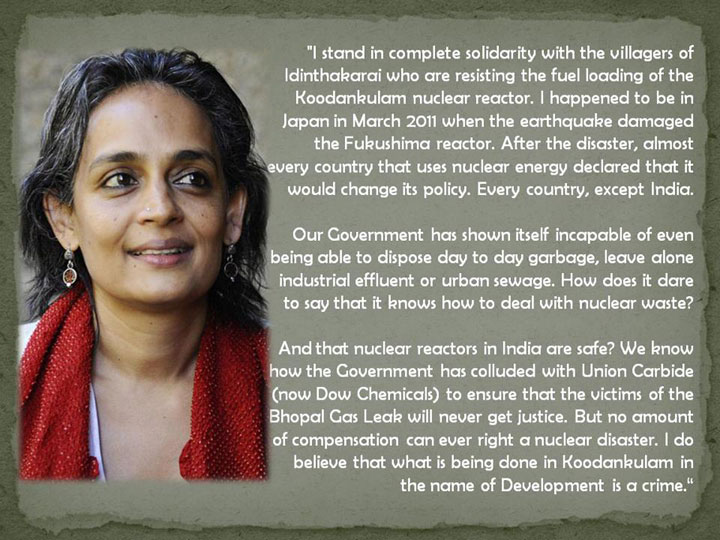
(Arundhati Roy, via Countercurrents.org)

Friday, September 14, 2012

Heiwa Kataoka: Friday Night Nuclear-Free Protest in Tokyo


Friday night Nuclear-Free Protest. Photo: Heiwa Kataoka

KJ Fresh Currents: Ongoing Friday Nuclear-Free Protests in Kyoto & Osaka


Via KJ Fresh Currents:
The Japanese government's commitment to a zero nuclear future is a significant step forward, but their ill-defined and somewhat distant deadline (sometime in the 2030s), and contradictory commitment to maintain the reprocessing program at Rokkasho cannot satisfy those who have been protesting each Friday since the controversial restarts in Fukui. The anti-nuclear movement has gained ground this week, but protests will continue until all the nuclear facilities are shut down for good. Here are the details for the Friday protests in Kansai (same time every week).

*** PLEASE SHARE ***

Kyoto 17:00-19:00
Outside Kanden Kyoto
https://plus.google.com/101615694937780488930/about?hl=en

Osaka 18:00-19:30
Outside Kanden
https://plus.google.com/101315689952581452988/about?hl=en

日本語での詳細はここで見つけることができます...
京都
http://ameblo.jp/harinaosu/
大阪
http://twitnonukes.blogspot.jp/
よろしくお願いします

Tuesday, July 17, 2012

170,000 passionately take to Tokyo streets for Sayonara Nukes Rally: “We HAVE made change! Now, it’s time to take it to the next level."


Aerial view of Monday's demonstration

I have been fortunate enough to take part in many vibrant demonstrations calling for social change in such areas as peace, clean energy and other justice-related causes in various cities around the world for years. Here in Tokyo, Japan, where I have lived for the past decade, I have felt the demonstrations against nuclear power following last year’s Fukushima nuclear disaster growing steadily. Nothing, however, compares to the size and intensity of yesterday’s Sayonara Nukes Rally, held in and around the city’s Yoyogi Park.

Deciding to take advantage of the summer sun by biking to the event, I understood that this demonstration was going to be different as soon as I approached police officers stationed more than a kilometer outside the park, followed soon thereafter by endless throngs of people clamoring to enter the demonstration grounds from all sides. Although the scene was familiar—event-goers of all ages waving placards, playing instruments, and shouting out various messages—the sheer immensity of the scale was absolutely unlike anything I had ever before experienced. The event had been extremely well-organized, catering to the many different demographics of protesters by arranging different marching contingents for the three major categories of attendees that were expected to attend: leftist labor groups, Gensuikyo and other anti-nuclear organizations, and NGOs/grassroots groups together with individual citizens—the latter of which constituted the newest historical element to protest culture in Japan. There was something here for everyone, and the combined energy felt vibrant, palpable—unstoppable.

The journey to the park (and adventure trying to find a space for my bike) took quite a bit longer than I had anticipated, and I ended up missing the first part of the day’s program, including speeches from numerous figures including musician/activist Ryuichi Sakamoto, author/nun Setouchi Jakucho, and performing artist/human rights activist Kaori Kanda, whose work I had become familiar with at a 2010 event. No matter, however; the day was just beginning, and there was plenty more to take in.

After swimming my way through the crowds, I was finally able to join members of the Namida Project to set off on the demonstration route through the streets of Shibuya. Needing more hands for our banners, we befriended a woman along the way who said she had never before attended a demonstration, but was moved to do so when thinking about the future for her two year-old daughter—a typical story I had heard many times during other post-3.11 demonstrations.

Marching with members of the Namida Project carrying a banner designed by Crystal Uchino,
author of the poignant essay, "Rise like Tsunamis after the Earthquakes"

Shortly thereafter, I had to turn back to meet up with a student of mine whom I had missed earlier in the park. The timing turned out to be perfect, since just as I returned to the event grounds, I heard wafting through the warm breeze the now-familiar guitar refrains from “Human Error”—the epic song from Kyoto-based band Frying Dutchman that had become the voice of the anti-nuclear movement following the 3.11 disaster. This was the song that had changed the views held by many of my previously pro-nuclear students, and I had been wanting badly to see it performed live. To do so here, surrounded by the powerful energy of the Sayonara Nukes rally, was beyond incredible. (Someone called my iPhone midway through, cutting off the filming. My apologies...)


I headed next to the other main stage, where another series of speakers were in the midst of delivering rousing speeches regarding the historical moment now taking place in Japan. I was pleased to see that Nobuto Hosaka—the mayor of Setagaya ward, where I just recently moved, and a staunch opponent of nuclear power—onstage discussing the Transition Setagaya movement (part of the global Transition Network), as well as Japan’s need for implementation of a “zero nuclear” policy. He was followed by Hiroko Uehara, former mayor of Kunitachi City, who minced no words in saying that the reason why the Ohi reactor was restarted boiled down to economics, pure and simple. “There is immense money to be made from nuclear power, and the nuclear mafia will not give up easily,” she said, “but the power is in our hands. If citizens raise their voices and pressure their local lawmakers to take up this issue at the national meeting of city mayors, we CAN make change!”

The need for political change was strongly echoed by Hajime Matsumoto, the owner of a recycled goods shop in Tokyo’s Koenji district, who successfully organized a large-scale anti-nuclear demonstration last April—mostly by word-of-mouth and social networking sites such as Twitter. “The attitude of this governmental administration following the Fukushima crisis has been beyond contemptible,” he alleged. “When citizens are demanding and pleading with regard to a specific issue—in this case the restart of the Ohi nuclear reactor—any respectable government would take some notice. Not these bastards, who just went right ahead and did what served them. Truly, it’s time for citizens to take back our country.”

Link Hajime Matsumoto

Taro Yamamoto, the actor who lost work over his vocal anti-nuclear stance following 3.11, took the stage next and voiced his deep emotion at viewing the crowds of attendees from the chartered helicopter flying above the crowd—an initiative spearheaded by author Takashi Hirose and funded by the Johnan Shinkin Bank, which had begun weeks earlier in order to ensure media coverage of the weekly demonstrations outside the Prime Minister’s residence. “Honestly speaking, I had been losing hope that we as individuals would be able to make change. But when I saw the endless sea of people extending out from the park in all directions, I realized I was wrong: We HAVE made change,” he said impassionedly. “Now, we must take this to the next level. Politicians must know that if they do not respond to the peoples’ wishes, their jobs are finished.”

“The world is watching to see Japan’s next moves regarding nuclear power, which will reveal whether or now we have learned from the pain of the Fukushima nuclear accident,” said Akira Kawasaki from the Peace Boat NGO, director of the Global Conference for a Nuclear Power-Free World held in Yokohama in January. “This is truly a pivotal moment in history.”

Link


The New York Times has a good article on the demonstration, and this Daily Kos had a brilliant overview of the day’s events, including organizers’ rebuttal to the short-sighted argument that the disaster is owing to “Japanese culture”. Kanagawa-based blogger Ruthie Iida also has an interesting account of her experience during the demo at her beautiful photo site, Faces of Japan.


Powerful video showing Fukushima women engaging in a"die-in"
 in front of the Prime Minister's residence on June 7, 2012 to protest the restart of the Ooi Nuclear Power Plant, after having submitted a protest to the office of Prime Minister Yoshihiko Noda.  


Top: "The Ohi Nuclear Power Plant and Osprey helicopters are destroying our lives and nature"
Bottom: Keibo Oiwa of the Sloth Club (left), whose sign reads "Nuclear power: Thank you and goodbye."

Above: Discussing the day's events together with a group of like-minded friends, including social and food justice activists, organic farmers, and filmmakers

--Kimberly Hughes

Wednesday, July 11, 2012

Rose Welsch: Faces Behind the Hydrangea Revolution

Many thanks to Rose Welsch of Peace Boat, Global Article 9 Campaign and US for Okinawa for sharing these radiant photos from the 7.7.12 Nuclear-Free rally in Tokyo.
Mainstream news doesn't cover it much--if at all--but hundreds of thousands of people in Japan are participating in demonstrations against nuclear energy. On Facebook, great aerial shots of crowds have been circulating, but in these photographs, I'd like show some of the faces (and spirit!) of the people participating in this Hydrangea Revolution.


Dressed in hydrangea colors, this woman was distributing
handmade origami hydrangea flowers that must have taken hours to make.

Origami Hydrangea


Calling for a national referendum to be held regarding whether or not
Japan should have nuclear power, this young woman passed out fliers
explaining how such a referendum could be carried out.


Passing out a batch of fliers on green paper, this man explained that he is starting
a Green Party in Japan that would not only protect the environment,
but would also guarantee the representation of women in the party.

Still dressed in rain gear, this woman moved inside the station to pass out information explaining what it's like for people in Fukushima to live 3.11 every day.


This lovely lady (right, in green) was very quiet,
but her gleaming eyes and sweet smile made her stand out in the crowd
at a protest against the restart of Japan's 54 nuclear reactors in July.
Here she is with her friend.


Despite the difficulty of navigating train stations and crowded sidewalks,
it's not uncommon to see people in wheelchairs participating in the demonstrations.


These two young men are promoting a large anti-nuke rally
that will be held in Tokyo on July 16 in Yoyogi park.


Her sign says "Praying for Happiness for All"

Sunday, July 8, 2012

7.7.12 - "SAVE BEAUTIFUL JAPAN & THE PLANET" Demonstration @ NYC

One participant (most whom are New York-based musicians from Japan):
This was the very first time in my life to join a demonstration yesterday 7-7-2012!!!

No more Nukes, Save beautiful Japan.


Thank you so much for giving me the opportunity to be a part of the movement. It is a huge step for me!!!

Save Beautiful Japan,
Save the Planet,
Rage Against Nukes

美しい日本を守りたい!
地球を汚したくない!
さらば原発!

Nonviolent demonstration & walk
through Union Square, Washington Square, and Astor Place.
Twitter: https://twitter.com/#!/RageAgainstNuke


(Photos: Yutaka Uchida)


Saturday, July 7, 2012

no nukes more heart - NO NUKES! ALL STAR DEMO 5 - Shibuya - 7.7.12

NO NUKES! ALL STAR DEMO 5: Shibuya, Tokyo on 7.7.12...

9.19脱原発デモ『NO NUKES! ALL ST☆R DEMO 2011』

Check out some of the music at the website, including "Wonderful World"...

Rose Welsch: "You know you're in the middle of a Japanese revolution when..."


(Photo: Rose Welsch)

Via beautiful Rose Welsch of Peace Boat:
You know you're in the middle of a Japanese revolution when a "revolutionary" is an older woman who sweetly passes out very carefully handcrafted origami hydrangea flowers. Each petal has been neatly folded out of paper, tiny buds glued one by one into the middle of each flower, and a real hydrangea leaf has been laminated and cut.

Now, let's hope Japan's government will follow suit and very carefully and lovingly craft new energy policies instead of recklessly restarting its 54 nuclear reactors even though this is an EARTHQUAKE PRONE COUNTRY with reactors sitting on fault lines!!!!
The organizers say 150,000 attended tonight's rally in drizzly weather; the police: 21,000.

NHK, Japan's public television channel, gave the demonstration 20 seconds of coverage, 40 minutes into the nightly news.

Friday, July 6, 2012

Friday Night Action (100,000+ "Nails Sticking Out") - July 6, 2012 - Tokyo, Japan

Via Metropolitan Coalition Against Nukes:

10万人集まった!!首相官邸前を見に行こうぜ!! Friday Night! Let's Drop By the Prime Minister's House

10万人集まった!!首相官邸前を見に行こうぜ!! Friday Night! Let's Drop By the Prime Minister's House (More Event Info on Facebook)


Since March of 2012, people have been gathering in front of the Japanese Prime Minister's Residence every Friday night to express opposition to the restart of Japan's 54 nuclear reactors, which were shut down last year for safety checks, and to call for a new energy policy rooted in greater human security, sustainability, and transparency.

Despite the fact that Japan is an earthquake prone country, despite the fact that tens of thousands of people in Japan have lost their homes, farms, families and livelihood and must live as evacuees because of the Fukushima Daiichi nuclear disaster, and despite the fact that Fukushima Daiichi continues to contaminate the earth and oceans of the planet, the Japanese government recently restarted nuclear reactors in the town of Ohi.

On Friday, June 29, more than 100,000 gathered in front of the Prime Minister's residence in Tokyo, in an astounding display of people demanding to be heard by the government that is supposed to represent them rather than an opaque nuclear industry. The gathering came shortly on the heels of the Tokyo Assembly vetoing down a referendum on the restart of Japan's nuclear reactors, despite the fact that nearly 100,000 more signatures than necessary were collected in order to call for the referendum.

Ensconced safely in his home, his livelihood assured, comfortably distanced from the devastating consequences of the nuclear disaster the people of Fukushima are living through every day, the Prime Minister was silent in the face of the massive protest on June 29--as he has been since the protests started in March. His only comment was reportedly to a guard, saying "How noisy!"

How many hundreds of thousands of petition signatures can the Prime Minister ignore? How many massive gatherings of people can he pretend to ignore before finally responding to calls for a sane energy policy for Japan--and ultimately for the world? Well, let's find out! On July 6 (Friday), another gathering will be held in front of his official residence. Last week, more than 100,000 people joined. This week, we're aiming to exceed that. Drop by on your way home from work or on your way to a party-- even if only for 15-30 minutes--and play a role in shaping the future of Japan!

Access: Kokkaigijidomae Station (on the Chiyoda or Marunouchi Lines), Exit 3

Time: 6-9 pm

Friday
6:00pm until 9:00pm in UTC+09
国会議事堂前駅3番出口


※大拡散お願いします。

前回企画した
「4万5千人集まった首相官邸前を見に行こうぜ!!」
企画は、、、

皆様のおかげで、
参加300人
シェア、もう把握不能
招待6000弱
集まりました!!!

びっくりでしょ?
勇気だして、やってみるもんですね。
いやいや、僕が一番びっくりしてます。

正式にデモの主催が発表したので
今回も、呼びかけたいと思います。


皆さんよろしくお願いします。

関西版も僕の友達がやってます。
→http://www.facebook.com/events/181281072002058/

【あえて、、、「見に行こうぜ」の思い。】

約10万人の人達が前回の抗議に参加しました。
(主催者発表は約20万人、警察発表は1万7000人)

安保闘争以来の最大抗議となりました。

しかし、

前回の呼びかけにも書きましたが
やはり原発は再稼働する事になりました。

僕は
違和感を感じます。

友達がいってましたよ。
「どうせ何しても変わらないよ、、、」
「これで変わらなかったら、どこに希望持つの?」

僕等の世代はどっか、
心のどっかでこの思いが強いと思います。

「こういう社会なんだからしょうがない」

そんな社会で育ったんですから
投票に行く若者が少ない事も納得できますよ、そりゃ。

若者の投票率は
60代〜70代の人の投票数の
約1/3しか有りません。

こりゃどうしようもないな(笑

でも。だから。

そういう、人達にこそ来て欲しい!!
10万人の人が集まる光景って凄まじいよ。

コレは原発に関わらず。

「自分達の未来は自分たちで
考えてもいいのだ!!!」って事を

実感できる場だと思います。

僕、自身は原発には本当に反対です。

でも、そのスタートとして
考えるのも、やになっちゃって、
一歩引いてる人って結構居ると思います。

だから、まあ反対しろおおお
って押し付けるんじゃなくて

答えが、どこに有るのか、、、、
分からないけど、
とりあえず見に行きません?

この話は若者だけじゃないかも知れません。

この国が今どこに行くのか
もう一回一緒に考えましょうよ。

よろしくお願いします。

奥田愛基

デモ後、日比谷公園の端で
学生が軽く集まってます。
よかったら是非。

集まったあと、
その後ご飯でも行きましょうよ。

"ODAKIAS" - Ryuichi Sakamoto's Remix of Demonstrators at the Oi Nuclear Plant restart protest chanting "Saikado Hantai!" ("Against the Re-start!")

Sounds for Our Generation: "ODAKIAS" - Ryuichi Sakamoto's haunting remix of demonstrators at the Oi Nuclear Plant Restart Protest chanting "SAIKADO HANTAI!" ("Against the Re-start!")

Tuesday, July 3, 2012

Hydrangea Revolution Supporters in Times Square, NYC: "SAYONARA NUKES"


(Photo: Kiyoko Horvath)
July 1, 2012 - ニューヨークタイムズスクエアから原発反対、再稼働反対のメッセージを送ります。諦めるな、頑張れ日本!
(撮影:Kiyoko Horvathさん) — at Times Square, New York City.

Friday, June 29, 2012

Hydrangea Revolution: 100,000-200,000 Japanese citizens rally for a Nuclear-Free Japan


(Photo: Chie Matsumoto on FB)

Via Chie Matsumoto, a reporter with LaborNet Japan:
We did it!! Revolution Hydrangea in Japan, where people say there never is a revolution. We figured nearly 100,000 were there.

The Diet/PM's office area is the most restricted area for demonstrations, but we flooded onto the streets and started walking toward PM's office in hopes of getting our voices heard.

Very peaceful demo. Respect to all who are determined to raise their voices until their fight is won and keep all power plants shut.
Via Temple Valley Times, estimates of rally participants:
Asahi Shimbun: 150-180,000
NHK TV: more than last time [next day's report estimated 100,000]
Police: about 17,000
Rally Organizer: 150,000
Sankei Shinbun: less than 20,000
TBS TV: 200,000
TV Asahi: 40-50,000
Kimberly Hughes notes that Bloomberg has reported more than 100 million Japanese citizens are against the nuclear power.