Links

Showing posts with label Peace Not War Japan. Show all posts

Wednesday, August 11, 2010

Hikari Matsuri (“Festival of Light”) commemorates Hiroshima & Nagasaki as it celebrates the arts & sustainable lifestyles

Similarly to other countries worldwide, Japan is home to an extensive lineup of summer outdoor music and arts festivals. A favorite event for festival-goers is the Hikari Matsuri, held in early August in Fujino, Kanagawa prefecture, which is located southwest of Tokyo along the Sagami River.

The festival features the usual fare of musical performers, international food stalls and nearby camping and onsen (hot springs) facilities. Additionally, the Hikari Matsuri offers a unique location: the grounds of a former elementary school, whose all-wooden buildings were converted in 2003 into an artists’ studio complex known as the Makisato Lab.

From August 6-8, 2010, the 7th annual Hikari Matsuri transformed the old school grounds into a dynamic space featuring a market with organic goods, a striking outdoor stage enshrouded in billowing white cloth, and classrooms converted into spaces for musical performances, mini dance clubs with DJs, film screenings, and more.

As its name suggests, the event also featured various impressive displays of light. Huge strobes beamed multi-colored patterns onto the surrounding trees, gorgeous installations of candles inlaid into clusters of bamboo tree trunks were placed throughout the grounds, and a dramatic fire dance performance took place on Saturday night—the highlight of the entire weekend for many.

The fire’s significance, however, went beyond simple artistic expression. All of the flames onsite were lit from embers of the fires in Hiroshima that followed the dropping of the atomic bomb exactly 65 years prior, which have been tended by Buddhist monks and other peace advocates ever since.

The festival’s opening ceremony on Friday evening featured a screening of the documentary film Atomic Flame (Japanese title: Gate), a project of the Global Nuclear Disarmament Fund that follows Japanese Buddhist monks as they walk across the southwestern United States to extinguish the flame at the Trinity test site in New Mexico where it originated. Festival organizers explained:

Gate will be shown on the outdoor stage, using solar powered electricity and candles to create a subdued, minimalist space where we may together call for peace. Truthfully speaking, there is not much more that we can do with regard to this issue beyond learning, thinking, feeling, and praying. While such actions may seem like trivial things, they are in fact immensely important.
Hikari Matsuri also included a nighttime study program, organized by Peace Not War Japan and the Neo Ryukyu Arc network, to explore various contemporary issues related to peace and sustainability.

The first speaker was Oyama Mikae, a member of the local NPO Transition Japan. The organization has gradually been recognized as an active hub of the international Transition Network movement, thereby earning the town of Fujino global recognition for its progressive action. The website describes the initiative:
A Transition Initiative (which could be a town, village, university or island etc) is a community-led response to the pressures of climate change, fossil fuel depletion and increasingly, economic contraction. There are thousands of initiatives around the world starting their journey to answer this crucial question:

"For all those aspects of life that this community needs in order to sustain itself and thrive, how do we significantly rebuild resilience (to mitigate the effects of Peak Oil and economic contraction) and drastically reduce carbon emissions (to mitigate the effects of Climate Change)?"
In response to these environmental challenges, the Fujino community has begun holding regular workshops on permaculture and other sustainable practices, publishing a regular newsletter titled “Transition Fujino”, and spearheading additional initiatives designed to elicit peoples’creative ideas regarding how to live without depending on fossil fuels. An excellent article highlighting the Transition Intitiative project in Fujino—which, coincidentally or not, has one of the highest concentrations of artists in all of Japan— may be read here.

Left: Information about the Transition Network posted in the former gymnasium of Makisoto Elementary School (now, Makisato Labo)

Right: Participants of nighttime study session

This presentation was followed by a screening of Hopi no yogen (The Hopi Prophecy), a 1986 documentary by Japanese director Miyata Kiyoshi. The film describes how the Hopi and Navajo tribes in the southwestern United States have responded to the resource colonization of their lands

that have been repeatedly plundered for plutonium and uranium, or—in their words—“carving out the earth’s vital organs.”

The film, a classic among social activists in Japan, recounts how tribal leaders—horrified after learning that plutonium and uranium taken forcibly from their land were used to create the atomic bombs that destroyed Hiroshima and Nagasaki—decided to go public with a prophecy that had been passed down from Hopi elders. The message described how humankind has now come to stand at the crossroads of two possible futures, depending on which actions are taken: one of total annihilation, and the other of peaceful sustainability.

The last of the four messengers chosen to interpret the prophecies, Thomas Banyacya, tried repeatedly to reach decision makers with the prophecy, with little success. His obituary in The New York Times following his 1999 death poignantly describes his efforts:
Although he was often warmly received by United Nations officials, his efforts to give a speech were repeatedly rebuffed. But then, as he explained, the elders had told him to knock on the door four times. On his fourth attempt, in 1992, he was allowed to make a brief speech at the General Assembly hall, but on a day when the General Assembly was in recess. Only a few delegates were present when he carefully sprinkled cornmeal on the podium and then delivered his message stressing the need for world leaders to listen to those still living in harmony with nature.
The rest of the obituary may be read here, and the full text of Banyacya’s address may be read here.

Left: Entrance to Hikari Matsuri festival grounds

Right: Night view of the festival taken from the second floor of a former classroom building

As part of grassroots citizen efforts to promote sustainability and ensure that our future is the more positive of the two possibilities outlined in the Hopi prophecy,


Peace Not War Japan and the Neo Ryukyu
Arc network will continue their series of
Peaceful New Earth events to highlight efforts of indigenous cultures and fostering connections between peace movements. Read about the first two events in the series here and here.


Text by Kimberly Hughes
Photos by Sheila Souza

Friday, June 18, 2010

Neo Ryukyu Arc Network Presents “Celebration for a Peaceful New Earth” in Tokyo, Sunday, June 20th


“Celebration for a Peaceful New Earth," scheduled for this Sunday, June 20th, seeks to support the people of Henoko and Tokunoshima—part of the Ryukyu archipelago—in their struggle to halt the construction of U.S. military bases on their islands. The event will feature the incredible power of music from some of Tokyo’s finest performers, plus a series of talk sessions from a number of seasoned grassroots social activists working both locally and around the world.

Come and add your energies and enthusiasm to this event, which promises to leave you inspired on many levels—as well as help us all move closer to the reality of a world based not upon military violence, but rather upon compassion, respect and justice.

Venue: Yoyogi Park Outdoor Stage

Event timetable (performer/speaker times subject to change):

• 10:45 AM: Meet at the Hachiko statue in front of Shibuya station

• 11:00 AM: Peace parade from Shibuya to Yoyogi Park. Bring instruments, colorful clothing, and enthusiasm!

• 12:00〜12:15 Parade arrival ceremony and opening remarks

• 12:15〜13:00  The ARTH (Club/Dub/alternative)

• 13:10〜13:40  Ailie (roots reggae singer) and Masago Hideaki (Indian flute)

• 13:40〜14:25 Speakers: Sakata Masako (Kenji no kai organization to protect Mt. Takao) and a representative from Yuntaku Takae (organization to stop the construction of U.S. military helipads in Takae Village, located in Okinawa’s Yanbaru “Broccoli” Forest)

• 14:25〜14:55  Tei Kazuma (singer/songwriter from Tokunoshima Island)

• 14:55〜15:40 Speaker: Hoshikawa Jun (Director, Greenpeace Japan; Member, Japan-US Citizens for Okinawa Network (JUCON)/Network for Okinawa)

• 15:40〜16:10  Miyake Yohei from Albatrus

• 16:10〜17:00 Speaker: Shiva Rei (freelance journalist)

• 17:00〜17:25  Takeru (reggae)

• 17:25〜17:50  Rakita (pop performer from Okinawa)

• 18:00〜18:50  Jintaramuta (Japanese chindon street music fusion)

• 18:50〜19:00 MC

• 19:00〜19:45  Asazaki Ikue (traditional performer from Amami-Oshima Island)

• 19:45〜20:00 Finale/ Closing MC remarks

Video messages also scheduled to be received from:

Kina Shoukichi, member of Parliament, globally renowned Okinawan musician, and peace advocate

• Mayors from several towns on Tokunoshima Island

The event calls for the following:

•  Adamant demand for the withdrawal of governmental plans for new U.S. military base construction in Henoko and/or Tokunoshima]

•  Strong opposition to Hatoyama’s administration trampling over the expressed desires of local citizens with regard to this issue, and the Kan administration’s announcement that it will adhere to its predecessor’s policy in this regard

•  The creation of a Neo Ryukyu Arc Network, connecting the shared peace movements of those in the Ryukyu and Amami Islands (located in Japan’s southern regions of Okinawa and Kagoshima prefecture), as well as other peace movements around the world

•  Renewed commitment to the protection of the rich natural environment and biodiversity found in the Ryukyu and Amami Island regions

Peace actions are also scheduled to be organized by the network in Tokyo, the Ryukyu archipelago, and beyond in conjunction with the following (watch for upcoming details!):

July: Elections in Japan
August: Japan-U.S. accord
September: COP 10
October: Peace Music Festa event
November: President Obama’s visit to Japan

Additional event details:

・Admission is free!
・Event will take place rain or shine!
・There will be no information or food booths at this event. (Sorry folks!)
・ Please be sure to leave the venue as clean as you found it!
・This is a completely volunteer-organized event. Your donations will be greatly appreciated!

Event organizers:

Peace Not War Japan


Spring Love Harukaze Organizing Committee

Neo Ryuku Arc Network

With support from:

“Don’t trample on Okinawa!" Emergency action organizing committee

Thursday, April 15, 2010

Spring Love Harukaze 2010: Music festival-goers feel the love; explore issues of peace and sustainability


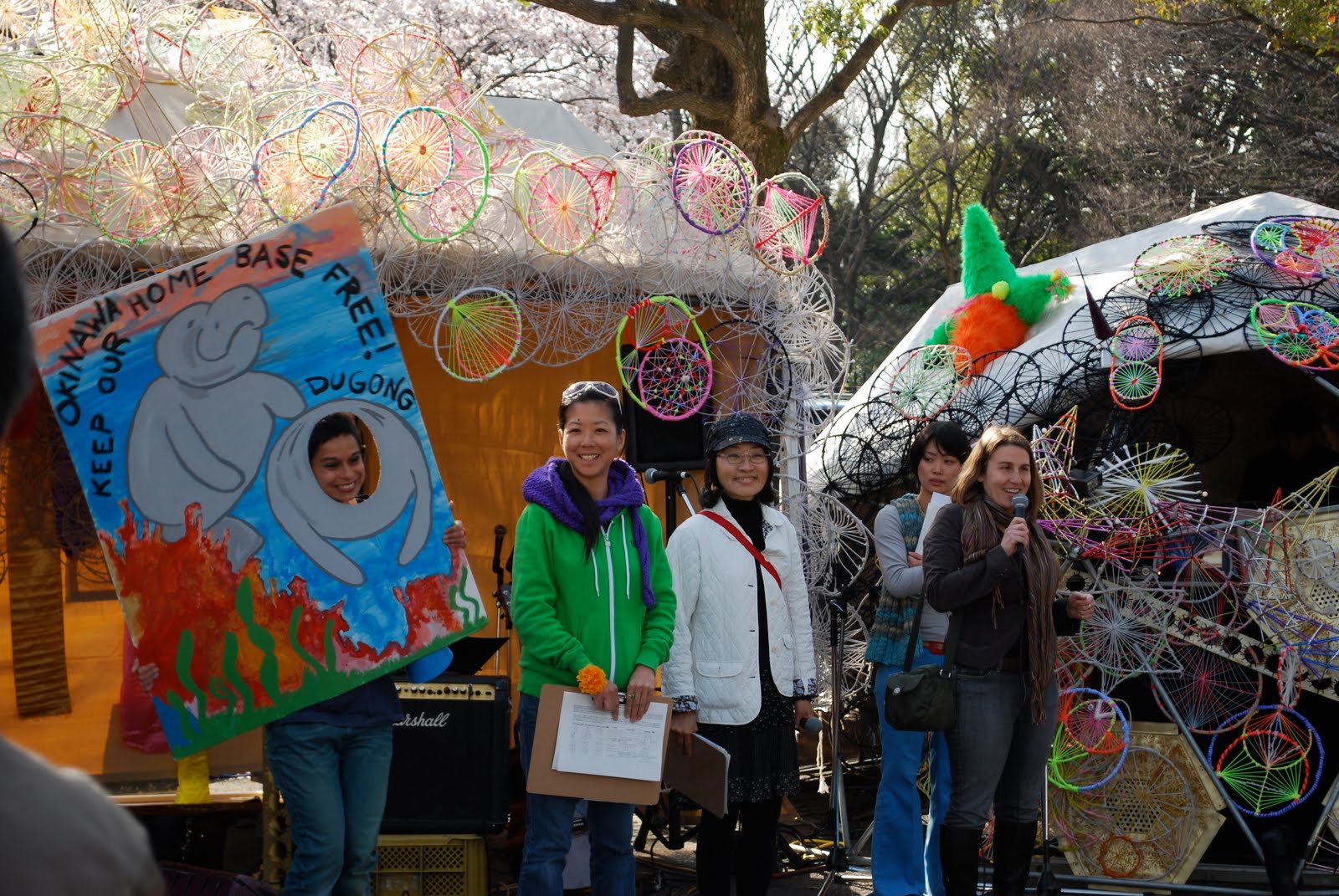
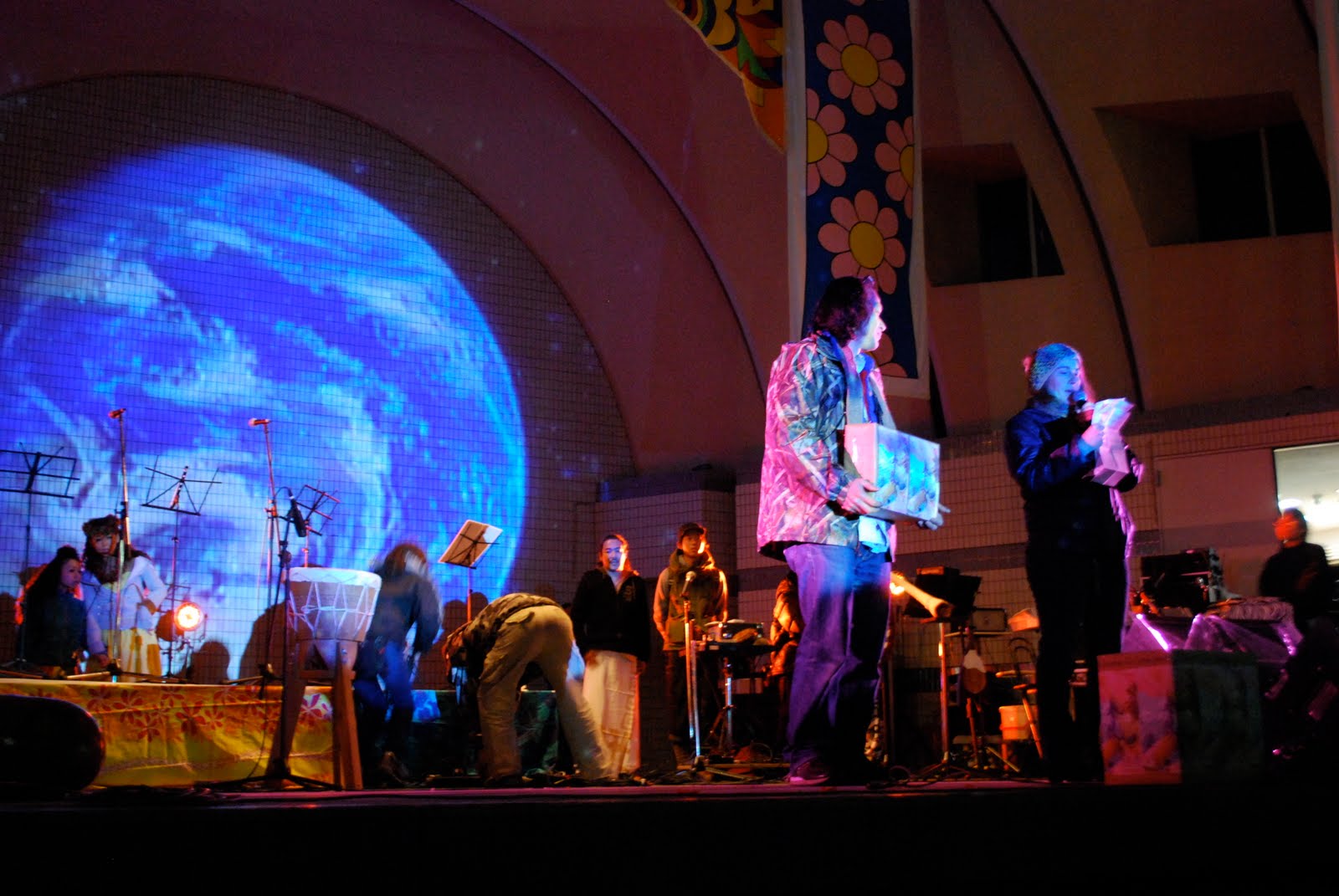
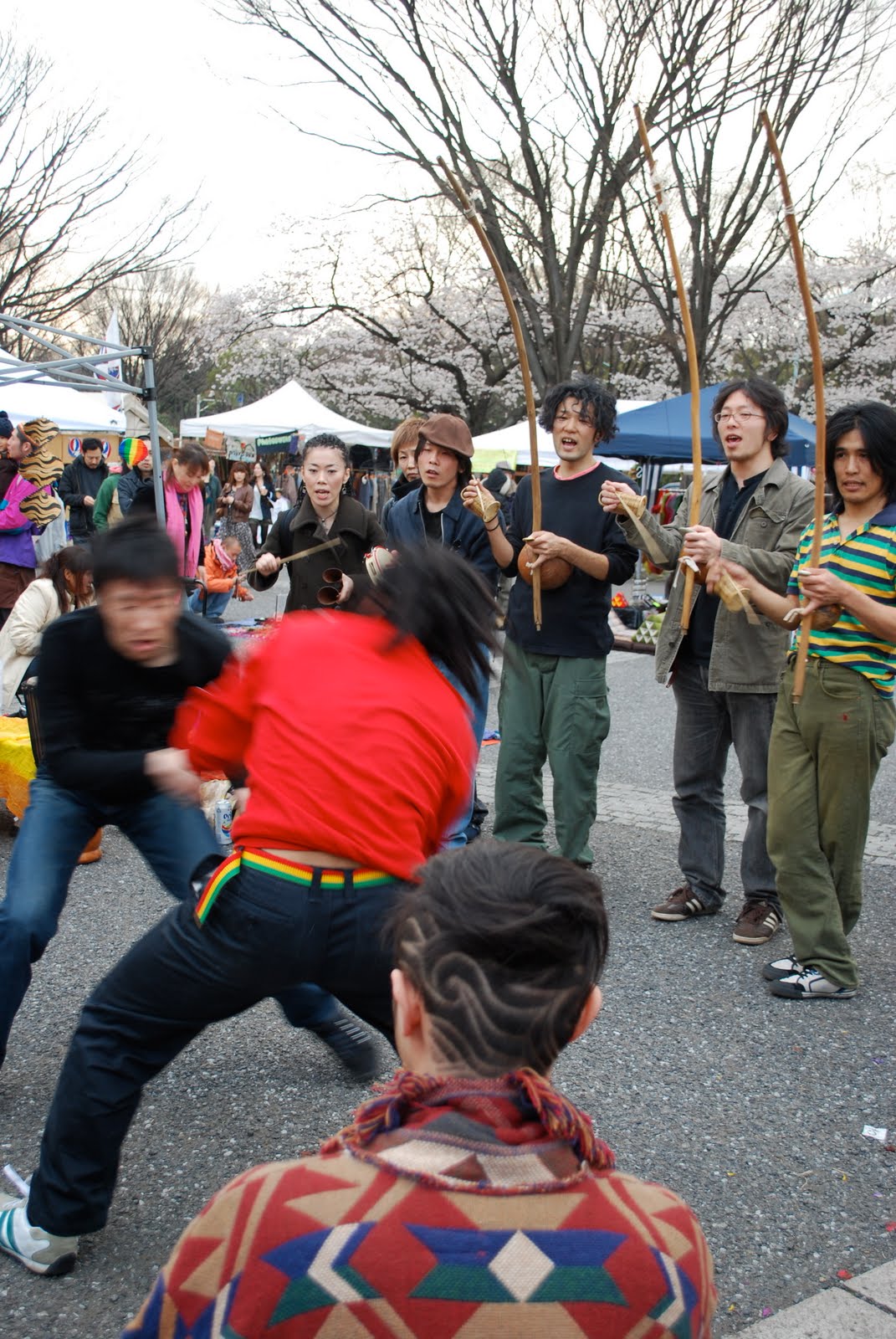
For the second year in a row during the first weekend of April, amidst cherry blossoms at their peak and near-perfect (if slightly chilly) weather, the Spring Love Harukaze festival transformed Tokyo's Yoyogi Park into a space of positive energy and peaceful vibes.

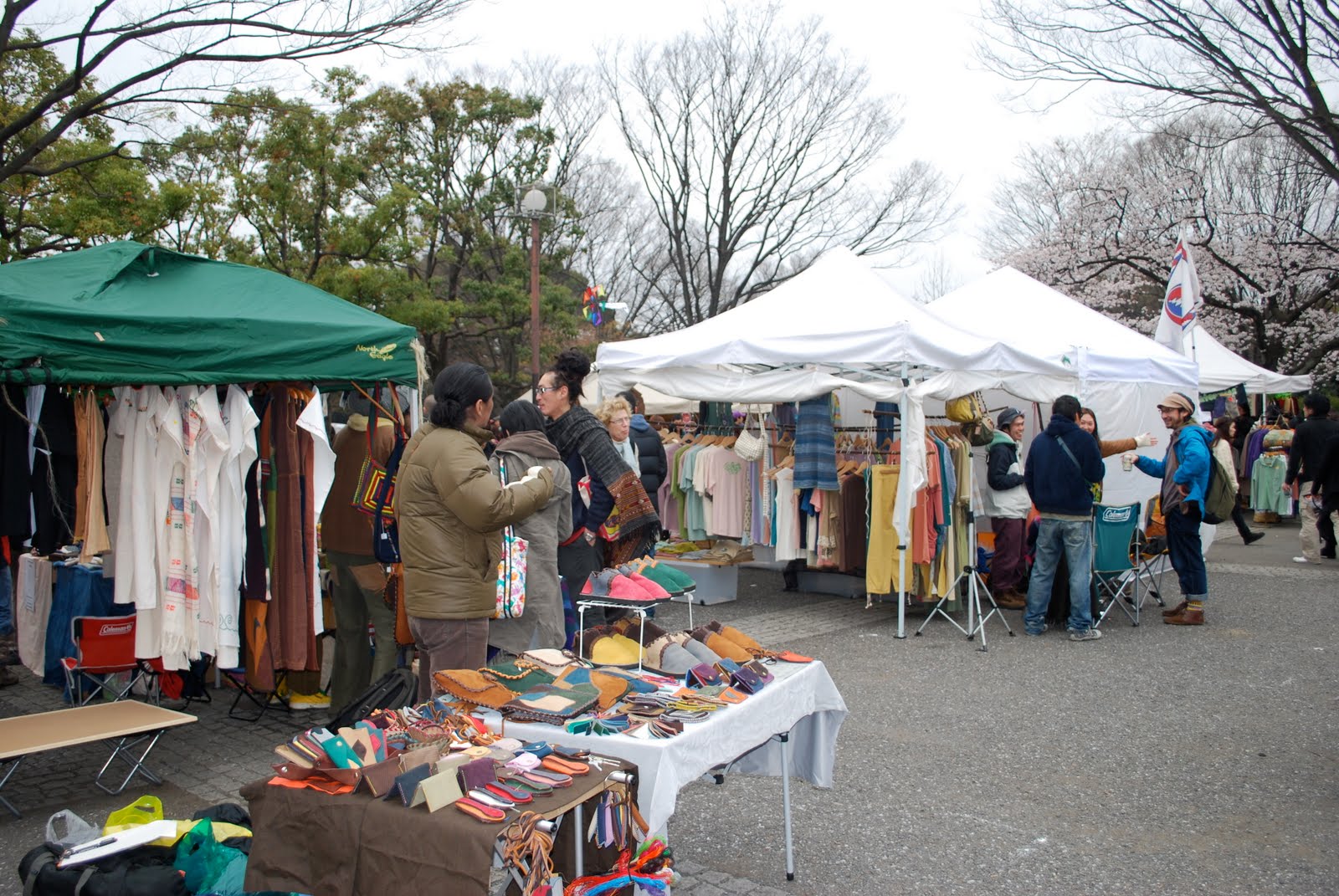
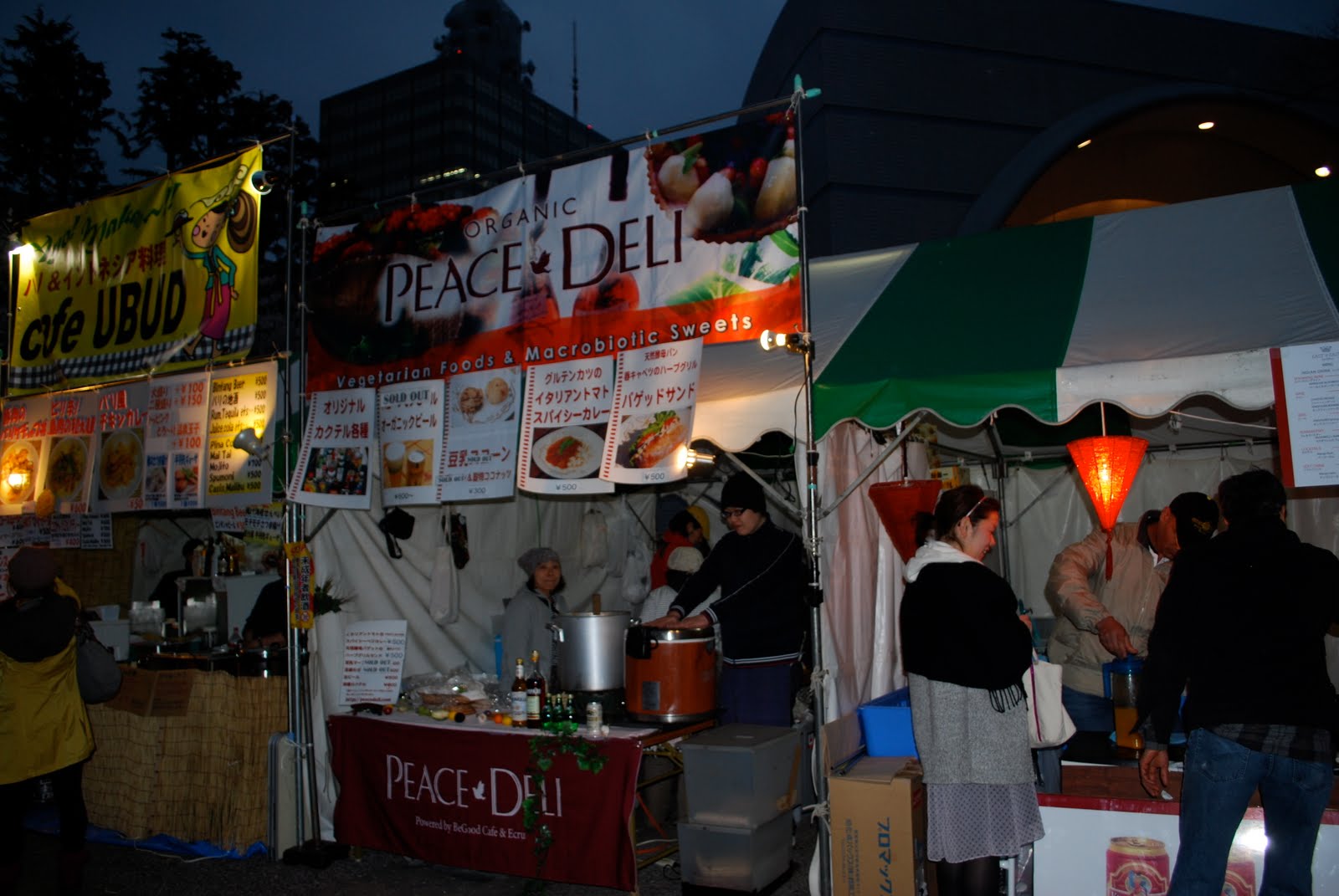
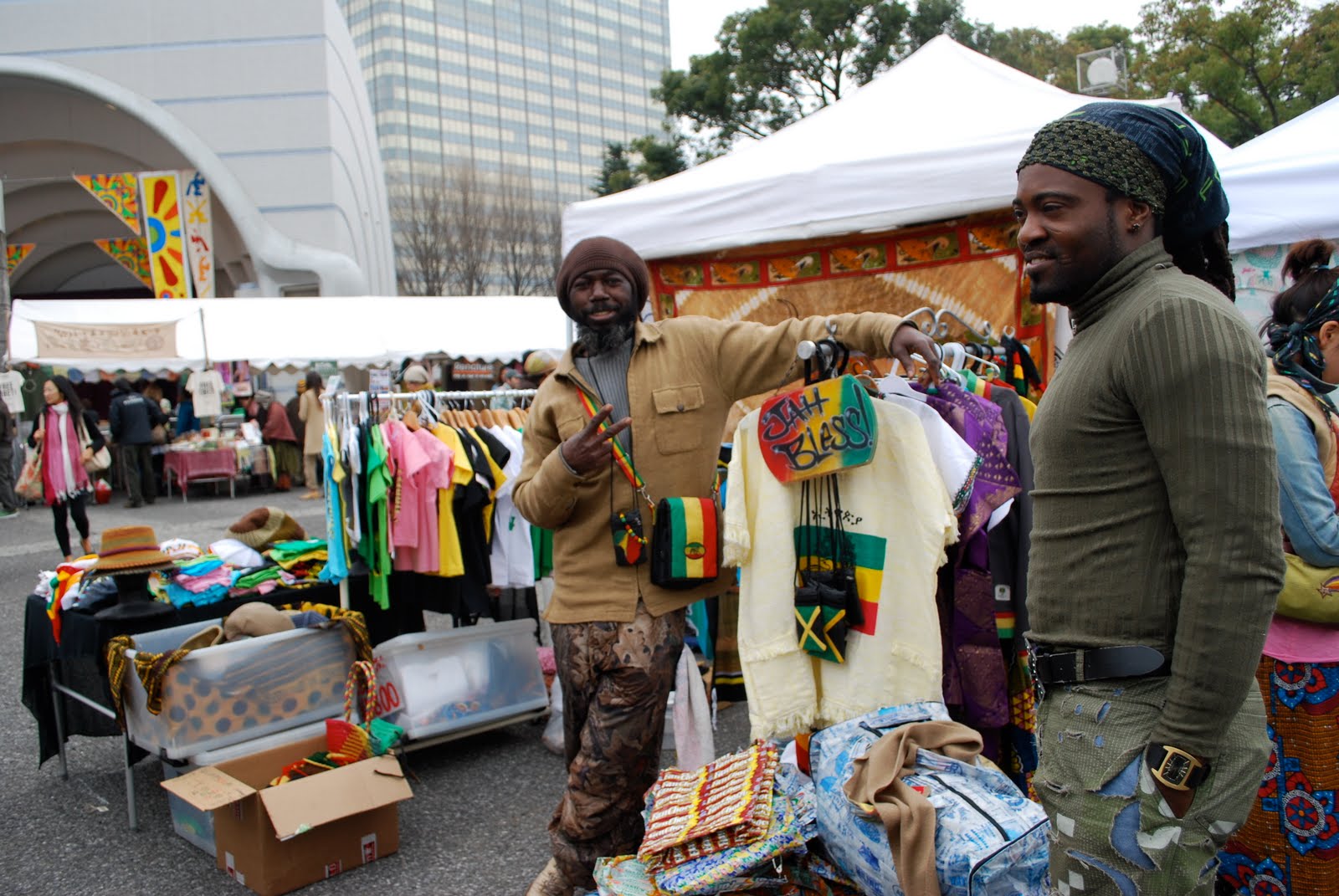
The event featured some of Japan’s top musical talent, as well as a series of talk sessions related to various peace and environmental issues. In addition, the festival included a flea market with natural and eco-related goods, food stalls with organic and various world cuisines, tents with information from peace and environmental NPOs/NGOs, a DJ tent where young dancers enjoyed chilled-out grooves, and jam sessions/performances spontaneously organized by festival-goers that cropped up all over the venue throughout the weekend.

The festival was the result of a collaboration between Harukaze organizers, who put on rave parties of the same name in Yoyogi Park during the 1990s, together with the volunteer collective Peace Not War Japan, which organizes events combining music and peace. By bringing back the festival as Spring Love: Harukaze and including the educational component, their goal expanded to encourage festival attendees—including youth who may never before have thought about these social topics—to consider war, militarism, peace and sustainability.
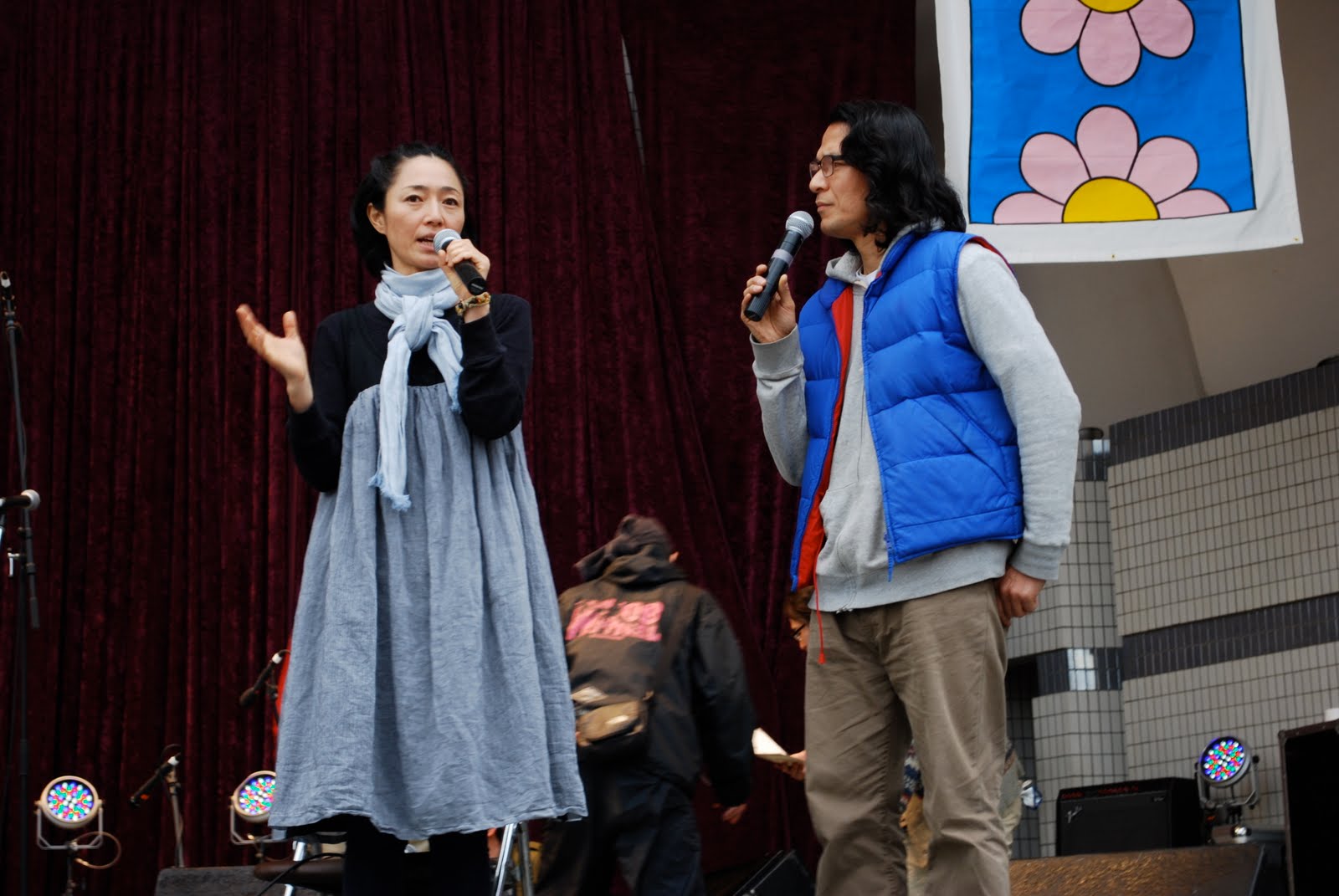
Masudo Ikue and Peace Not War Japan coordinator Fukui Hiroshi

One speaker was Masudo Ikue, a television and film actor, well-known by her former stage name, Takagi Saya. While still making occasional public appearances, she decided in 2008 to scale back her work to focus on natural pursuits such as running her own beachside eco-gallery, growing some of her own food, and free-diving (she is a champion record-holder in Hawaii!).

“The modern capitalist system that we live in encourages us to spend our energy gathering material possessions while gradually drifting further and further away from nature and healthy ways of living, ” Ikue declared. “It is up to each one of us to look deep inside and reconnect with our own deepest selves to see what we truly want out of this life.”

Another discussion, titled “Building sustainable, non-militarized economies: examples of organic, small-scale, community-based alternatives to a military-dependent economy,” featured three well-known peace and environmental activists and offered a similar message.

“When you structure your life the way the capitalist system demands—working as a slave to one single company—your individuality has absolutely no meaning, since the instant you are gone, you will simply be replaced by another cog in the wheel,” explained speaker Tanaka Yu. “The recipe for happiness is to be in control of your life by diversifying your income sources, and always doing what you want to do rather than what some boss is telling you to do.”

Panelist Kosaka Masaru, a thirtysomething who runs his own organic café/bar and grows his own soybeans and rice, said that his greatest happiness is listening to great music and cooking tasty, healthy food.

Also on the panel was writer, translator, and activist Kikuchi Yumi, whose family lives in a restored farmhouse and grows all of their own organic vegetables and rice. She emphasized that growing one’s own food is as easy as starting with one simple herb planter at home; anyone can do it. She also described the local currency system in her region of Awa, southern Chiba, where residents may buy certain products using “Awa Money" in addition to Japanese yen.

“This kind of local currency movement is the basis for building peaceful societies, as opposed to what happens with Japan’s major banks—where money in peoples’ savings accounts are used without their knowledge to purchase things like cluster bombs used in U.S. wars,” concluded Tanaka, who also serves as executive director of the Mirai Bank (“Bank of the Future”)—a model for other sustainable community projects such as the Artist Power Bank. “We have the power to create peaceful societies by choosing how and where we use our money.


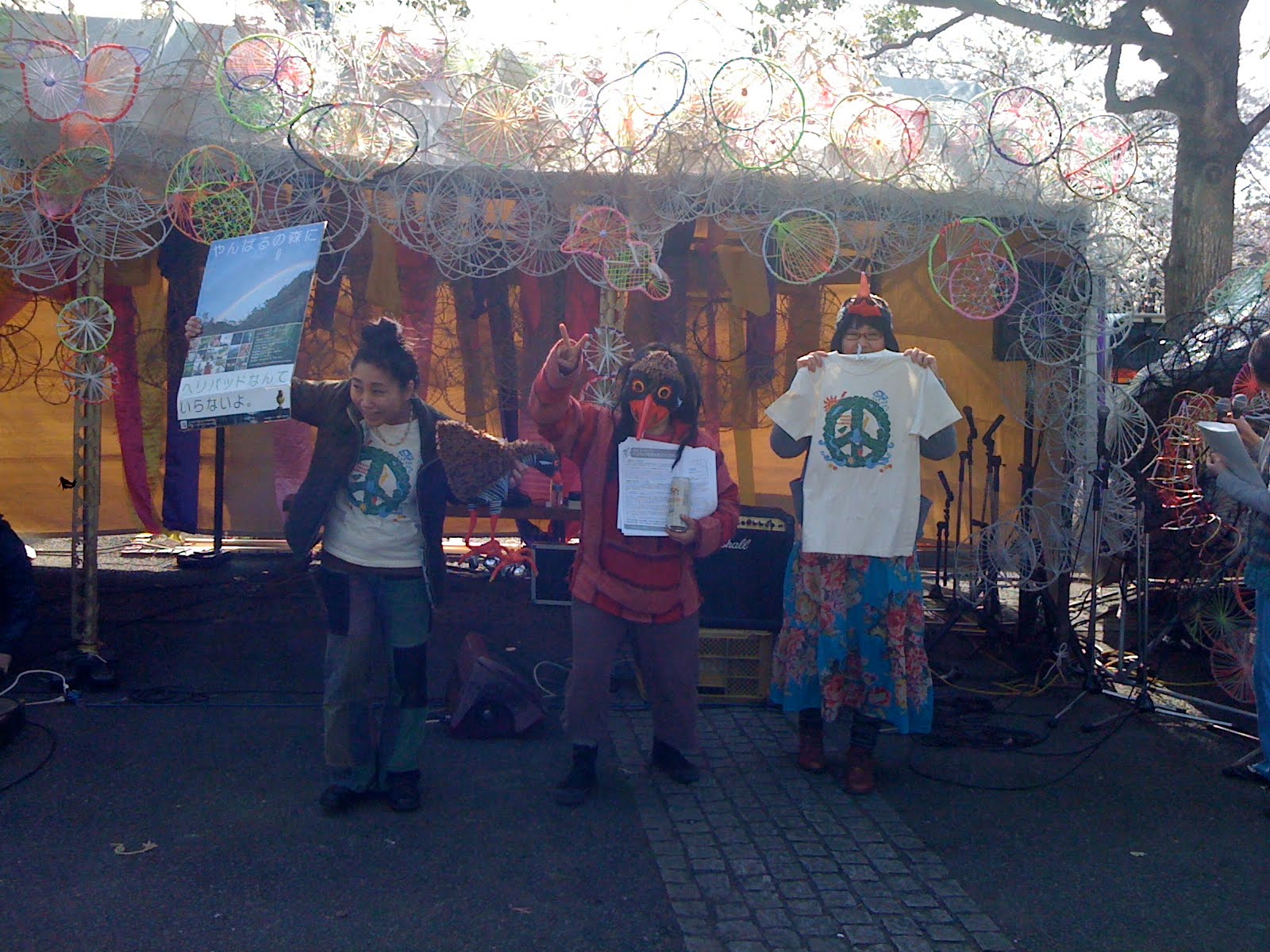
Supporters of Takae Village, Okinawa, portraying the kuina bird that is endangered by U.S. military base construction in Yanbaru, a subtropical rainforest in northern Okinawa 

The third talk session also focused closely on creating alternatives to existing ills. Titled “Listen to citizens' voices: No more wasteful, destructive construction projects!," the panel discussion featured speakers from groups working to save Mt. Takao from a highway tunnel; stop the construction of a nuclear power plant in Kaminoseki, on the Inland Sea; and protect the lush Takae Village in Okinawa’s Yanbaru forest from construction of U.S. military training helipads. In the latter case, the Japanese government has brought a lawsuit against villagers who organized to stage a nonviolent sit-in protest against the construction.

“The role of a government is supposed to be protecting its citizens, but the Japanese government is clearly doing the opposite by exposing locals to these helipads, which carry very real risks of accidents using the unstable, dangerous Osprey aircraft,” explained Peace Not War Japan coordinator Fukui Hiroshi. He organized the panel to create solidarity among various domestic movements, all facing a common goal: to protect human beings and nature alike from militarism’s endless capacity for destruction.

The event’s final talk session, titled “Why should Japan's Constitutional Article 9 (the peace clause) be protected?,” considered the ways in which governments should function--as opposed to how they often do in reality. “With Japan’s peace constitution in danger, we must also look at other examples of peace constitutions at work, such as the case of Ecuador, which successfully ousted a U.S. military base,” said panel moderator and Peace Boat staff member Matsumura Masumi.

“Japan must protect its peace constitution in order to avoid becoming a country like the United States, where systematic poverty results in young people being shipped off to fight destructive wars,” agreed freelance journalist Shiva Rei, a firsthand observer of war and violent occupation areas like Iraq and Gaza. “We must also do what we can to solve other related problems, such as making sure that we use natural energy sources rather than nuclear power—something that requires that we act on both personal and social/political levels.”


Panelists Shiva Rei, Kamebuchi Yuka and Matsumura Masumi 
discussing issues related to Japan's Constitutional Article 9

"This kind of topic might not come naturally for some of us,” concluded the third panelist Kamebuchi Yuka, a gospel singer and director of the Harukaze planning committee.“But one thing that every single one of us here can do is to go home tonight and talk to others about what we heard here at this festival. Another thing we can do is to get educated about the constitutional change election that is coming up next month.”

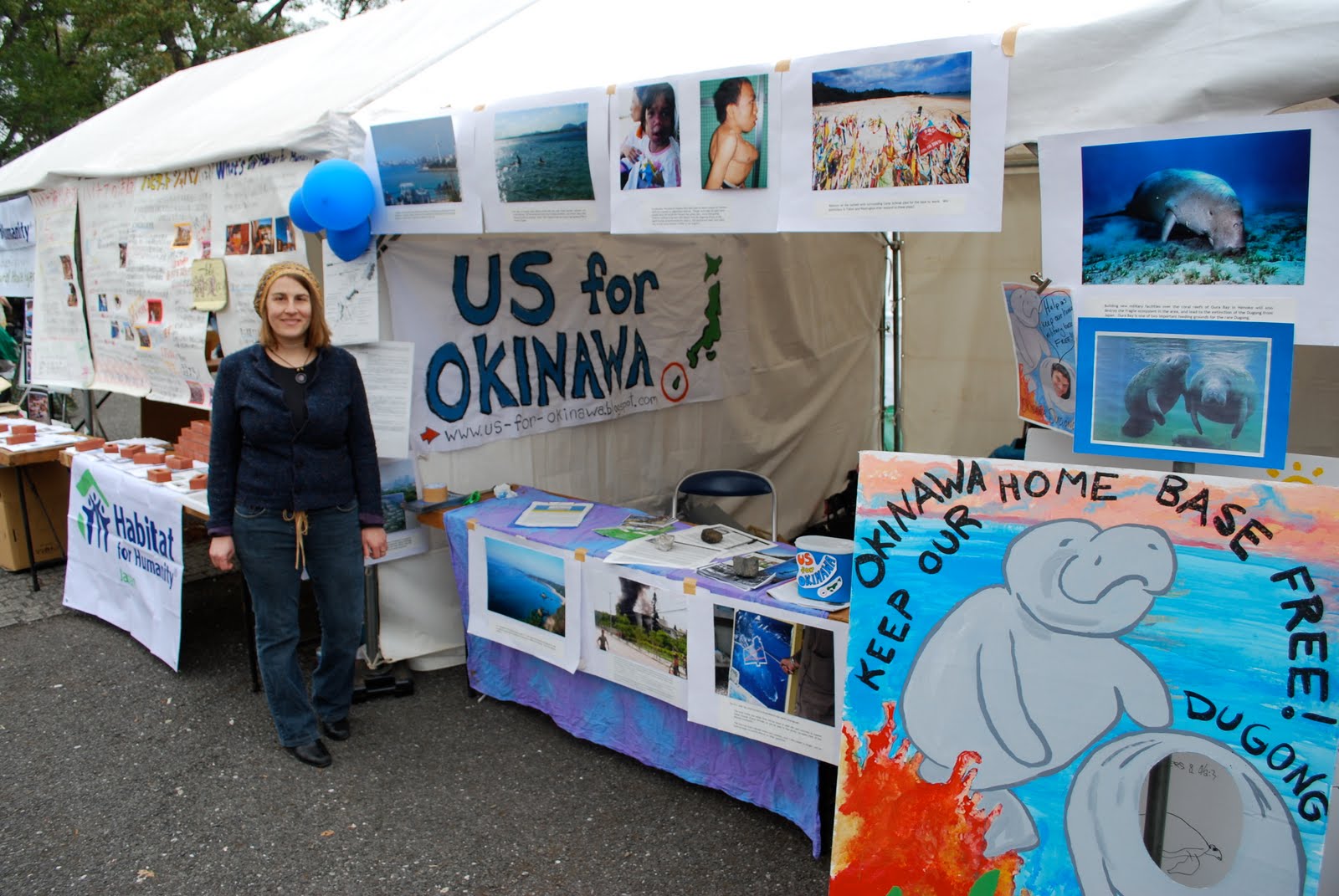
The event featured two stages: the main Spring Stage, where most musical acts and peace talks took place; and the smaller, cozier Love Stage, which housed DJs, smaller musical acts, and presentations from representatives of several of the NPOs and NGOs in attendance. One group was US for Okinawa, composed mostly of foreign residents in Japan committed to demonstrating their support for the halt of U.S. military expansion in Okinawa. The group organized a booth at the event with a photo exhibition, FAQ sheet, and petition that show the destructive impact of U.S. military bases. Coincidentally, many of the network's core members were actually on a study tour to visit U.S. bases in Okinawa on the very same weekend as Spring Love—their report of their fruitful tour may be read here.


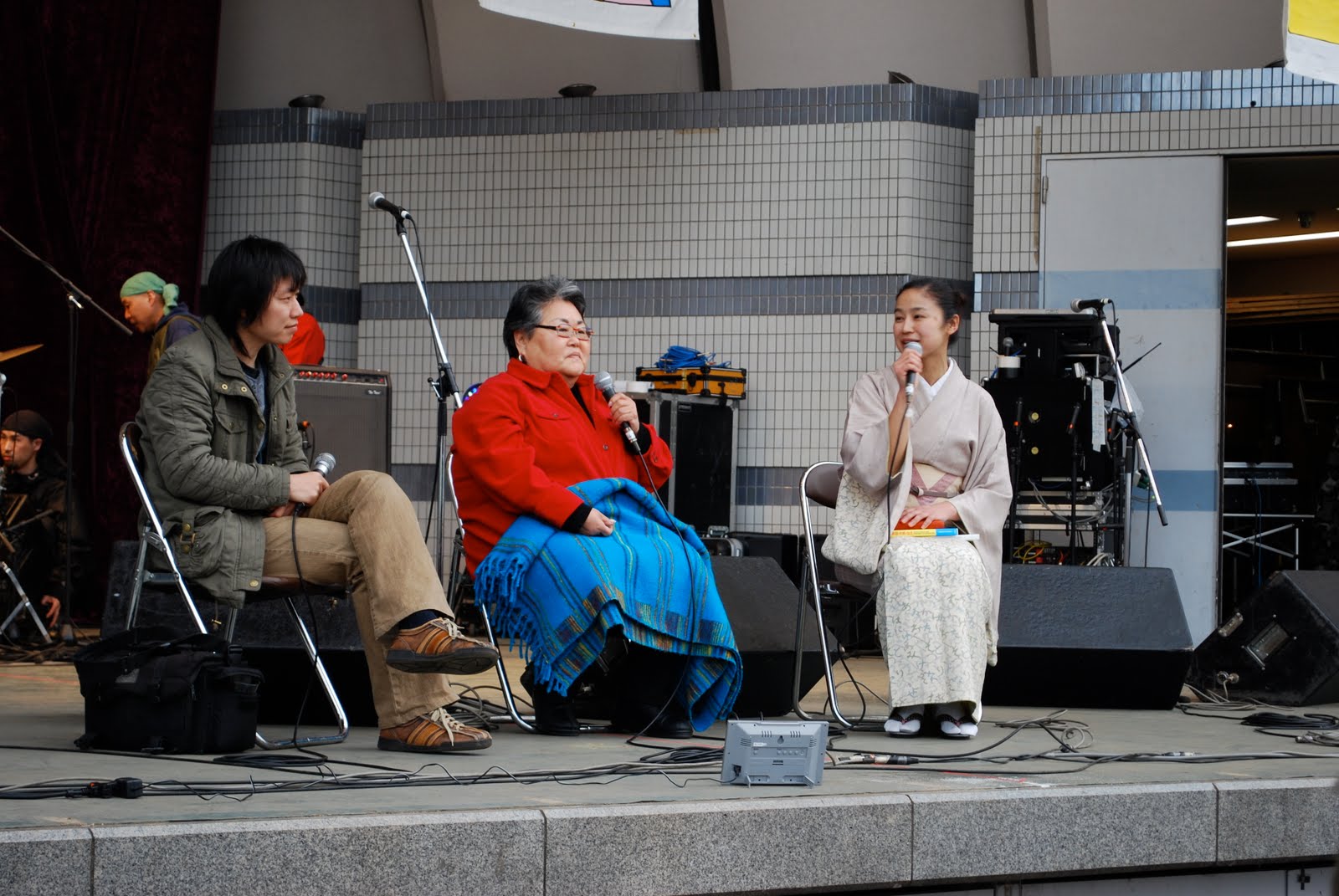
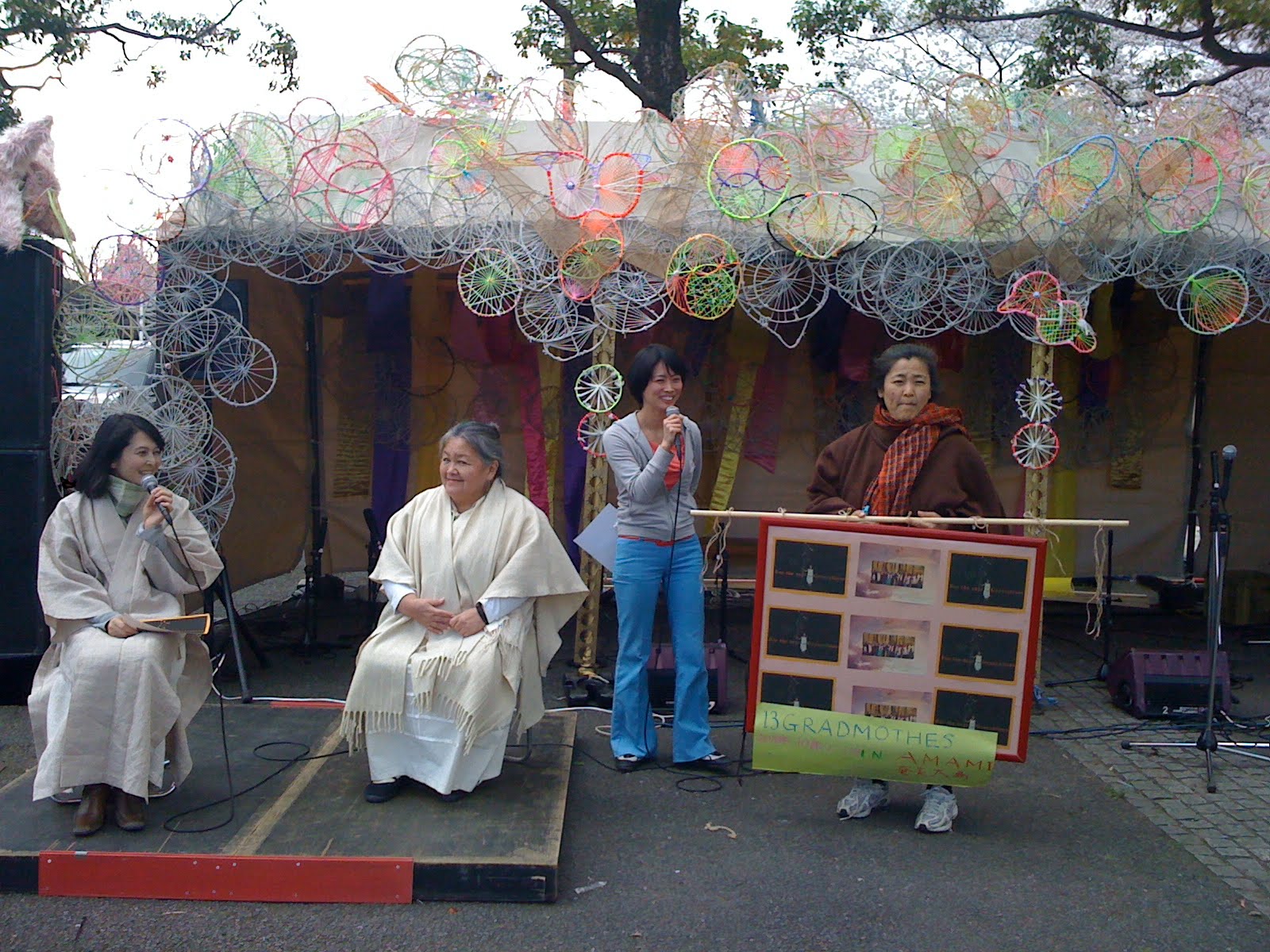
Another speaker on the Love Stage was Clara Shinobu Iura, a Japanese-Brazilian who is one of the 13 indigenous grandmothers featured in the film For the Next Seven Generations. It recounts how the women came together from around the world to impart their knowledge and healing wisdom to younger generations before it is too late.

“I was warned by my sister to be careful when visiting Mt. Fuji, because I am such a sensitive person and might be susceptible to particular energies there,” Iura told festival listeners. “Well, that is exactly what happened…it was as if the mountain was speaking to me, and telling me to dedicate my life to trying to save the earth.”

Iura, who is now a practicing shaman in the Amazon rainforest of Brazil, will visit Amami Oshima island in southern Japan with the other grandmothers this coming October for a festival event, where they will conduct healing prayers and workshops. More information is available about the grandmothers’ project here.

 
Clara Shinobu Iura, seated right

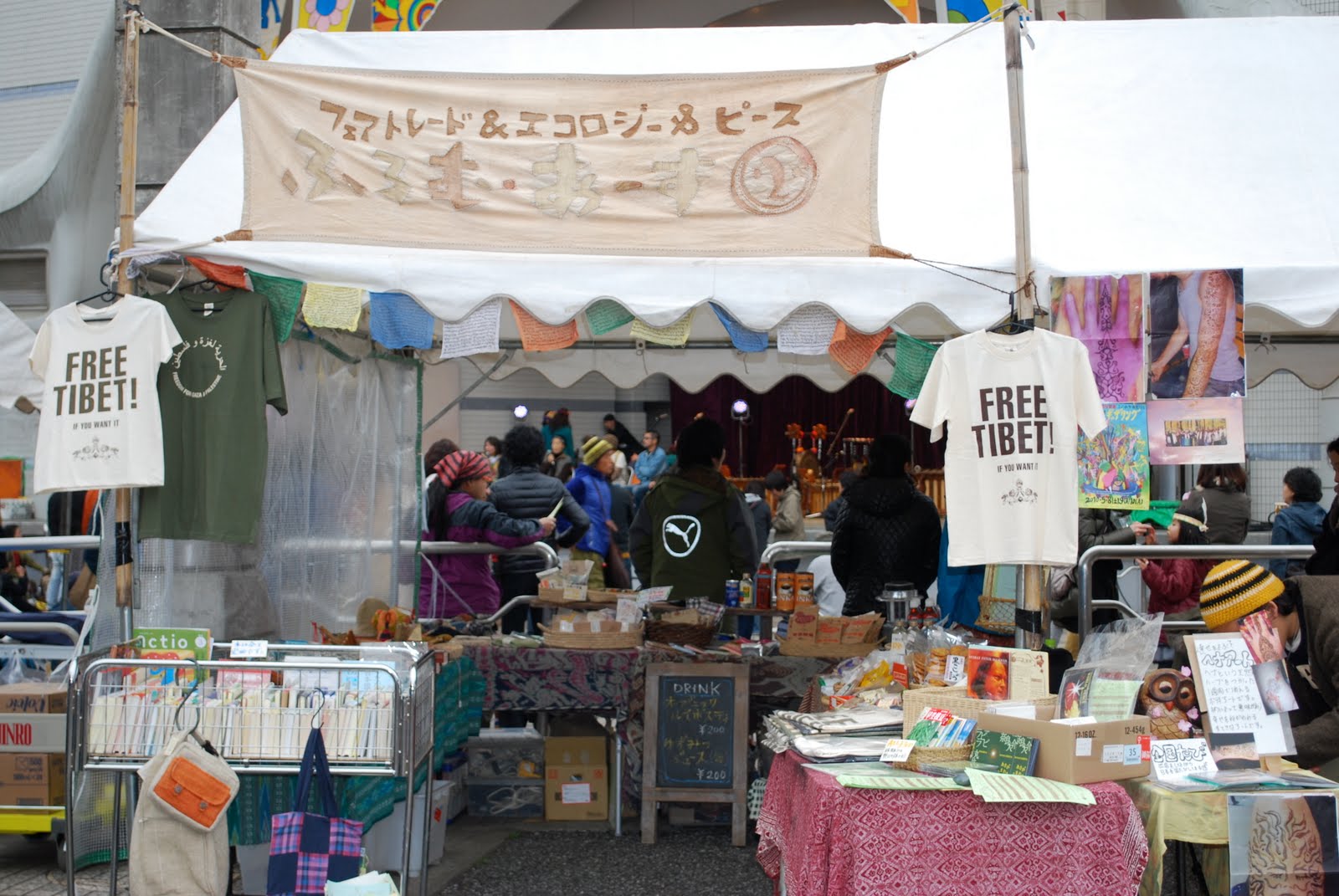
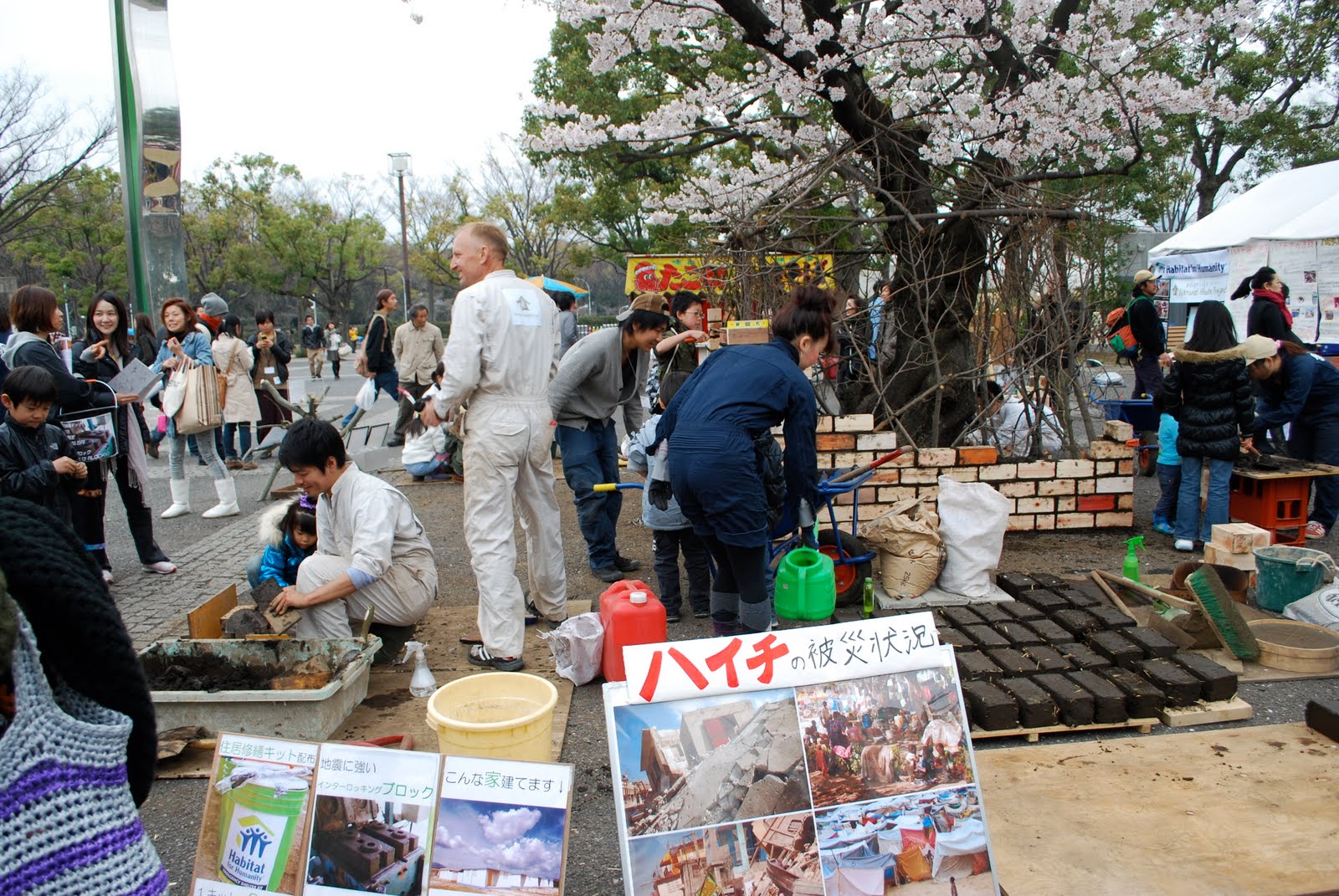
Many other organizations participated—including From Earth, an ecology/fair trade shop promoting organic lifestyles; and the nonprofit groups Habitat for Humanity and Natural House, partnering to spearhead a unique fundraiser for survivors of the earthquake in Haiti by selling handmade bricks for ¥500 in a project simulating the construction of new homes.


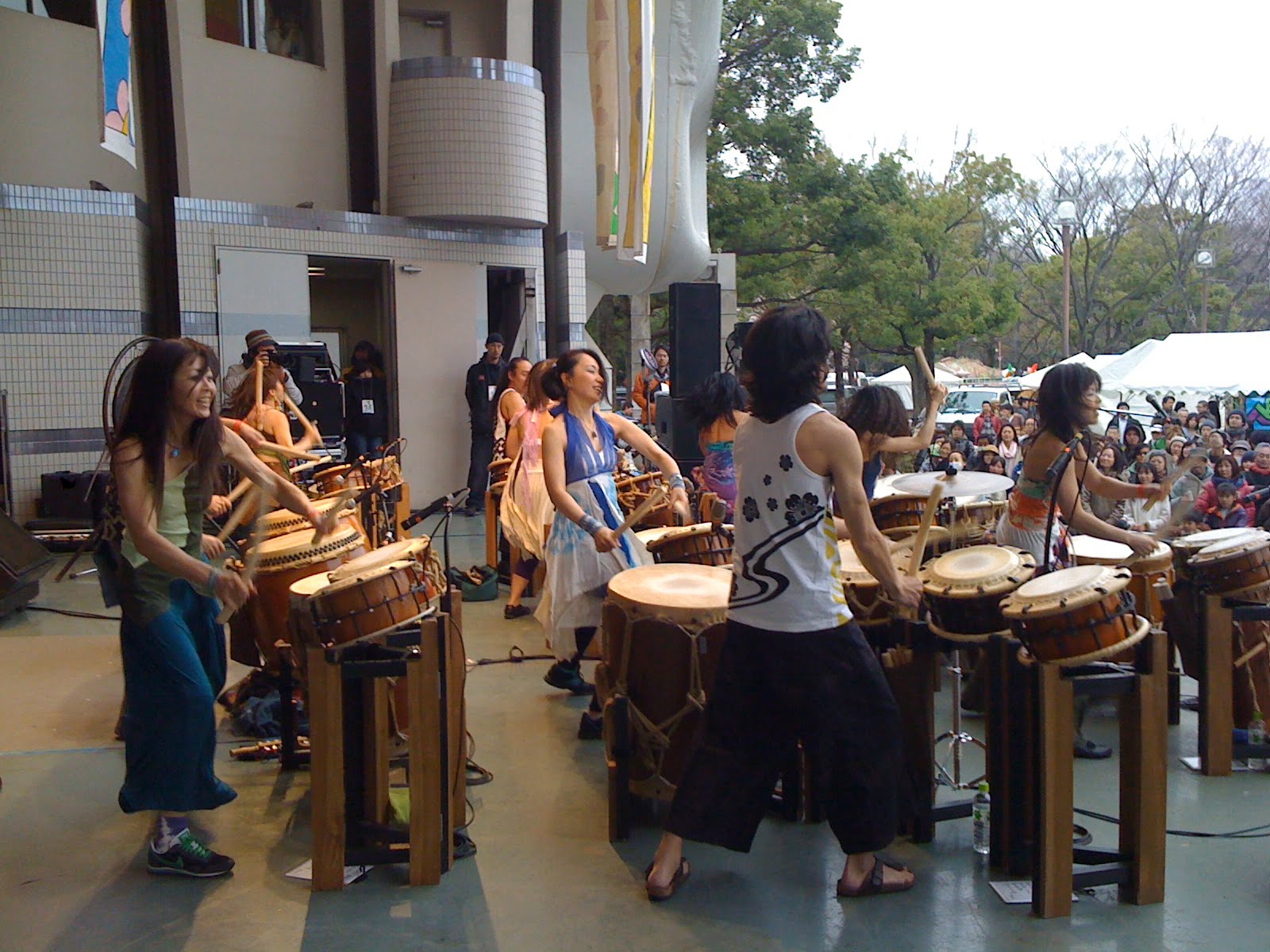
Many of the performing artists echoed messages onstage supporting the spirit of the event. “Even if we feel we cannot make a difference on a large scale with our individual actions, it is still important to live every single moment with purpose and clarity; this in itself is a step toward creating a peaceful world,” said the spokesperson for Gocoo, a phenomenal 11-piece wadaiko (Japanese drum) ensemble.


The event’s closing artist, Sandii Bunbun, offered one of the most striking stage performances of the entire weekend. An internationally-known rock singer who collaborated with many famous artists during the 1970's and 80's using various stage names, Sandii—who grew up in Hawai’i—returned to her roots some years ago by performing more Hawai’ian music, and also earning the rank of Kumu Hula (hula master).


春風2010 SANDII~SandiiBunbun with Earth Conscious and Hula All 

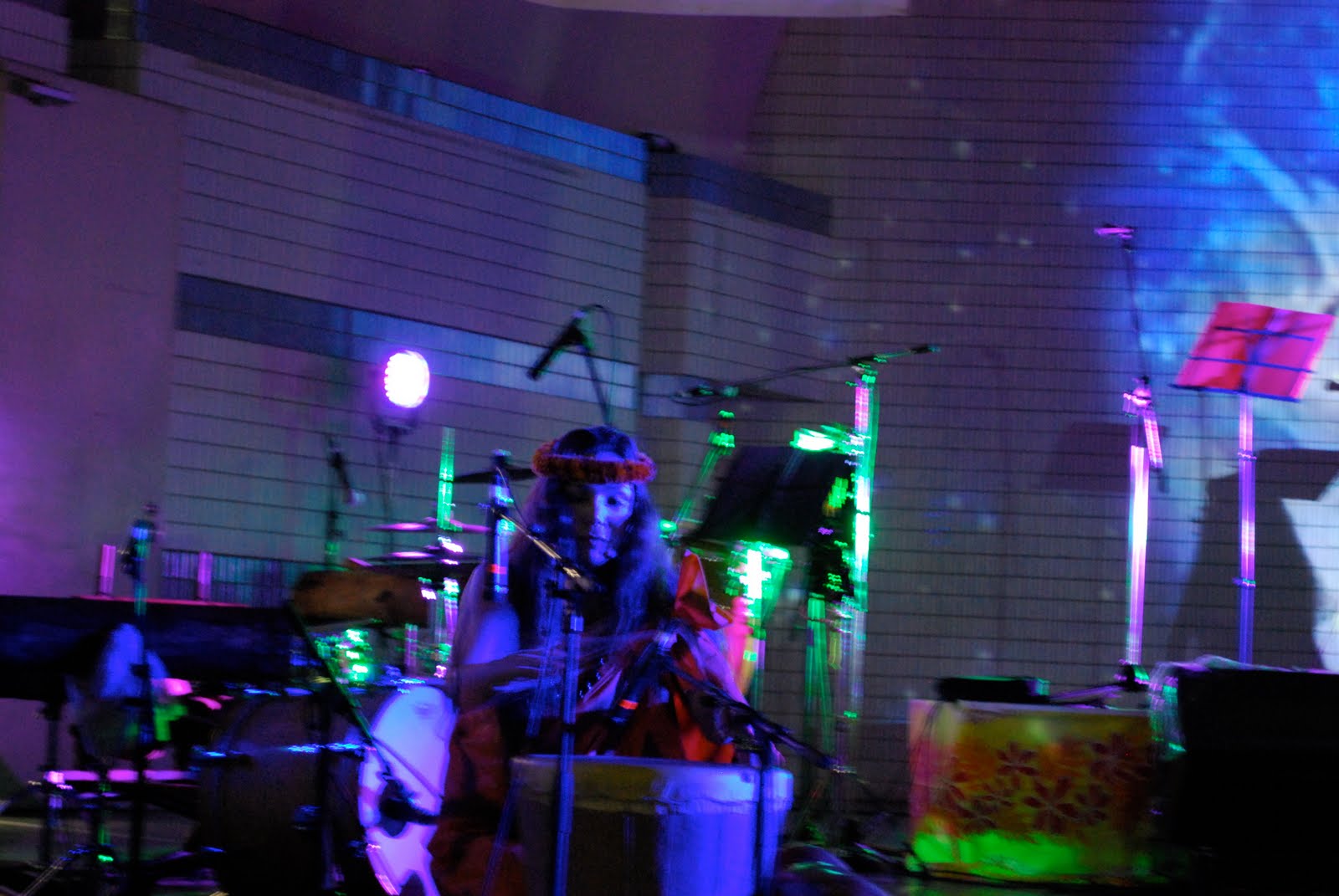
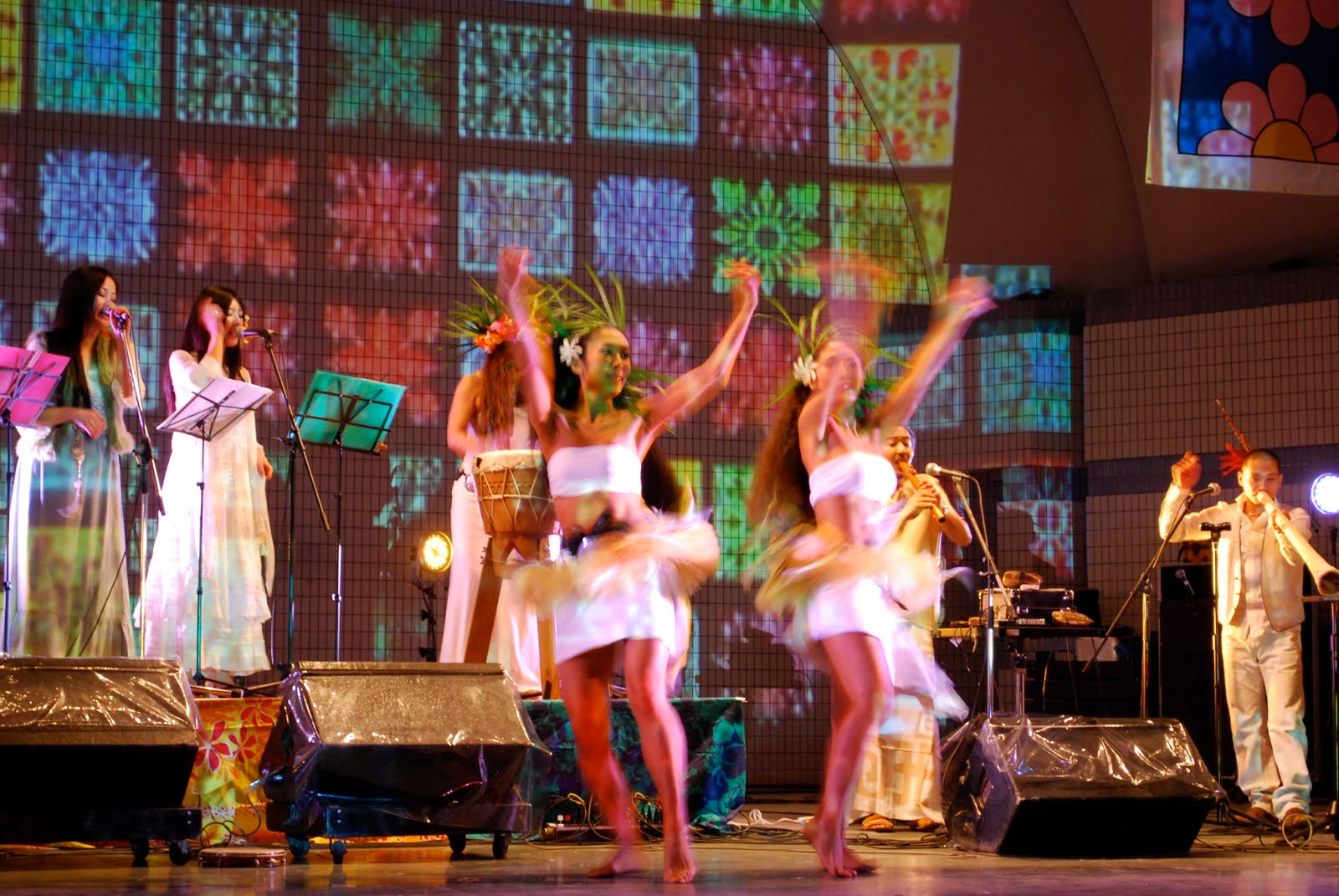
After purifying the energy of the space, Sandii began her set by singing and drumming several numbers dedicated to Pele, the Hawai’ian goddess of passion and fire, while flanked by a troupe of her dancing students, known as the Hula All Stars. This was followed by an energetic set with her band, Earth Consciousness, which featured instrumentation including a didgeridoo, as well as stunning background visuals projected behind the stage.


Just prior to her performance, Peace Not War Japan shared a powerfully poignant message of solidarity that had been received from activist Kyle Kajihiro in Hawai’i, which may be read in full here.


Peace Not War Japan coordinators Fukui Hiroshi and Kimberly Hughes

The festival received thoughtful solidarity messages from Sung-Hee Choi, an activist with the No Base Stories of Korea website and Peace Not War Japan founder Dom Pates.

"I enjoyed myself here so much," said one event-goer, a third-year university student of social issues and history. "Coming here made me feel like it is possible to change the world to make it a better place!"

Peace Not War Japan extends deepest thanks to all artists and participants who helped make the Spring Love Harukaze event possible, as well as the 40,000 some attendees who dropped by the event over the weekend to make it their own—and everyone who took the time to read this report.

Truly…each one of us represents the peace we wish to see in the world!

-- Kimberly Hughes

Friday, April 2, 2010

Spring Love Harukaze 2010 focuses on issue of military bases & militaristic versus sustainable economy & culture

It’s back!!

Spring Love (Harukaze) is making its second run in Yoyogi Park on April 3rd and 4th, promising a weekend extravaganza of top-rated musical and dance performances, film screenings, organic food and goods, and talk sessions featuring peace-related social action.

Come out and enjoy the cherry blossoms while feeding your mind and soul with some Spring Love!!

Date/Time: Saturday, April 3rd (1-8 PM) and Sunday,
April 4th (12-7:30 PM)
Venue: Yoyogi Park Outdoor Stage
Admission: Free!!

Event will feature:


■ Performances from numerous musicians and dancers representing a variety of artistic genres
■ Peace-related talk sessions, films, and exhibitions
■ Events on two separate stages (Spring Stage and Love Stage)
■ Booths with literature from peace-related NPOs/NGOs
■ Spring Love Market with sales of various eco-friendly goods
■ Spring Love Kitchen featuring stalls with organic/ethnic foods
■ Live painting
■ Kids’ activities

Peace program:

Saturday, April 3rd

2:30-3:25 PM: Military bases and the role of the media


Panelists: Kobayashi Atsushi (director/producer of several military-base related documentary films); Shiva Rei (freelance journalist who has reported from places including Iraq and Gaza)
Navigator: Inada Hideaki (Solar Inc.)

4:35-4:50 PM: Hints for carving out natural, sustainable lifestyles in today's unnatural, unsustainable modern societies

Speaker: Ikue Masudo, formerly known as Takagi Saya (TV/film actor, free diver, owner of Furyu organic cafe/gallery)
Navigator: Fukui Hiroshi (Peace Not War Japan music director,DJ)

4:50-5:50 PM: Why should Japan's Constitutional Article 9 (the peace clause) be protected?

Panelists: Matsumari Masumi (Peace Boat); Shiva Rei (freelance journalist); Kamebuchi Yuka (gospel singer, peace advocate)

8:30 PM〜: Documentary film screenings

We don’t need bases anywhere!, ANPO and The Insular Empire: America in the Marianas promotional clips, Message from Yanbaru: A Documentary of Takae, Higashi Village in Okinawa, Alternative Lifestyles: Learning from the European Squatting Movement, Kukuru (featuring a live performance from singer UA in Takae village, Okinawa)

Sunday, April 4th

2:00-2:45 PM: Listen to citizens' voices: No more wasteful, destructive construction!

Hear from activists working to stop the following projects in environmentally rich areas: a tunnel through Mt. Takao; a nuclear power plant in Kaminoseki; and a U.S. military site in Takae Village, Okinawa.


Panelists: Sakata Masako (Kenju no kai); Higa "Marty" Masato (documentary filmmaker); Yamato Taka (organic loquat farmer); Yamada Sei (peace/environmental activist and author)

3:30-4:25 PM: Building sustainable, non-militarized economies: examples of organic, small-scale, community-based alternatives to a military-dependent economy

Panelists: Kikuchi Yumi (Harmonics Life Center director, Tokyo Peace Film Festival producer, Japan United for a Ministry of Peace committee member); Tanaka Yu (Mirai Bank Director, Japan International Volunteer Center board member, ap bank member); Kosaka Masaru (organic restaurant/bar owner, writer, rice/soybean farmer)

5:10-5:25 PM: Kikuchi Yumi, a well-known peace/environmental activist, writer, translator, and international speaker, shares the latest information on 9/11-related issues, the Tokyo Peace Film Festival, and more!

Navigator: Kimberly Hughes, Peace Not War Japan co-coordinator.

Musical performers:

Ikue Asazaki (traditional Amami Shimauta folk songs)
http://www.asazakiikue.com/profile.html

Sayoko meets YA MAN RIDDIM (funky reggae + djembe)
http://www.watonari.net/, http://www.naradaisuke.com/

Blues the Butcher-590213 + Leyona (rock/soul/reggae/blues)
http://bls-act.co.jp/artists/bluesthe-butcher-590213
http://www.leyona.net/bio.html

Rakita (acoustic groove)
http://www.myspace.com/uheheheoregarakitada

Yuppi & Tane (elementary school aged singer/songwriter!)
http://www.conisis.com/yuppi/

Rabirabi (percussion/voice duo)
http://www.rabirabi.com/about%20R/about_R.html

Ailie (roots reggae)
http://www.roots1music.com/ailie/index_main.html

nam

GOCOO + GoRo
11-piece wadaiko (Japanese drum) ensemble

Kamebuchi Yuka and Voices of Japan (VOJA) (gospel)
http://www.tmp-voja.co.jp/index.html

Mika Arisaka (jazz)
http://www.jvcmusic.co.jp/-/Profile/A014076.html

SandiiBunbun with Earth Conscious and Hula All Stars (Hawaiian)
http://www.sandii.info/

The Tchiky's (Acoustic/Afrobeat/Dub)
http://nbsa.info/site/?p=1012

Takeru (reggae)

Fukugawa Baron Club (Indonesian gamelan)

YOSHIE (belly dancing)
http://ameblo.jp/bellydancer-yoshie/

Uranagel (folk)

Jintaramuta (fusion unit blending Japanese traveling street protest music together with elements of modern jazz)
http://www.cicala-mvta.com/profileenglish.shtml

Abdallah
(http://yaplog.jp/abdallah/archive/15)

Mon Kumagai (shamisen)

And more!

Additional Information:

※ Please note that there may be changes in the list of performers and guests.

※ Please refrain from smoking within the venue area, as well as from taking photographs of the performers.

※ A portion of the sales of food and goods--as well as all donations placed in our donation boxes, will be given to several grassroots organizations in order to support their ongoing work for nonviolent peace action.

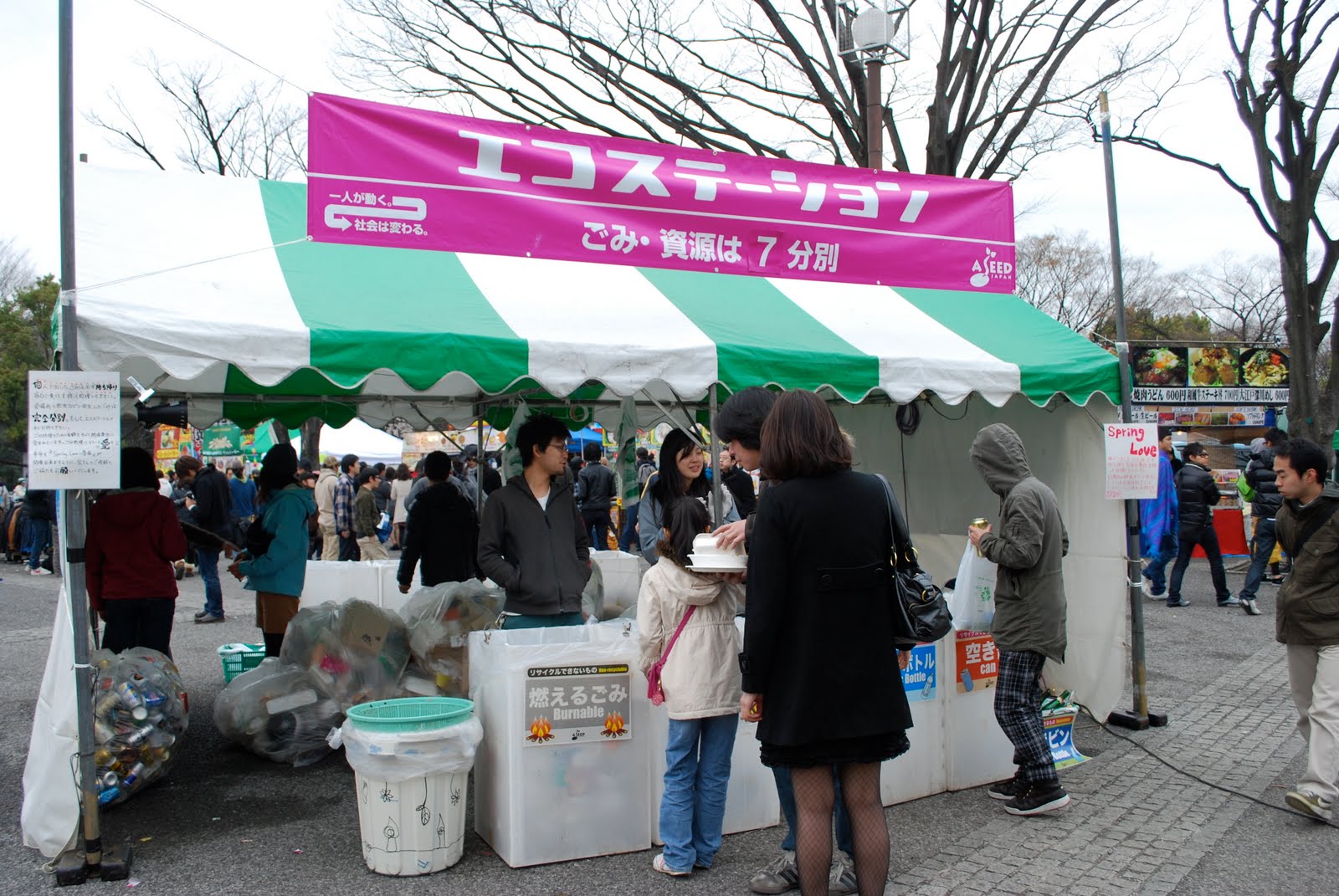
※ Spring Love has a “gomi-zero” ("no garbage") policy.

Please leave the venue as clean as you found it by separating your trash at one of the provided garbage stations. Garbage
cleanup is an extremely expensive undertaking, and if this policy is not respected, we may not be able to offer this free
festival in the future. Show some spring love by following the "gomi-zero" rule!!

※ Volunteers needed before and during the event!! (setup, translation/interpretation, cleanup, various administrative tasks,
etc.) If you are able to help, please contact us at kim@pnwj.org!

Event support: A SEED JAPAN, Solar, Peace Not War Japan,
TEAM

Thursday, March 18, 2010

Nonviolent Pink Joan of Arc duo lead World Peace Now's commemoration of the 7th anniversary of the US/UK invasion of Iraq this Saturday in Tokyo

"Pink Jeanne d'Arc" performance artists Kunihiko Ukai and Rena Masuyama, a/k/a "Momo Iro Jean," promise to liven up the event with their special celebration event against war...(Photo: Renaart.exblog.jp)

At this time of record military spending; the push for military schools, and obstinate military empire-building by a few very rich people against the wishes of the billions of peace-loving people in our world—the world more than ever needs a Nonviolent Pink Joan of Arc.

Performance artists Kunihiko Ukai and Rena Masuyama subvert the dominant Western paradigm (embodied in the original Joan of Arc who wielded a sword and killed in the name of God—in quest of power and territory) that violent force is the best way to acquire resources, land, and resolve conflicts. Of course—on an unevolved and morally challenged level— it makes some sense that nations that have no legitimate claim to territories would resort to violence—knowing that their positions would not be honored in civilized forums.

Rena Masuyama is the wife of Shiva Rei, a freelance journalist who reported from Iraq. Rei will be one of the speakers at Peace Not War, Japan's upcoming "Spring Love" event. Masuyama used to be part of a performance art peace group called the "Momoiro (peach-colored, as in the color of buttocks) Guerillas"—another subversive inversion of the the concept of the macho mindset that emotionally fuels the war paradigm. The "Momoiro Guerillas" had nothing (no ill will, no violent intent) to hide in contrast to armored, armed, and camouflaged guerilla warriors.

Pink Jeanne D'Arc will be performing at the World Peace Now event commemorating the 7th anniversary of the ongoing U.S. war in Iraq.

Thanks for the head's up to Martin Frid at his Kurashi--the "Eco" Blog:
Peace groups are gathering at noon in Tokyo on Saturday for a big anti-war event on the 7th anniversary of the Iraq War.

The booths with information as well as rally speeches start at 13:00. Do join the parade, as they call the demonstration, starting at 15:00 from Shiba Koen.

There are events in the evening as well, with music and presentations.

Background on World Peace Now from Jennifer Chan's Another Japan is Possible: New Social Movements and Global Citizen Education (short excerpt of interview with Machiko Hanawa):
World Peace Now (WPN) came into being as an amorphous network when youth-centered groups centered around CHANCE!pono2 and many civic groups (dominated by relatively older people) taking action against the attack on Iraq got together and organized the first demonstration on October 26, 2002. In that first attempt, eight hundred people joined.

WPN started as a broad coalition of individuals in citizens' groups, religious groups, and international NGOs who have agreed on four principles: no more war, opposition to the war in Iraq, opposition to the Japanese government's support and cooperation for the attack on Iraq, and nonviolent action. There were some thirty organizations at the beginning, but currently the number has increased to fifty.

Until this kind of coalition came into being, many NGOs in Japan focused on a single theme and acted separately. In order to overcome this, we requested the participation and self-expression of NGOs in different fields, including Peace Boat and Greenpeace Japan. In this way, on Jan. 18, 2003, before the start of the attack on Iraq, seven thousand people participated in the demonstration in Tokyo, and fifty thousand people joined on March 21, 2003, right after the attack was started. After December 2003, when the Japanese Self-Defense Forces (SDF) joined the occupation of Iraq, opposition to the occupation of Iraq and immediate withdrawal of SDF became WPN's demands.

In March 2004, the first anniversary of the U.S. invasion of Iraq, WPN also joined the international antiwar action again. This time, 130,000 people in 120 places across Japan marched on the streets.

Wednesday, October 28, 2009

Peace Not War Japan Presents: "Kunitachi Peace Film and Live Music Festival" in Tokyo, November 1-3, 2009


Peace Not War Japan, a grassroots collective that has been organizing live music, dance and other cultural events since 2006 to raise awareness and funds for citizen-level peace groups, is pleased to announce its latest event to be held this weekend, November 1st-3rd, in the western Tokyo town of Kunitachi.

Kunitachi--known for its progressive social activism and a lively arts scene--will also be holding the "Kunitachi Tenkaichi festival" on the same three days. The town's main street of "Daigakudori" will be transformed into full festival mode, with food stalls and local merchants showcasing their wares.

On each of the three nights, the Chikyuya bar and cafe--a cozy space whose name loosely translates as "Earth House"--will host a lineup of fantastic live bands representing a variety of musical genres, as well as a thought-provoking, peace-themed documentary film to be followed by a talk session. A portion of each night's proceeds will then be donated to a grassroots peace group working in conjunction with the issue being spotlighted.

We believe that peace starts in each of our own individual hearts, and this event will be held in the spirit of inspiring peaceful energies amongst everyone present. So come out to Kunitachi to get some fresh perspectives on important issues that you're not likely to find elsewhere... all while supporting a great cause, *and* enjoying some fabulous entertainment!


Venue: Chikyuya Live House, Kunitachi, Tokyo
Phone: 0425-725-851
Website here (map in Japanese only).
Entry: 1500 yen per night (includes peace group donation)
Time: Doors open at 7:30 PM nightly; shows will run from 8PM
until around 11PM

Sunday, November 1st
Peace issue: Stop construction on Mt. Takao!
Documentary film: "Takao san: 24 years of memories" (Japanese only)
Director: Sisido Daisuke
Peace talk: Sakata Masako from the Kenji no kai (eco-action
group working to save Mt. Takao from slated construction)
Donations: Kenji no kai
Website: http://homepage2.nifty.com/kenju/ (Japanese only)

Live performers:
* LEYONA
* Ailie
* Numazawa Takashi (DUB AINU BAND/blues.the-butcher-590213/ill)
* Tengokudan

Monday, November 2nd
Peace issue: War in Iraq and Afghanistan
Documentary film: "Fuyu no heishi" (Winter Soldier)
(English with Japanese subtitles)
Director: Tabo Junichi
A peace talk will be held with the director following the film,
which recounts the Iraq Veterans Against the War's Winter Soldier testimonies of U.S. soldiers who served in Iraq and Afghanistan and are now committed to revealing the truth regarding the miseries of war and militarism.

Donations: Collateral Repair Project (grassroots coalition of U.S. and Iraqi citizens working to provide support to Iraqi refugees )

Live performers:
* Nigayomogi
* 東京月桃三味線
* Takeru

Tuesday, November 3rd
Peace issue: No Helipads in Takae!
Documentary film: "Kukuru" (Japanese only)
Director: Kim Sunyon
Peace Talk: Kondo Ichiro and Murakami Yoko, from Yuntaku Takae

Donations: Yanbaru Takae--Association to Protect the Broccoli Forest (Local movement to stop U.S. military construction in Okinawa's Yanbaru region)

Live performers:
* Kudo "Big H" Haruyasu and Friends
* poodles
* Love Station

Additional Info:
* We ask that you please refrain from smoking in the venue.
* All artists are performing on a volunteer basis. Once the venue rental fee and other expenses have been paid, all proceeds will be donated to the peace groups specified above.