Links

Showing posts with label satoyama. Show all posts

Friday, October 18, 2013

Organic tea farmer Ayumi Kinezuka on protecting Japan's rich family farm culture, food safety, and the need for reconnection—with each other, with land and nature...


In this 5-min. video (via Reciprocity/Food Sovereignty Japan
Ayumi Kinezuka talks about her family farming cooperative; community-supported farming;  how her father embraced organic farming after reading Rachel Carson's Silent Spring,
 and Nouminren, the farmers' union.

Ayumi Kinezuka, after getting degrees in psychology and sociology at the University of California (Berkeley). returned home 10 years ago, to help carry on her family's organic tea farm near Fujieda, Shizuoka.

Her father, Toshiaki Kinezuka, is one of the pioneers of the global organic farming movement:  Thirty-seven years ago, he shifted his 2 hectare (5-acre) tea and orange farm to organic and founded a group with several tea growers that became Hito to No, Shizen wo Tsunagu Kai (Connecting People, Agriculture, and Nature). Their organic green and black teas are popular worldwide among tea enthusiasts.

In 2011, after they were hit (as was most of Japan) with fallout from the Fukushima meltdowns, the Kinezukas decided, at great financial loss, to destroy their entire crop from that year, even though the radiation readings of their tea were far below the Japanese government's safety standard.  The reason: as organic farmers, food safety is their integral to their ethos and they felt responsible to maintain their high standard of purity to protect their customers.

They are now continuing to recover from the accident, while strengthening organic food culture in many ways:  hosting WOOLF interns; deepening relationships with their consumers and other farmers, and welcoming urban dwellers in need of reconnecting with nature.

This is an inspirational family and community -- on every level.  The Kinezukas and their farming cooperative keep in contact with their customers and sell directly to them at their website, (naturalitea.com/), a trove of info on tea and the rich traditional Japanese way of life (reverencing nature, farming, food, relationships, and community).

In the second -part (5-min) of a 3-part series of video interviews,  
Ayumi Kinezuka relates why she became a farmer:
 it is a field in which she can help connect people with each other and with nature 

In the  final short video, she talks about miso-making, and rice-growing with friends (non-farmers who visit the Kinezuka farm during rice-planting, weeding, and harvesting seasons to enjoy connecting with the earth, others, and eating fresh, organic local foods).  She brings her social psychological and outreach skills to creating and deepening awareness, connections in all that she does.

Also in two (10- and 15-min.) videos at the same webpage, Toshiaki Kinezuka shares his story of why and how he became an organic farmer.

The above videos were made in January, 2011, during a peak  the Japanese organic farming movement, which had been developing steadily since the 1970's.  The multiple meltdowns at Fukushima Daiichi Nuclear Power Plant have hit farmers throughout Japan (not just in Fukushima) hard, especially organic farmers like the Kinezukas.

In this Women Rising radio interview (her interview begins at 20:30 of the tape), Ayumi Kinezuka describes her organic philosophy and how her family and their organic tea cooperative decided, at great financial loss, to destroy their entire 2011 crop  to protect the food safety of their customers.
I'm living in the community, hoping to protecting the rich culture we've inherited...There are not many young farmers...So when I came back ten years ago, one of the things I thought was very important was to have a network of young farmers because, first we need to share an understanding of our current situation...When I attended the youth meeting of Nouminren, I met a lot of young people and they are facing the same challenges.  As I talked to them, it was very inspiring, so I suggested to La Via Campesina to organize the youth...  Since 2008, we have started a regional youth gathering...

I think farming is not just the production of food. To produce the food is more like an expression of our own ideology or our own beliefs. So participating in La Via Campesina meetings and Nouminren meetings, I'm receiving a lot of information and education about how to perceive the world, how to perceive the current agricultural system, and so on. It's given me a lot of inspiration in that way...

I live in Shizuoka Prefecture, which is west of Tokyo, close to Mount Fuji. From the Fukushima nuclear power plant, it's about 400 km (260 miles) away.  I never imagined our farm would be affected when the accident happened. So after we harvested the tea, we sent our tea samples for testing and we found 350 becquerels of cesium in our tea. At the end of the second harvest season, after June, we found 150 becquerels. And the last harvest in October, there was 76 becquerels. Even though the government regulation at that time was 500 becquerels, and according to them, since it's below the regulation level, they say it's safe.

But as an organic farmer, we have never used any chemicals, herbicides, pesticides, or chemical fertilizers in our fields to ensure the safety of our tea and food, and also to protect the environment. It was a very difficult time for us. We did not know how to understand this reality that our tea was contaminated.

So, collectively, since we're a group of organic tea farmers, we discussed and decided we were going to destroy all the tea we produced that year. All together, we destroyed more than 20 tons of tea that was produced in 2011.  Since then, we've been testing the tea at least three times a year to make it obvious to the consumer the truth about the tea.

We are very upset at what happened because we have been working so hard to build a community of organic farming, and at the same time, we've been working very hard to build very good relationships with consumers and producers. But all of a sudden, without our control, this accident put radioactivity into our tea. What's scary about radioactivity is that you can't see it, feel it, taste it, smell it, but it's still there. The accident contaminated our soil, air, water, and also all the plants, and, of course, our bodies too. We have to be very clear that we can't co-exist with this dangerous generation of power.

Now many people in Japan are living in cities so they are detached from nature. Even though human beings are part of nature, we forget that, and that is driving people crazy. So organic farming has the responsibility of connecting people back with nature. It is very nice when people come to my farm and they have a very beautiful smile on their face, and their eyes are just bright. That really tells us what is really essential for us to live as a human being. It's not just money, goods, iPhones, and computers. So I want to provide, as an organic farmer, not just safe food, but an opportunity for people to come back to nature and feel for themselves what it is like to be alive.

The Kinekuza Family taking a break.
 (via Samovar Life: photo and (great blog post on the Kinezuka tea festival))
Wednesday, October 16, 2013

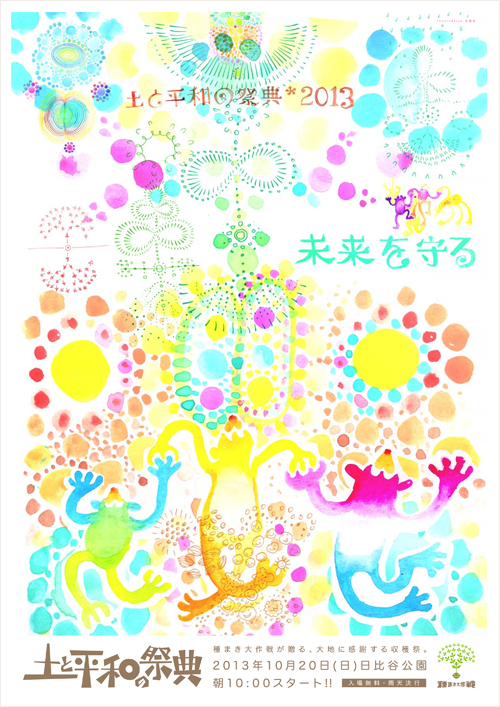
World Food Sovereignty Day • Soil and Peace Festival @Hibiya Park, Tokyo - Oct. 20, 2013


soil and peace festival 2013

Today is the international family farmer movement Via Campesina's World Food Sovereignty Day; and this weekend, Japanese organic family farmers and their supporters will join in a celebration of the best of visionary Japanese (organic, recycling, nuclear-free, GMO-free, fair-trade, Slow Life, satoyama, Tohoku-supporting) culture.

Via the Consumers Union of Japan:
There will be a Soil and Peace Festival in Hibiya Park, Tokyo, on Sunday October 20, 2013. Starting at 10:00 hundreds of farmers and activists and artists will hold a great event until the evening.

A great opportunity to meet your favourite NGOs and learn more about organic food, anti-nuclear campaigns and the future of Japan. Look forward to lots of inspiration! Music by Kato Tokiko and many others throughout the day, starting with a taiko performance by Gocco.

Website with more info (J) here.

Sunday, July 24, 2011

Martin Frid: Support for Japanese farmers from French Organic Farmers

Wonderful news from Martin Frid in his latest post: "Support For Japan From French Organic Farmers".

Those of us who love and support traditional Japanese culture (rooted in small, organic family farms) are thrilled to hear that the French organic farming movement, Urgenci, is renaming their newsletter "Teikei," (cooperation) as a sign of solidarity with the Japanese Organic Agriculture Association (JOAA):
Tei-Kei: Legend has it that the face of the farmer is hiding in the vegetables in the box. The truth is far more prosaic, but none the less elegant. The word teikei 提 携 Is composed of two characters that depict an action : that of an outstretched hand and that of helping each other. This is the term chosen by the Japanese pioneers to designate the first partnerships that were developed between producers and consumers. From the outset, in the 1970s, this new form of direct sales illustrated how to jointly maintain the often fragile balance between farmers and consumers...

At a time when Japan is still suffering from the trauma of the nuclear disaster, renaming our newsletter TEIKEI is a legitimate act anchored in our history. It shows that our movements all recognise our family ties with the Japanese movement and is also a symbol of our unconditional solidarity towards the families that are victims of the disaster. It is an important signal that will strengthen a great many actions that are already up and running. The reconstruction projects carried out with such strength by Hiroko Amemiya to help the farmers in the contaminated zones, as well as the testimony by Shimpei and Toshihide in Aubagne. This is the 33rd Urgenci newsletter, the first to be published using our new name, Teikei. A great deal of it is dedicated to them.
More at the linked post from Martin, who will be visiting Namyangju City, Gyeonggi Province, South Korea in September with the JOAA for the International Federation of Organic Agriculture Movements (IFOAM) World Congress, the first such event in Asia for the organic movement. IFOAM is the global umbrella organization for the organic movement, uniting more than 750 member organizations in 116 countries.

Most (1.9 million) Japanese farms are very small (less than 5 acres). These farms are based on harmony between humans and nature, highly sensitive to ecological balance of their landscapes (Satoyama).

Wednesday, October 20, 2010

Appeal to Tokyo to comply with its "Satoyama Initiative" & stop biodiversity destruction at the Kaminoseki Nuclear Power & Henoko, Okinawa

An appeal from the Japan Environmental Lawyers' Federation (JELF) and JUCON (Japan-US Citizens' for Okinawa Network):

At the tenth meeting of the Conference of the Parties (COP10) on the Convention on Biological Diversity (CBD), held in Nagoya, Aichi, from October 18 to 29, host nation Japan announced its “Satoyama Initiative,” expressing Tokyo's intention to lead global projects related to the Convention.

At the same time — even as the COP10 is underway — Tokyo is pushing government projects that will destroy biodiversity in Japan: the construction of Kaminoseki Nuclear Power Plant in a biodiversity hotspot in Yamaguchi Prefecture and the plan to to reclaim land at Oura Bay in Henoko, Okinawa (the habitat of the critically endangered dugong and many other unique species) to build a U.S. Marine Corps air base. These are a couple of examples among many of the Japanese government’s policies that contradicts its official position and strategic objectives on preservation of the nation’s biodiversity. Tokyo's Official Development Assistance (ODA) policies also include those that contradict these biodiversity principles.

We, international NGOs, hereby issue a joint statement, to raise awareness about these realities, and to call for the Japanese government to review its policies.

Please read the appeal below and send the endorsement of your organization by 24:00 (in Japan) of 23th to jelf@green-justice.com.
Joint NGO statement to Japan, host nation of CBD-COP10, to call for reviewing environmental policies of Japan

On the following site, Japanese Government, the presidency of the 10th Conference of the Parties (COP10) of Convention on Biological Diversity, has pulished "Original draft of the post-2010 target (new strategy plan)" pamphlet: http://www.mofa.go.jp/mofaj/gaiko/kankyo/seibutsu_tayosei/pdfs/post2010.pdf

Five strategic targets are in this original daraft as of September 26, 2010.
Strategic target A: Deal with the primary cause for the loss of biodiversity.

Strategic target B: Decrease direct pressure to biodiversity.

Strategic target C: Improve the situation of biodiversity.

Strategic target D: Strengthen the benefit from biodiversity.

Strategic target E: Strengthen the execution of the agreement through the capacity building.
Moreover, it advocates the target of 20 items such as" All people recognize the value of biodiversity, the value of biodiversity is built into the plan of the government, and harmful measures to biodiversity is abolished."

The following two plans are proposed as "Mission (short-run target to 2020)".
Plan 1: Take effective and urgent actions to stop the loss of biodiversity.

Plan 2: Through the effective and urgent actions, stop the loss of biodiversity by 2020.
In addition, "Vision (mid/long-term target to 2050)"says that the vision of this strategy plan is "The world where people live in good harmony with nature" and "The biodiversity as natural capital is evaluated, maintained, recovered, used wisely, and thereby healthy earth is maintained and an indispensable benefit to all people is given."

Japan has named this approach "Satoyama Initiative", and tries to take related activities of the agreement globally from now.
However, Japanese Government is doing a lot of policies contradicting its standpoint and strategic target domestically. They are destroying biodiversity one after another. For example, they are reclaiming Oura bay in the east coast of northern Okinawa, a hot spot of biodiversity, to build the U.S. military Marine Corps airport. Moreover, various businesses in contradiction to this strategic target are done by official development assistance (ODA) in the foreign countries.

It is a problem for Japan to leave the ecocide go and not to stop the biodiversity destruction businesses only doing "Satoyama Initiative".

We enumerate the data of biodiversity destruction businesses from the next page to let COP10 attending countries and NGOs refer to them. And we request that the Japanese Government review businesses concerned at once and achieve the strategic target proposed in COP10. In addition, the signatures of the NGO groups that agrees to the request of stopping of businesses concerned are appended.

Saturday, June 5, 2010

SAVE HIRABARI SATOYAMA: How can Nagoya City allow the destruction of this biodiverse treasure while hosting a UN conference on biodiversity?

From Takuya Kamibayashi of Hirabari Satoyama Conservancy:
Hirabari Satoyama is in real danger...

On the 29th of May, developers started blocking visitors' entry to Hirabari Satoyama.

Inside of the Satoyama, local children were growing rice inside of buckets—not inside the rice fields that actually exist inside of Satoyama. But once the developers started the blockade, the children were forced to remove buckets. The only available alternative location for the rice buckets seemed to be the public pathway that actually runs inside of Satoyama; but without a clear explanation, it was also blocked. Some locals asked Nagoya City for an explanation why it allowed the blockade of a public road, but the city turned them away.

I also had a chance to plant rice seedlings inside of buckets, and also to tour inside of Satoyama. What I witnessed there: shining eyes of kids–finding out how their food grows, looking up at the big Totoro tree, discovering the mystery of life. Now, they have not only mystery of the nature, but also the mystery of disappearance of nature.

Hiroaki Somiya, a retired professor at Nagoya University, lives right next to this problematic land. The coordinator of activities at Hirabari Satoyama including rice planting—he cannot help but wonder:
Why does the nature of Nagoya City, the host of COP10 (upcoming UN meeting on the Convention for Biodiversity), keep being destroyed?

How are we—who live in the cities—supposed to understand the importance of biodiversity?

Our Satoyama might be a small problem compared to really big issues, but it all relates to each other. There is no reason we can destroy small ones.
Professor Somiya sees how the struggle between Nagoya City's and the developers and the Hirabari Satoyama Conservancy over these 12 acres is a microcosm of the ongoing global epic between destructive forces and people who respect and want to preserve their natural environments.

This year Nagoya City seeks the prestige of holding a UN conference, touting the slogan "Life in Harmony, into the future," following a 2008 Japanese government announcement of its "Satoyama Initiative." According to Eric Johnston in "Battle lines drawn across Nagoya land: Loss of 'satoyama' risks loss of face ahead of biodiversity summit" published in the Japan Times on March 4, Tokyo plans push this initiative during the October U.N. meeting "to promote protection worldwide of natural habitats from urbanization. Thus if the site comes under development, this would be a major embarrassment."

What does this contradiction between talk and action say about about Nagoya City's and the Japanese government's commitment to saving biodiversity when they are unable to figure out how and commit to saving an irreplaceable biodiverse treasure in Nagoya's own backyard?

There's still time to change course and save the Hirabari Satoyama. Its fate will determine whether Nagoya's holding the COP10 conference and Tokyo's "Satoyama Initiative" reflects a sincere commitment to a sustainable and biodiverse future or a tragic, transparent pretense.

What is a satoyama?

Satoyama (里山) is a manifestation of the traditional Japanese keen awareness of healthy and respectful symbiosis between people and their natural environment. An ancient Japanese concept describing the transitional space between mountain foothills and flat farmland, the word derives from Sato (里) meaning homeland, and yama (山) meaning mountain. Japanese farmers have refined satoyama, havens of biodiversity, through centuries of small-scale farming and forestry.
Because of unsustainable historical changes, many satoyama have been destroyed. In the 1980's and 1990's, renewed awareness resulted in a satoyama conservation movement.

See Jen Teeter's post "Where Children can see Totoro: Hirabari Satoyama and COP10" on Hibaraki Satoyama and one of its defenders, website designer and book binder Takuya Kamibayashi, who shared this latest disturbing news with us.

Please visit the English-language website for the Hirabari Satoyama Conservancy and its Facebook site (lots of wonderful photos that show what's at stake).

Monday, May 10, 2010

Where Children can see Totoro: Hirabari Satoyama and COP10

Website designer and book binder Takuya Kamibayashi and film director Hayao Miyazaki find similar inspiration in the Hirabari Satoyama. Miyazaki named the forest "Nagoya no Totori no Mori", or 'Totoro's Forest of Nagoya," after he joined the movement to save this wonderland of biodiversity from developers.

Hirabari Satoyma sits in the middle of a residential area, a five minutes walk from a driving school. It measures only 12 hectares, yet holds three rice fields, bamboo forests, zoukibayashi (wooded areas), and three ponds that provide water to three rice fields.

The satoyama is only 40 minutes away from the site of the tenth Conference of Parties on Biodiversity (COP10) in Nagoya. To appeal to COP10 participants to pressure developers to halt their plans that would destroy Hirabari, Takuya is creating a guide to this picturesque site of sustainable farming maintained in harmony with surrounding ecosystems. This guide will appear as an insert in the next edition of Kyoto Journal.. The special issue--one of the few pieces of English print media available to the international and Japanese audience--will be distributed to all COP10 attendees.

Eric Johnston reports in the Japan Times that shortly after the death of its owner at an advanced age, a real estate developer purchased the land and conveniently received approval to "develop the land" on the last day the mayor, with alleged ties to the real estate bidders, was still in office.

The present mayor Takashi Kawamura publicly denounces the proposed destruction of Hirabari, calling the plans an embarrassment not only to Nagoya, but also Japan. However, he has failed to raise funds to pay off developers, and in December 2009 the mayor ended up granting permission to them to proceed with their plans to demolish the satoyama. The real estate group's conception of development is contrary to sustainable development: it will destroy an ecosystem that has supported wildlife and human communities for decades.

During several trips to the area, Takuya has interviewed local citizens about the importance of Hirabari Satoyama in their lives:
When the city mayor was replaced, the development was put on hold, but last year December, it resumed. What is obvious is there are all the dirty hook-ups in back, and there actually are. With this in my mind, I interviewed Ms. Fujioka, a Nagoya resident and one of the primary members of Hirabari Satoyama Conservancy (HSC).

I asked her, "What do you want to emphasize the most about Hirabari Satoyama to the people who do not know about this place yet?"

She replied, "How fun and how much this Satoyama can offer to the local residents and especially to the kids. This Satoyama ecosystem provides not only a place to run around, but to learn how the nature relates to us. And at Hirabari Satoyama, children don't have to go far from home. They can learn right outside of their rooms."

I answered, "But there seems to be so many wrong things going on behind the scenes. Don't you want to let people know about that also?"

She replied to me that the most important thing about Hirabari Satoyama is what it means to children.

Before I was assigned to make a slip-in for Kyoto Journal COP10 issue, I didn't even know what Satoyama was. After witnessing and experiencing the nature of Satoyama, I finally understood the reasons of HSC's activities.

I saw two boys taking a walk in Hirabari Satoyama, and I asked them why they came. They simply said, "because we saw a forest and we wanted to see inside."

A mother taking her two daughters on a walk told me that it was her regular sampo (walk) course. Her daughter, Nana Kito, sang me "Nanohana no Uta' (song of the rape blossoms), and ran around to find dandelion puffballs. I thought then was that kids really can find their fun in Satoyama.

The area that kids can engage with nature now is so much smaller than that of adults. There used be urayama (backyard mountains) all over Japan. Now, kids in urban area do not have a chance to experience nature like this. That is why Hirabari Satoyama needs to be saved.

We adults cannot see Totoro; it is only visible to children.

I am now contributing to the next issue of Kyoto Journal to get more people to think what we are about to cut down. Is it only the trees, or is it more?

I hope many spectacular articles in the magazine and my slip-in will be triggers to bring more interest in environmental issues in the reader's local areas.

To find out how you can support community efforts to stop the bulldozing of Hirabari Satoyama, please visit this website: http://www.wa.commufa.jp/~hirabari/index_english.html

-- Posted by Jen Teeter