
Radioactive materials from Fukushima Daiichi reached the US by March 18, Iceland by March 20, and Europe by March 22 (Kyushu University and Tokyo University research. Image: Jiji Press)
Just hours after our field radiation team held a press conference calling for further evacuation around Fukushima, the Japanese government announced that it will extend the mandatory evacuation zone around the stricken nuclear plant to 30km and evacuate the contaminated towns of Namie, Iitate and parts of Minamisoma within one month.Reuters:
Japan raised the severity of its nuclear crisis to the highest level on Tuesday, putting it on a par with the world's worst nuclear disaster at Chernobyl in 1986 because of the amount of radiation released into the air and sea.
As another major aftershock rattled the earthquake-ravaged east of the country, a fire broke out at the Fukushima Daiichi power plant, although engineers later appeared to have extinguished the blaze. Developments in recent days suggest the operator of the stricken facility is no closer to restoring cooling systems at the reactors, which is critical to bringing down the temperature of overheated nuclear fuel rods.
An official at Japan's Nuclear and Industrial Safety Agency (NISA) said that based on cumulative levels of radiation released, the severity of the incident had been raised to 7, the worst on an internationally recognized scale...The month-long nuclear crisis that has gripped Japan following an earthquake and tsunami has claimed up to 28,000 lives and the estimated cost stands at $300 billion, making it the world's most expensive disaster.
Japan's Nuclear and Industrial Safety Agency (NISA) said the amount of radiation released into the atmosphere from the plant, 240 km (150 miles) north of Tokyo, was around 10 percent that of Chernobyl. However, plant operator Tokyo Electric Power (TEPCO) warned the release could eventually exceed Chernobyl if leaks were not halted. "Radiation released into the atmosphere peaked from March 15 to 16. Radiation is still being released, but the amount now has fallen considerably," said Hidehiko Nishiyama, NISA's deputy director-general.

 Banner reading “We Prioritize Life Over Electricity”, lovingly handcrafted by Crystal Uchino, author of “Rise Like Tsunamis After the Earthquakes”
Give us back our land30 year-old Japanese-Brazilian Sheila Yamamoto de Souza, a Tokyo resident who took part in the parade, said, “When I heard others starting to chant ‘Give us back our lives,' it really hit me hard. Even in Tokyo, our daily lives have been completely changed as we deal with fears of radiation, and I fear things will never go back to the way they were before. And we have it easy compared to others. I can’t even begin to imagine how the people who have been affected by the earthquake and tsunami in Tohoku, as well as those living near the nuclear plant in Fukushima, must be feeling right now.”
Give us back our work
Give us back our lives
Give us back Fukushima
Radiation is dangerous
How can this possibly be “ecological”?
We don’t need nuclear power
Nuclear power is dangerous
Stop Hamaoka
Stop the Monju reactor
Don’t build the Kaminoseki plant
Stop nuclear power


The Human Recovery Project /DIY music network "nobody for everybody" outreach is a loose group of DIY punk band people, rising up in support for victims of the earthquake/tsunami/nuclear power plant catastrophe in north-east Japan. We are based in Tokyo and work in solidarity with our nation-wide/worldwide network of DIY musicians and have already started our "gigs" to the disaster areas with band-vans full of supplies for the victims. Donations welcome!A local musician involved with the event tweeted afterward, “The mass media in Japan is clearly afraid that the anti-nuclear wave created in Koenji today would turn into a tsunami that would reach every corner of the country, and so they just ignored us. This is no different than the fear we have seen recently on the part of dictator-led governments regarding the small struggles for freedom in Middle Eastern countries spreading elsewhere like wildfire.”


JUAN GONZALEZ: I wanted to ask you about another—something that you’ve written about: the connection, in terms of risk analysis, between the nuclear crisis in Japan and the meltdown of the reactors there and the credit default swaps. And I would even throw in perhaps the BP blowout, which was another example of a risk analysis that said it could never happen.
JOSEPH STIGLITZ: Yeah. Well, I just wrote an interesting article making a comparison between our ability to judge what are called small probability events, you know, rare—events that are supposed to be rare—those in the financial market said that the kind of collapse that we had should happen once in a thousand years, once in the history of the universe. But we had a collapse in the 1980s, we had a problem in the 1990s, we have them every 10 years. And that shows the models are very bad, our ability to judge rare events is very bad. Now, a lot of research in behavioral economics and psychology have explained why it is that these events that don’t happen very much, we don’t have a lot of experience.
But one of the points that I raised was that these people have an incentive not to see things accurately. You know, the nuclear power industry has an incentive to tell everybody, "Oh, don’t worry. Nothing—no risk there." The financial sector had an incentive to say, "Don’t worry about these derivatives, even if they’re already a quadrillion dollars. Don’t worry, because we can manage that risk. We have systems of diversifying the risk across the economy." Clearly wrong. So, you know, when there’s so much money at stake, people have a way of seeing—of discounting these risks, especially because those risks are borne by everybody else in our society.
And, you know, nuclear power is a really interesting case, because that industry has never been commercially viable. It has always existed on the back of a government-provided insurance, that we provide as taxpayers, that they don’t pay for. And we see now in Japan that, you know, they did the same thing, and we see the cost of that. The rest of society is paying an enormous price. There is no way that the slight savings in energy cost can make up for the loss to the Japanese economy that has resulted from the nuclear explosion. And the same thing could happen here in the United States.
AMY GOODMAN: I loved seeing on Meet the Press right after the tsunami and the earthquake and the terrible tragedy in Japan, they had on the head of the Nuclear Energy Institute, so, you know, they represent the nuclear industry, and the host of the show saying, "Thank you so much for running in at the last minute to be here with us." And I could only think about—I mean, here he is speaking to save the butts of the nuclear industry in this country and saying there’s nothing to worry about here, as we’re saying this—well, what is looking like a partial meltdown or more.
JOSEPH STIGLITZ: If the industry really believed it, let them make an unlimited liability and provide us with a guarantee that they would pick up for the financial cost of the kind of disaster that Japan is facing. And I can tell you that if you made them bear those costs, if we didn’t give them that free ride of limited liability, that industry would not exist in the United States today...
AMY GOODMAN: Joe Stiglitz...let’s end on the issue of war. You wrote with Linda Bilmes the book The Three Trillion Dollar War: The True Cost of the Iraq Conflict. That’s not talking about Afghanistan, what, $2 billion a week, the longest ongoing conflict in U.S. history. What about the cost of this?
JOSEPH STIGLITZ: It’s enormous. And since we wrote that book, we did—new numbers came in, and things are worse than we said. The disability rates are higher. The cost of caring for the disabled are higher. Almost one out of two people coming back from Iraq and Afghanistan are disabled. This is an unfunded liability of—we calculate now to be almost a trillion dollars, over $900 billion. So, one of the big ways of reducing our deficit is a—is cut back some expenditures.
I believe we could have more security with much less spending. We are spending literally hundreds of billions of dollars for weapons that don’t work against enemies that don’t exist. The Cold War ended more than 20 years ago. And yet, if you look at our military, nobody seems to have told it that.
Another way of thinking about it, we spend more money now than all the rest of the countries of the world, or almost as much as all the rest of the countries put together.
And yet, when you have a case where you might arguably want some use of it—you know, to protect people who are being killed—we say we can’t do it, even in a small country of a few million people. We say, "Oh, no. Our military can’t do anything." So we’ve been spending all this money and getting actually very little security for it. So my own feeling is that we could reduce our money, our expenditures markedly—particularly, get out of Afghanistan—and improve our security.
"Why I love Japan even more since the earthquakeRead his entire essay here.
The strength of the group is what helps people carry on",
David McNeill, April 7, 2011
cnngo.com
A week into Japan’s crisis, when many of my spooked friends had already decamped west, south or abroad, I urged my pregnant partner Nanako to leave Tokyo for the apparent safety of Kansai. She wasn’t happy and for good reason: I was staying behind, her parents were in Tokyo and she knew nobody in Osaka...
Exhausted and emotional after Nanako’s tearful departure, I headed for a coffee shop in the station where four perfectly turned-out waitresses serenaded my entry with a singsong "irrashaimase!” and fussed over my order with typically attentive service.
“Take your time,” said a beaming young woman as she passed me my coffee. At which point I started crying.
I wrote something later that day for The Irish Times, pondering this admirable and mysterious ability of many Japanese people to function normally as the scenery collapses around them. How black-suited salarymen stayed at their posts, housewives calmly queued for water and fuel, and waitresses still acted as though the most important thing in the world was my ¥280 order.
Car navigation systems still direct visitors to the post office and the local government building, which are no longer there.
Some say that these people are just falling back on routine because they don’t know any better.
“Robots,” said one of my friends disparagingly, after I told him how a video store clerk kept calling during the week to remind me to return an overdue DVD.
But I don’t agree. Those waitresses are human beings with families who worry about radiation too. I like to think they stay focused because to not do so is to let down others, and that invites chaos....
Tohoku people are renowned for their taciturn manners, and at first, people were reluctant to speak. Ten or fifteen minutes into the interviews, however, when they realized I wasn’t searching for a 5-second sound bite, something in them seemed to give way. Their stories came out in a flow of pain, guilt and disbelief at what they had experienced. Time and time again, they described the Hollywood-like disconnect of racing before the massive tsunami. “It was as though we were in a movie.”
There was another phrase that was just as common in these survivors’ testimonies. No matter how bad their homes had been damaged or how many of their friends and relatives were missing, Ishinomaki’s residents assured us that their losses were negligible. “There are other people far worse off than us.”
When the tsunami hit, I’d run back to my house to get some warm clothes. My house is a little old and I was worried that, as the waters rose, it wouldn’t be able to survive. So I jumped onto my neighbor’s veranda - their house is newer. I stayed on their balcony all night.
One day later, the waters were still waist deep. But after a couple of days, they’d receded to my knees.
Now, we stay here in this school classroom with 40 other people. We have no way to leave. Our cars have been washed away. But even if we had them, there’s no gas available. We don’t know what to do. Should we try to relocate? Should we stay? The government isn't telling us anything.
Tadahiro Haga
I was working in my office when the earthquake struck. It came in three distinct waves. As soon as it was over, I put on the radio and heard the tsunami warning. I jumped on my bicycle and went door to door warning people to flee to high ground. Hundreds of people were running from the port area, screaming that the tsunami was coming. I heard the roar of the water and cycled as hard as I could towards this school. I ran up to the second floor and when I looked down, the whole of the grounds were two meters deep in water.Read more and find out about Peace Boat's work in Tohoku here.
Now, two weeks on, there are 500 people taking shelter here in Minato Elementary School. We need food and water, blankets - it gets so cold that we wake up in the middle of the night in pain. A lot of the older evacuees are traumatized. In the daytime we have doctors, but when people grow sick at night, it’s impossible to do anything for them until the next day.
Yoshiaki Shoji

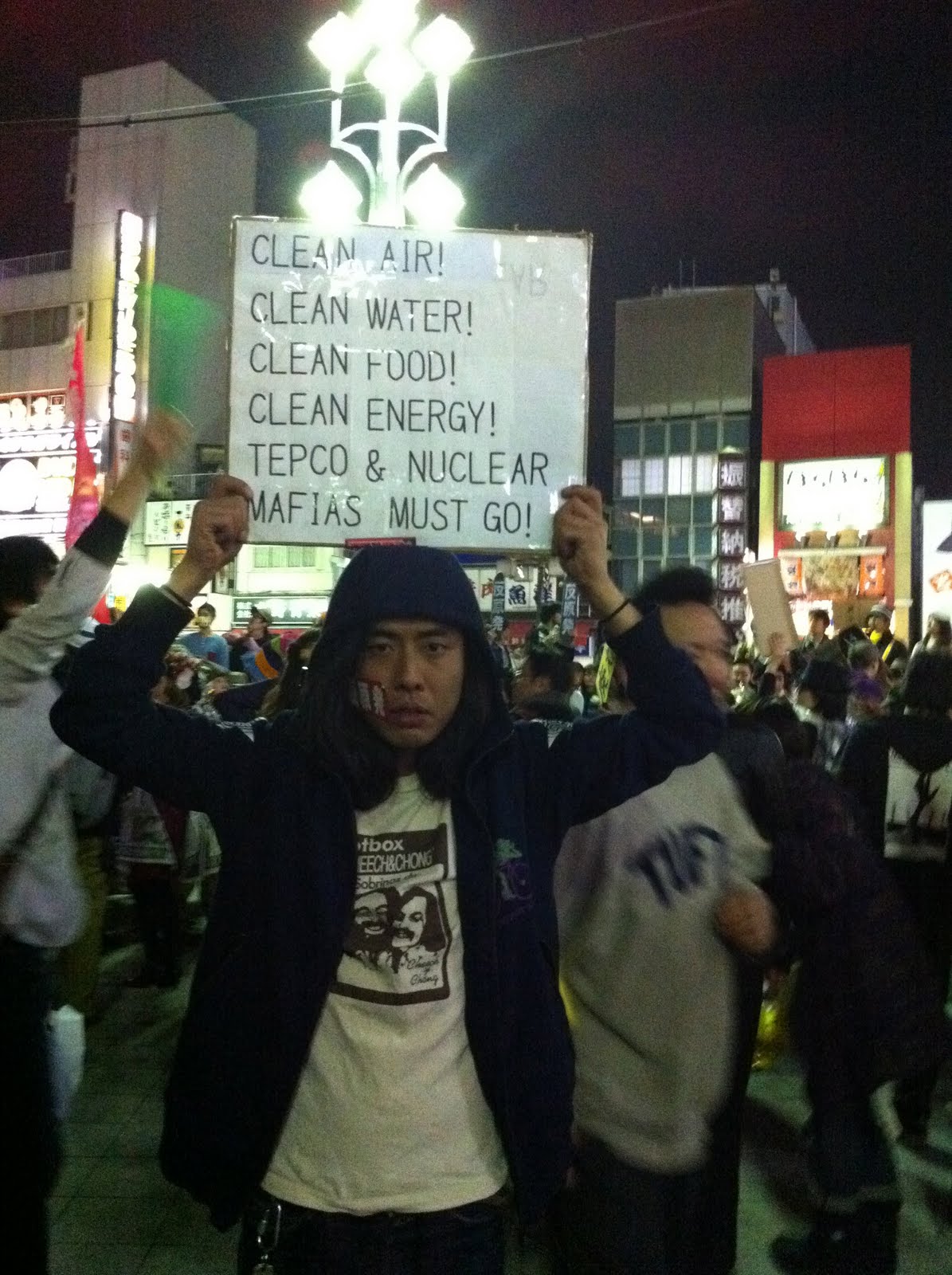
Japanese anti-nuclear demos aren't unusual, but they've never been very well attended. Until now, that is. A protest march in Ginza on March 27, campaigning against nuclear power, saw around 1,200 people turn out to express their displeasure - hardly the vast swathes you'd expect in other world capitals, but around 40 times more than the monthly gathering usually attracts (a hardcore gang of 30). Similarly, a March 20 protest in Shibuya attracted 1,000 disgruntled protesters.See the website of the April 10th 'Stop Nuclear Power Plants! Global Action Day' for more information about the Koenji event, as well as information in various languages regarding solidarity demonstrations taking place on the same day in locales around the world, including Canada, France, Germany, Korea, Mexico, the United Kingdom and the United States.
The biggest yet, or so the organisers hope, will be the Hangenbatsu Choukyodai Demo (literally, the 'Anti-Nuclear Power Plants Super Huge Demo'), taking place in Koenji Chuo Park on April 10. The event looks like being part protest, part rock concert, part charity event. The line-up features DJs Axeman and Yahman, MCs Rankin Taxi and Rumi, and live bands including Jintara-Mvta, a raucous big band that includes members of Cicala-Mvta, Soul Flower Union and others. The event will kick off at 2pm, and the concert/demo will run between 3pm and 5pm, at which point the audience is encouraged to move to the Koenji Kitaguchi Hiroba area to donate money.
The cash will go partly towards supporting the people of Koenji's sister city Minami Souma, a town located within the 30km Fukushima evacuation zone, and partly to the Sendai Birdland, a charity collective made up of musicians who are actively involved in getting supplies to Tohoku.


Our radiation monitoring teams have discovered high levels of contamination in crops grown on the outskirts of Minamisoma city in Japan. The data was collected from the gardens of Minamisoma city residents, and registered well over the official limits for spinach and other vegetables. This is bad news amid already serious concerns over the health risks to residents and a lack of official information from Japanese government.Read the entire article and find more background here.
“In several Minamisoma gardens, the vegetables were too contaminated for consumption,” reports Rianne Teule, who is leading our food testing team. “The owner of one garden with contaminated spinach told us that she had received no information from authorities on the radiation risks to her crops, despite reports that government tests on plants in Minamisoma have been underway since March 18.”
The government has been publishing raw data from its own field monitoring. However, its assessment is far from comprehensive. Measurements taken by our radiation team in several parts of Minamisoma city show levels of up to 4.5 microSievert per hour, as opposed to the relatively low levels of 0.7 microSievert per hour recorded at the only official monitoring point in Minamisoma City.
While the Japanese government’s data might not be incorrect, it doesn’t actually give the public the full picture, nor does it adequately protect the health of people in Minamisoma. The people in Minamisoma have been advised to stay indoors or told they can leave on a voluntary basis. However, our measurements, which were taken between government monitoring points, show levels of contamination that indicate a risk to health and safety.
Our field monitoring team met with the Mayor of Minamisoma, Katsunobu Sakurai. He expressed his frustration, citing a lack of reliable information or clear advice from TEPCO and the authorities regarding risks this crisis poses to his community.
“TEPCO has been irresponsible. This was clearly demonstrated when it took 11 days for it to speak to us after the accident. The government has also not supplied us with any kind of report that we can understand,” said Sakurai. “We are asking the government to not only supply enough information about what has happened, but also that it guarantee that it will respond responsibly to possible future risks.”


